

Wayground
Who was Martin Luther King Jr.? - Printable Social studies Worksheets class 3 - Wayground

Who was Martin Luther King Jr.?

Celina Barrera

Created by Celina Barrera

10 questions

3rd Grade

Social studies

Who was Martin Luther King Jr.? is a Grade 3 social studies worksheet that uses 10 multiple-choice questions to build foundational knowledge about his life, education, civil rights work, and historical impact. Students identify biographical details, explain the purpose of the NAACP and SCLC, connect the bus boycott to Rosa Parks, and recognize why marches and the 1963 March on Washington were significant. This free printable worksheet with an answer key helps students distinguish important people, organizations, protests, laws, and events connected to the civil rights movement. Teachers can use the selected-response format for introductory instruction, review, independent practice, or a quick check of students’ understanding after a lesson on Martin Luther King Jr. and the goals of nonviolent civil rights activism.

Worksheet settings

Font size

S
M
L
XL
WaygroundWorksheets

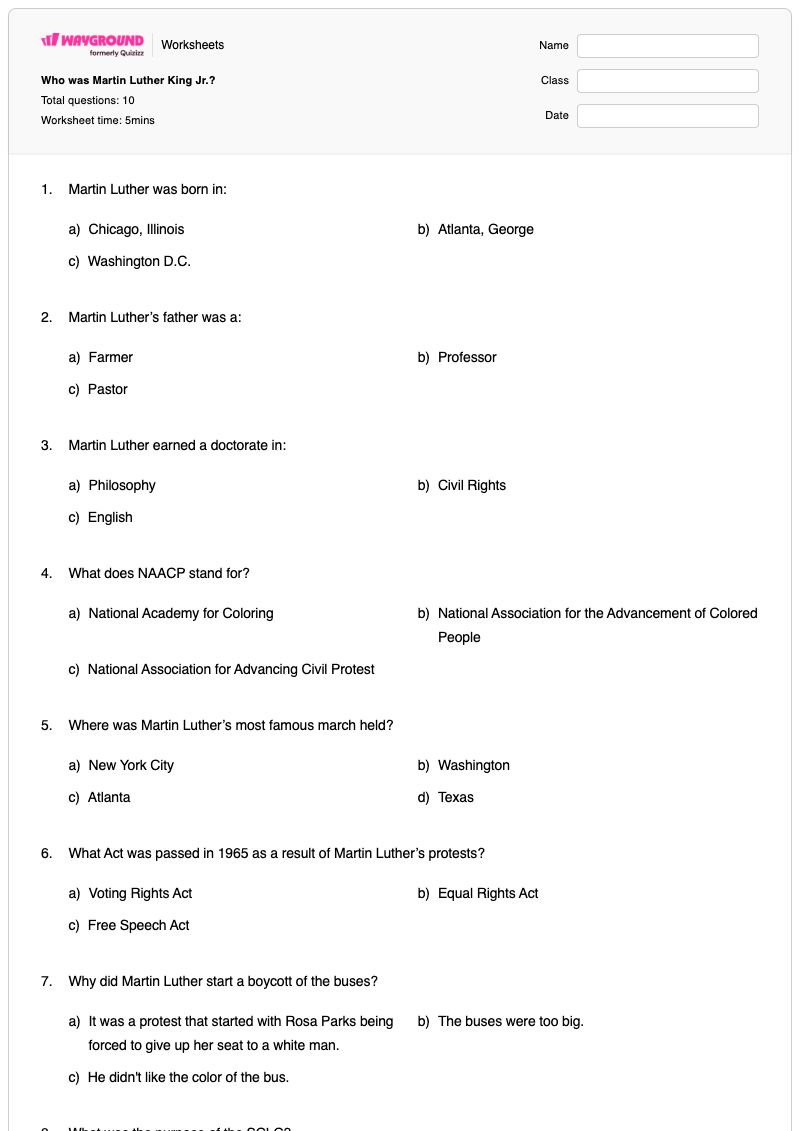
Who was Martin Luther King Jr.?

Total questions: 10

Name
Class
Date
1.

Martin Luther was born in:

a)

Chicago, Illinois

b)

Atlanta, George

c)

Washington D.C.

2.

Martin Luther’s father was a:

a)

Farmer

b)

Professor

c)

Pastor

3.

Martin Luther earned a doctorate in:

a)

Philosophy

b)

Civil Rights

c)

English

4.

What does NAACP stand for?

a)

National Academy for Coloring

b)

National Association for the Advancement of Colored People

c)

National Association for Advancing Civil Protest

5.

Where was Martin Luther’s most famous march held?

a)

New York City

b)

Washington

c)

Atlanta

d)

Texas

6.

What Act was passed in 1965 as a result of Martin Luther’s protests?

a)

Voting Rights Act

b)

Equal Rights Act

c)

Free Speech Act

7.

Why did Martin Luther start a boycott of the buses?

a)

It was a protest that started with Rosa Parks being forced to give up her seat to a white man.

b)

The buses were too big.

c)

He didn't like the color of the bus.

8.

What was the purpose of the SCLC?

a)

To boycott as much as possible.

b)

It was to conduct nonviolent protest to spur civil rights reform.

c)

Both A and B

9.

Why were marches held?

a)

They were held to call for greater civil rights such as the right to vote, labor rights and desegregation.

b)

The people wanted to exercise.

c)

They wanted to spend time together.

10.

Why was the march in 1963 in Washington so important?

a)

It was the largest gathering of people in Washington's history.

b)

It included all races.

c)

It was where Martin Luther gave his most famous speech.

d)

All the above

WaygroundAnswer Key

Who was Martin Luther King Jr.?

Total questions: 10

1.
b)

Atlanta, George

2.
c)

Pastor

3.
a)

Philosophy

4.
b)

National Association for the Advancement of Colored People

5.
b)

Washington

6.
a)

Voting Rights Act

7.
a)

It was a protest that started with Rosa Parks being forced to give up her seat to a white man.

8.
b)

It was to conduct nonviolent protest to spur civil rights reform.

9.
a)

They were held to call for greater civil rights such as the right to vote, labor rights and desegregation.

10.
d)

All the above

FAQs

What does this Martin Luther King Jr. worksheet cover?

This Grade 3 social studies worksheet uses 10 multiple-choice questions to review Martin Luther King Jr.’s biography and civil rights leadership. Students identify details such as his birthplace, father’s profession, and doctorate, then connect the NAACP, SCLC, bus boycott, Voting Rights Act, civil rights marches, and the 1963 March on Washington to their purposes and significance.

How can I use this worksheet to teach students about Martin Luther King Jr.?

Introduce the worksheet by building a simple timeline from Martin Luther King Jr.’s early life to the bus boycott, civil rights organizations, major marches, and the Voting Rights Act. Have students explain why each correct choice fits, especially the difference between the NAACP and SCLC and the reasons people held marches. Use the 1963 March on Washington question as a closing discussion about how an event can be important for more than one reason.

What mistakes should I watch for when students complete this worksheet?

Watch for students who confuse the NAACP’s full name with the SCLC’s purpose, or who select a general protest-related answer without identifying nonviolent civil rights reform. Students may also mix up the bus boycott’s connection to Rosa Parks, the Voting Rights Act, and the reasons for the 1963 March on Washington. In the final question, remind them to evaluate the combined answer rather than choosing only one true detail.

How do I assign and grade this Martin Luther King Jr. worksheet?

On Wayground, assign it either as a printable PDF or as a digital quiz, depending on how you want students to answer the 10 multiple-choice questions. The worksheet includes a complete answer key for checking responses, and printable submissions can be graded by scanning student work with the Wayground for Teachers app. The printable format also supports classrooms that are reducing screen time.

How can I differentiate this worksheet for my students?

Use the worksheet’s Advanced Settings to adjust font spacing or increase the font size so the multiple-choice questions and answer options are easier to follow. You can also enable a dyslexia-friendly font or translate the worksheet into another language when those options support access to the historical vocabulary and organization names. These changes preserve the worksheet’s 10-question format while adapting its presentation.

Where can I find more free worksheets like this on Wayground?

Wayground offers a comprehensive collection of free printable worksheets and practice problems across subjects, with downloadable PDFs and answer keys to help students master essential skills and concepts. Browse more resources at https://wayground.com/en-us/worksheets.