Laws of Motion Video Quiz is a Grade 5 science worksheet that checks students’ understanding of Newton’s three laws through one comprehension video item and 10 multiple-choice questions. Students identify what the law of inertia says about objects at rest, connect increased mass with increased inertia, and explain why a car needs force to begin moving. They also examine Newton’s second-law relationship between force, mass, and acceleration, including the equation Force = Mass × Acceleration and an example involving a hammer and a piggy bank.
The worksheet also uses familiar motion examples to reinforce action and reaction, including a jellyfish moving forward after pushing its body backward and a skateboard illustrating equal and opposite forces. It is designed for Grade 5 science instruction, review, or formative assessment. This free printable worksheet includes a complete answer key, helping teachers check students’ understanding of inertia, force, mass, acceleration, and everyday applications of the laws of motion.
Worksheet settings
Font size
S
M
L
XL
Worksheets
Laws of Motion Video Quiz
Total questions: 1
Name
Class
Date
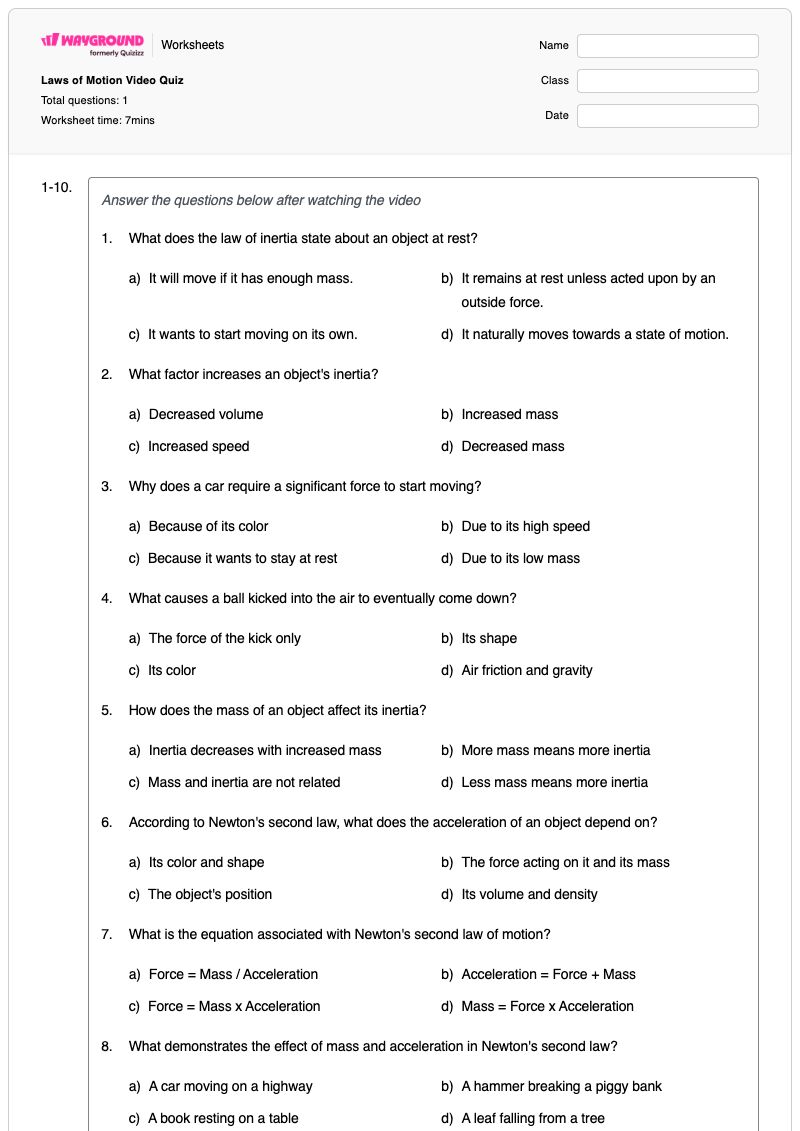
1-10.
Answer the questions below after watching the video
1.
What does the law of inertia state about an object at rest?
a)
It will move if it has enough mass.
b)
It remains at rest unless acted upon by an outside force.
c)
It wants to start moving on its own.
d)
It naturally moves towards a state of motion.
2.
What factor increases an object's inertia?
a)
Decreased volume
b)
Increased mass
c)
Increased speed
d)
Decreased mass
3.
Why does a car require a significant force to start moving?
a)
Because of its color
b)
Due to its high speed
c)
Because it wants to stay at rest
d)
Due to its low mass
4.
What causes a ball kicked into the air to eventually come down?
a)
The force of the kick only
b)
Its shape
c)
Its color
d)
Air friction and gravity
5.
How does the mass of an object affect its inertia?
a)
Inertia decreases with increased mass
b)
More mass means more inertia
c)
Mass and inertia are not related
d)
Less mass means more inertia
6.
According to Newton's second law, what does the acceleration of an object depend on?
a)
Its color and shape
b)
The force acting on it and its mass
c)
The object's position
d)
Its volume and density
7.
What is the equation associated with Newton's second law of motion?
a)
Force = Mass / Acceleration
b)
Acceleration = Force + Mass
c)
Force = Mass x Acceleration
d)
Mass = Force x Acceleration
8.
What demonstrates the effect of mass and acceleration in Newton's second law?
a)
A car moving on a highway
b)
A hammer breaking a piggy bank
c)
A book resting on a table
d)
A leaf falling from a tree
9.
What happens when a jellyfish moves its body backward?
a)
It spins around.
b)
It moves forward.
c)
It stays in the same place.
d)
It moves backward.
10.
What principle does a skateboard illustrate according to Newton's third law?
a)
For every action, there is a weaker reaction.
b)
Motion is not affected by external forces.
c)
For every action, there is an equal and opposite reaction.
d)
Action and reaction are not related.
Answer Key
Laws of Motion Video Quiz
Total questions: 1
1-10.
1.
b)
It remains at rest unless acted upon by an outside force.
2.
b)
Increased mass
3.
c)
Because it wants to stay at rest
4.
d)
Air friction and gravity
5.
b)
More mass means more inertia
6.
b)
The force acting on it and its mass
7.
c)
Force = Mass x Acceleration
8.
b)
A hammer breaking a piggy bank
9.
b)
It moves forward.
10.
c)
For every action, there is an equal and opposite reaction.
140 %
Browse by subjects
Browse by grades
Browse by format
FAQs
What does the Laws of Motion Video Quiz worksheet cover?
This Grade 5 science worksheet combines one comprehension video item with 10 multiple-choice questions about Newton’s three laws of motion. Students identify inertia and its relationship to mass, select the force–mass–acceleration equation, and apply action-and-reaction ideas to examples such as a jellyfish and a skateboard.
How can I use this worksheet to teach Newton’s laws of motion?
Introduce each law with a concrete example, then have students complete the video item and multiple-choice questions individually or in pairs. Pause to discuss why a car requires force to start moving, how Force = Mass × Acceleration represents Newton’s second law, and how a jellyfish’s backward motion produces forward movement.
What mistakes should I watch for when students complete this laws of motion quiz?
Students may confuse inertia with a desire to move, even though the worksheet asks them to recognize that an object at rest remains at rest unless an outside force acts on it. Watch for reversed mass-and-inertia relationships, incorrect rearrangements of the second-law equation, and choices that describe action and reaction as unequal rather than equal and opposite.
How do I assign and grade the Laws of Motion Video Quiz worksheet?
On Wayground, you can assign this worksheet as a printable PDF or as a digital quiz. It includes a complete answer key, and printable submissions can be graded by scanning student work with the Wayground for Teachers app. The printable format can also support schools that are reducing screen time.
How can I differentiate this laws of motion worksheet for my students?
Use the worksheet’s Advanced Settings to adjust font spacing or font size so the video prompt and multiple-choice questions are easier to navigate. You can also apply a dyslexia-friendly font or translate the laws of motion worksheet into another language when those options better support access to the questions.
Where can I find more worksheets like this on Wayground?
Wayground offers a broad collection of free printable worksheets and practice problems across subjects, with downloadable PDFs and answer keys to help students master essential skills and concepts. Browse more resources at https://wayground.com/en-us/worksheets.

 Worksheets