

Wayground
Newton's Laws - Printable Science Worksheets class 5 - Wayground

Newton's Laws

22 questions

5th - 5th Grade

Science

Newton's Laws is a Grade 5 science worksheet that helps students identify and distinguish the three laws of motion. Across 22 questions—21 multiple-choice items and one multiple-select item—students match inertia with Newton's First Law, connect force, mass, and acceleration with the Second Law, and recognize equal and opposite reactions in the Third Law. The worksheet also checks related vocabulary and ideas, including force, net force, balanced and unbalanced forces, inertia, acceleration, and velocity. Students apply these concepts to short definitions, statements, and real-world situations, such as explaining why a boat bounces off a dock. This format supports quick concept checks and reveals whether students can select the correct law or variable relationship rather than simply recall isolated terms. Designed for Grade 5 science instruction, this free printable worksheet includes a complete answer key for independent practice, review, homework, or assessment.

Worksheet settings

Font size

S
M
L
XL
Worksheets

Newton's Laws

Total questions: 22

Name
Class
Date
1.
What law is best described by inertia?
a)
1st
b)
2nd
c)
3rd
2.
What is Newtons 1st law of motion?
a)
Force= Mass multiplied by acceleration 
b)
An object at rest stays at rest unless acted on an unbalanced force. (inertia)
c)
For every action there is a equal and opposite  re-action.
d)
law of gravity 
3.

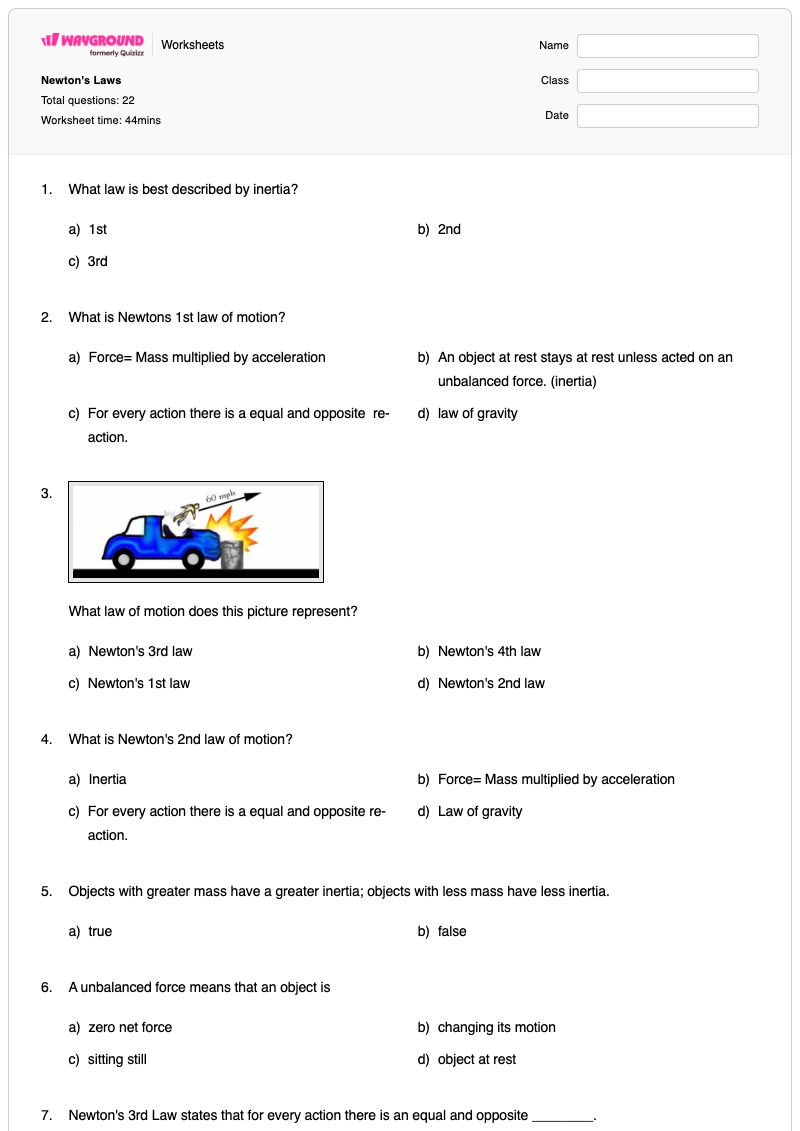
What law of motion does this picture represent?

a)

Newton's 3rd law

b)

Newton's 4th law

c)

Newton's 1st law

d)

Newton's 2nd law

4.

What is Newton's 2nd law of motion?

a)

Inertia

b)

Force= Mass multiplied by acceleration

c)

For every action there is a equal and opposite re-action.

d)

Law of gravity

5.

Objects with greater mass have a greater inertia; objects with less mass have less inertia.

a)

true

b)

false

6.

A unbalanced force means that an object is

a)

zero net force

b)

changing its motion

c)

sitting still

d)

object at rest

7.

Newton's 3rd Law states that for every action there is an equal and opposite ________.

a)

reaction

b)

satisfaction

c)

fraction

d)

transaction

8.

A ______ is a push or pull on an object.

a)

force

b)

speed

c)

acceleration

d)

velocity

9.

Newton's 2nd Law says the acceleration of an object depends on its _______ and ______. (Choose two answers)

a)

force or applied force

b)

weight

c)

gravity

d)

mass

10.

Net force is a combination of all ________ acting on an object.

a)

forces

b)

speeds

c)

accelerations

d)

velocities

11.

if an object stays still or continues moving at the same speed and in the same direction, it is a _______ force.

a)

weak

b)

strong

c)

balanced

d)

unbalanced

12.

What is Newton's 2nd Law?

a)

For every action there is an equal and opposite reaction.

b)

Acceleration depends on two variables, the mass of the object and the amount of force.

13.

What is Newton's 3rd Law?

a)

For every action there is an equal and opposite reaction.

b)

Acceleration depends on two variables, the mass of the object and the amount of force.

14.

What explains a quantity that has BOTH speed and direction?

a)

Inertia

b)

Force

c)

Speed

d)

Velocity

15.

The reason a boat bounces off the dock when it hits it.

a)

The boat and the dock repel each other.

b)

When the boat exerts a force on the dock, the dock exerts a force on the boat.

16.

If an object is accelerating, then the forces acting on it must be:

a)

Balanced

b)

Unbalanced

17.
 What is the unit called that measures force?
a)
Isaac
b)
Yee
c)
Newton
d)
kilogram
18.
When a cannon fires a cannonball we observe Newton's third law. Which force is the reaction force?
a)
The cannon moving forward
b)
The cannonball moving forward
c)
The cannon moving backward
d)
The cannonball moving backward
19.
Why is the net force 0 in the image?
a)
Because the elephants are the same size
b)
Because they are both pulling the same amount of force in opposite directions
c)
Because they are elephants
d)
Because they are pulling away from each other.
20.

A sports car speeds up much faster than a dump truck when a traffic light turns from red to green. Which law is this?

a)

Law 1

b)

Law 2

c)

Law 3

21.

A rocket pushes burning gases DOWN which causes the rocket to launch UP. Which law is this?

a)

Law 1

b)

Law 2

c)

Law 3

22.

When a truck stops suddenly, the packages on its truckbed continue to move forward. Which law is this?

a)

Law 1

b)

Law 2

c)

Law 3

Answer Key

Newton's Laws

Total questions: 22

1.
a) 1st
2.
b) An object at rest stays at rest unless acted on an unbalanced force. (inertia)
3.
c)

Newton's 1st law

4.
b)

Force= Mass multiplied by acceleration

5.
a)

true

6.
b)

changing its motion

7.
a)

reaction

8.
a)

force

9.
a)

force or applied force

, d)

mass

10.
a)

forces

11.
c)

balanced

12.
b)

Acceleration depends on two variables, the mass of the object and the amount of force.

13.
a)

For every action there is an equal and opposite reaction.

14.
d)

Velocity

15.
b)

When the boat exerts a force on the dock, the dock exerts a force on the boat.

16.
b)

Unbalanced

17.
c) Newton
18.
c) The cannon moving backward
19.
b) Because they are both pulling the same amount of force in opposite directions
20.
b)

Law 2

21.
c)

Law 3

22.
a)

Law 1

FAQs

What does this Newton’s Laws worksheet help students learn?

This Grade 5 science worksheet helps students identify Newton’s First, Second, and Third Laws of Motion through 21 multiple-choice questions and one multiple-select question. Students connect inertia and unbalanced forces to the First Law, force–mass–acceleration relationships to the Second Law, and equal-and-opposite reactions to the Third Law while also distinguishing balanced force, net force, force, and velocity.

How can I use this worksheet to teach Newton’s three laws of motion?

Introduce the three laws with simple demonstrations, then use the worksheet’s definition and scenario questions to have students name the law each example represents. Pause at the items about inertia, balanced versus unbalanced forces, and the boat striking the dock, asking students to explain the force interaction or change in motion before choosing an answer. Finish with the multiple-select item to check whether students understand that acceleration depends on both applied force and mass.

What mistakes should I watch for when students complete this Newton’s Laws worksheet?

Students may confuse inertia with force, choose the First Law when a question describes an action-and-reaction pair, or reverse the Second and Third Laws. Watch for students who select weight or gravity instead of force and mass in the multiple-select item, and for confusion between balanced force, which is associated here with unchanged motion, and unbalanced force, which changes motion. Some students may also choose speed instead of velocity when both speed and direction are described.

How do I assign and grade this Newton’s Laws worksheet?

The Newton’s Laws worksheet is available as a printable PDF and as a digital quiz on Wayground, with a complete answer key for all 22 questions. You can print it for paper-based practice or assign the digital version for online responses; printable submissions can be graded by scanning student work with the Wayground for Teachers app. The printable option can also support instruction in settings that are reducing screen time.

How can I differentiate this Newton’s Laws worksheet for my students?

Use the worksheet’s Advanced Settings to adjust font spacing or choose a larger font size so the law definitions, force vocabulary, and answer choices are easier to scan. You can also select a dyslexia-friendly font for students who benefit from that text style, or translate the worksheet into another language to support access to the multiple-choice and multiple-select items.

Where can I find more worksheets like this on Wayground?

Wayground offers a comprehensive collection of free printable worksheets and practice problems across all subjects, with downloadable PDFs and answer keys to help students master essential skills and concepts. Browse more resources at https://wayground.com/en-us/worksheets.