

Wayground
Cheating Survey - Printable Math Worksheets 9th Grade - Wayground

Cheating Survey

Catrina Lim

Created by Catrina Lim

25 questions

9th Grade

Math

Updated Aug 2025

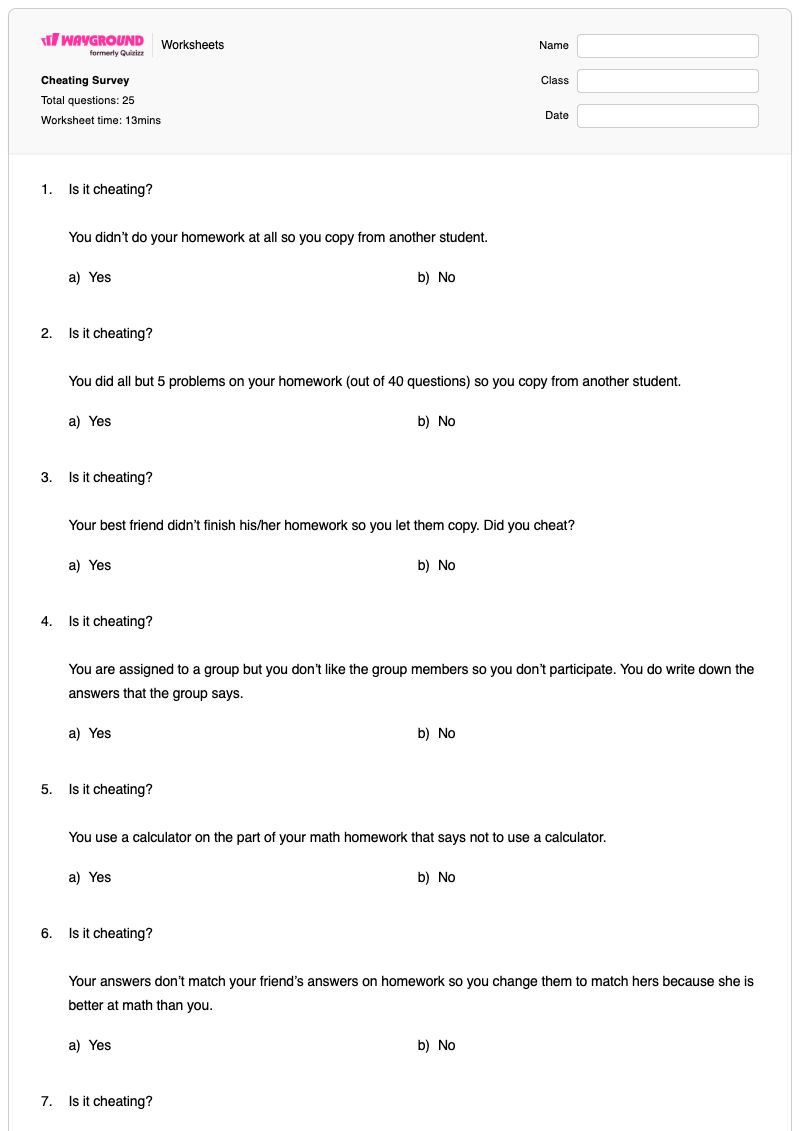
Cheating Survey is a Grade 9 professional development worksheet that uses 25 multiple-choice, yes-or-no scenarios to help students identify academic cheating in realistic school situations. The items address homework copying, group-work participation, prohibited calculator use, changing answers after viewing a peer’s test, sharing test answers, obtaining information from an earlier test period, using unauthorized notes, and having someone else complete an assignment. This free printable worksheet gives students a structured way to examine how academic dishonesty can occur through both actions and assistance to others. Teachers can use the scenarios to prompt discussion about responsible choices, assessment rules, and the difference between completing one’s own work and using another student’s answers or unauthorized help. The worksheet includes a complete answer key for reviewing responses and supporting follow-up conversations.

Worksheet settings

Font size

S
M
L
XL
WaygroundWorksheets

Cheating Survey

Total questions: 25

Name
Class
Date
1.

Is it cheating?


You didn’t do your homework at all so you copy from another student.

a)

Yes

b)

No

2.

Is it cheating?


You did all but 5 problems on your homework (out of 40 questions) so you copy from another student.

a)

Yes

b)

No

3.

Is it cheating?


Your best friend didn’t finish his/her homework so you let them copy. Did you cheat?

a)

Yes

b)

No

4.

Is it cheating?


You are assigned to a group but you don’t like the group members so you don’t participate. You do write down the answers that the group says.

a)

Yes

b)

No

5.

Is it cheating?


You use a calculator on the part of your math homework that says not to use a calculator.

a)

Yes

b)

No

6.

Is it cheating?


Your answers don’t match your friend’s answers on homework so you change them to match hers because she is better at math than you.

a)

Yes

b)

No

7.

Is it cheating?


During a test you look at another person’s test and copy their answers.

a)

Yes

b)

No

8.

Is it cheating?


During a test you look at another person’s test just to check one of the really hard questions.

a)

Yes

b)

No

9.

Is it cheating?


During a test you look at another person’s test and see that they have B instead of C marked. You go back, rework the problem and find out that you were wrong. You change your answer.

a)

Yes

b)

No

10.

Is it cheating?


Someone you don’t really know in the class asks you for the answer to a test question. You give it to them.

a)

Yes

b)

No

11.

Is it cheating?


Your best friend asks you for the answer to a test question. You give it to them.

a)

Yes

b)

No

12.

Is it cheating?


You ask a student who has already taken the test to tell you one of the questions on the test. (For example, you were absent on test day or you are in 2nd period so you ask someone in 1st period).

a)

Yes

b)

No

13.

Is it cheating?


You write some piece of information on your hand prior to a test (such as PEMDAS)

a)

Yes

b)

No

14.

Is it cheating?


You let your older brother/sister do your homework.

a)

Yes

b)

No

15.

Is it cheating?


Another student on the bus asks to look at your homework. She says it’s easy so you let her do it for you.

a)

Yes

b)

No

16.

Is it cheating?


You don’t cover your answers during a test so your friend can see how far you are.

a)

Yes

b)

No

17.

Is it cheating?


The test paper you are using already has some answers marked. You bubble in those answers because they look right to you.

a)

Yes

b)

No

18.

Is it cheating?


Two kids behind you are whispering about answers to the test. You hear them say “the answer to number 5 is B.” Since you couldn’t find the answer to number 5 you mark B on your paper.

a)

Yes

b)

No

19.

Is it cheating?


You get back your math assignment with a grade of 87. You change one of the wrong answers and tell your teacher that she marked it incorrectly so that you will get a 90.

a)

Yes

b)

No

20.

Is it cheating?


Your teacher asks you to answer a question out loud. You don’t know the answer. The person next to you whispers the answer so you say that one aloud.

a)

Yes

b)

No

21.

Is it cheating?


You didn’t finish last night’s homework. Since it’s not checked for correctness your friend in the period before yours gives you his/her worksheet so you can get credit.

a)

Yes

b)

No

22.

Is it cheating?


You didn’t finish your project on time so you tell your parents you are sick so you can stay home and complete the project before returning to school.

a)

Yes

b)

No

23.

Is it cheating?


You were supposed to read a book for English but forgot until the last minute. You read a summary of the book instead of reading the entire book.

a)

Yes

b)

No

24.

I cheat on major assignments (tests, quizzes, projects)

a)

I have never done this.

b)

I have done this just a few times, but I knew it was wrong.

c)

I do this occasionally.

d)

I do this fairly often.

e)

I do this all the time.

25.

I cheat on minor assignments (homework, classwork, weekly assignments)

a)

I have never done this.

b)

I have done this just a few times, but I knew it was wrong.

c)

I do this occasionally.

d)

I do this fairly often.

e)

I do this all the time.

WaygroundAnswer Key

Cheating Survey

Total questions: 25

1.
n/a
2.
n/a
3.
n/a
4.
n/a
5.
n/a
6.
n/a
7.
n/a
8.
n/a
9.
n/a
10.
n/a
11.
n/a
12.
n/a
13.
n/a
14.
n/a
15.
n/a
16.
n/a
17.
n/a
18.
n/a
19.
n/a
20.
n/a
21.
n/a
22.
n/a
23.
n/a
24.
n/a
25.
n/a

FAQs

What does the Cheating Survey worksheet cover?

The Cheating Survey covers how to identify academic cheating across 25 multiple-choice, yes-or-no scenarios involving homework, group work, tests, unauthorized aids, and sharing answers. Students evaluate specific choices—such as copying incomplete homework, using a calculator when it is prohibited, looking at another student’s test, or allowing someone else to complete an assignment—to build ethical decision-making and academic-integrity awareness.

How can I use this worksheet to teach students about academic cheating?

Introduce the Cheating Survey by distinguishing independent work, permitted collaboration, and unauthorized assistance, then have students answer the scenarios individually. Afterward, discuss contrasting items, such as copying homework versus helping a friend, or viewing a test answer versus reworking a difficult problem, and ask students to explain what rule or responsibility each situation raises.

What mistakes should I watch for when students complete the Cheating Survey?

Students may focus only on who benefits and overlook the action of providing answers, as in the homework-copying and test-answer scenarios. They may also miss the importance of stated assessment rules when considering calculator use or written information, or treat checking another student’s test as acceptable because they look at only one question. Review the reasoning behind responses rather than accepting an unexplained yes-or-no choice.

How do I assign and grade the Cheating Survey worksheet?

The Cheating Survey is available as a printable PDF and as a digital quiz on Wayground, and it includes a complete answer key for checking all 25 multiple-choice responses. For printable submissions, you can scan student work with the Wayground for Teachers app to help grade the completed survey.

How can I differentiate the Cheating Survey worksheet for my students?

In the worksheet’s Advanced Settings, adjust font spacing or choose a larger font size to make the yes-or-no scenarios easier to read. You can also enable a dyslexia-friendly font or translate the worksheet into another language, while keeping the multiple-choice academic-integrity situations unchanged.

Where can I find more free worksheets like this on Wayground?

Wayground offers a comprehensive collection of free printable worksheets and practice problems across subjects, with downloadable PDFs and answer keys to support essential skills and concepts. Browse more resources at https://wayground.com/en-us/worksheets.