

Wayground
Diffusion Through a Membrane State Lab - Printable Science Worksheets class 9 - Wayground

Diffusion Through a Membrane State Lab

18 questions

9th - 9th Grade

Science

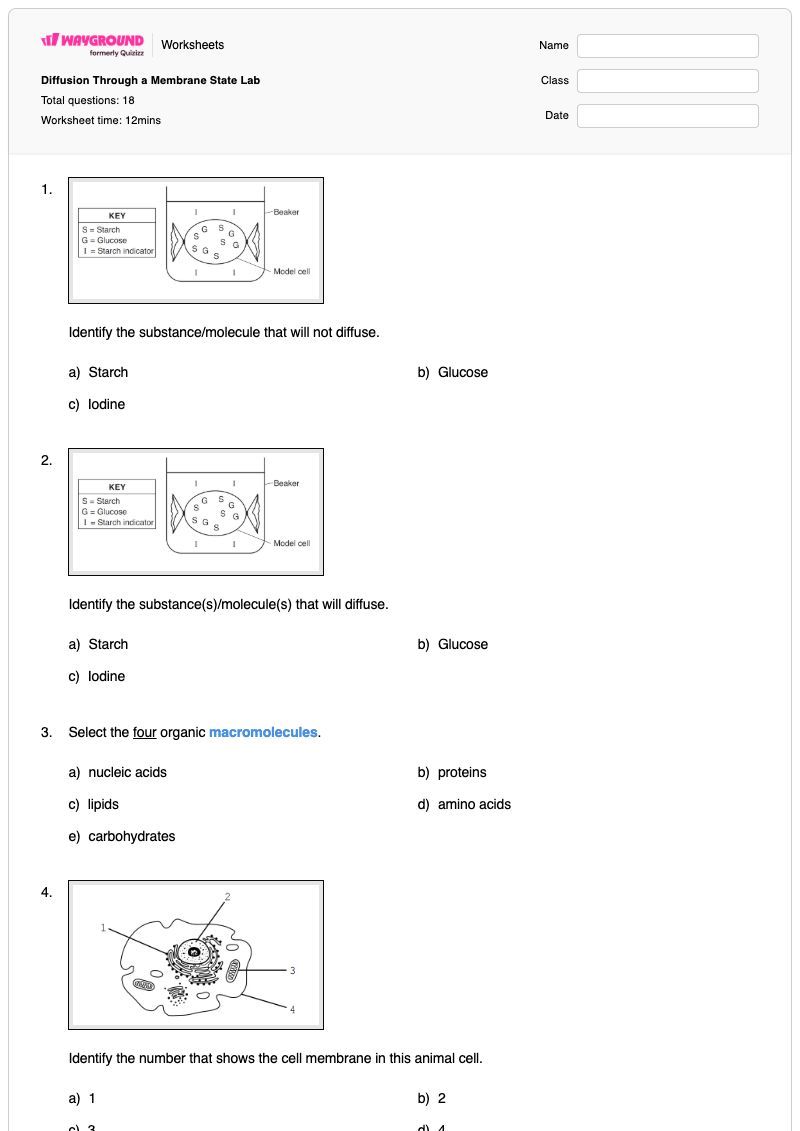
Diffusion Through a Membrane State Lab is a free printable Grade 9 science worksheet that checks students’ understanding of diffusion, selective permeability, and how molecule size affects movement through a cell membrane. Across 18 questions—including multiple-choice, multiple-select, and dropdown items—students identify which substances diffuse, distinguish macromolecules from their building blocks, and connect starch with glucose and iodine with starch testing. Students also interpret membrane diagrams and experimental outcomes, including where starch and glucose are found after 24 hours, which Benedict’s solution result indicates a positive test, and how distilled water and salt water affect the membrane. The worksheet reinforces vocabulary and evidence-based reasoning related to a membrane’s ability to control what enters and leaves the cell. It includes a complete answer key for efficient review, feedback, or assessment.

Worksheet settings

Font size

S
M
L
XL
Worksheets

Diffusion Through a Membrane State Lab

Total questions: 18

Name
Class
Date
1.

Identify the substance/molecule that will not diffuse.

a)

Starch

b)

Glucose

c)

Iodine

2.

Identify the substance(s)/molecule(s) that will diffuse.

a)

Starch

b)

Glucose

c)

Iodine

3.

Select the four organic macromolecules.

a)

nucleic acids

b)

proteins

c)

lipids

d)

amino acids

e)

carbohydrates

4.

Identify the number that shows the cell membrane in this animal cell.

a)

1

b)

2

c)

3

d)

4

5.

Molecule A cannot diffuse. What is a possible reason why?

a)

Molecule A is a macromolecule and it is too large to move.

b)

Molecule A is a building block and it is too large to move.

c)

Molecule A is a building block and it is too small to move.

d)

Molecule A is a macromole and it is too small to move.

6.

Which of the following is a organic macromolecule?

a)

starch

b)

glucose

c)

amino acid

d)

nucleotide base

7.

What is the starch indicator?

a)

Iodine

b)

Bromothymol Blue

c)

Benedict's Solution

d)

Glucose

8.

Cell membranes are said to be selectively permeable. Which statement best explains what selectively permeable means?

a)

The cell membrane prevents any harmful substance from entering the cell.

b)

The cell membrane lets certain substances enter the cell and keeps certain substances out of the cell.

c)

The cell membrane allows only large molecules to diffuse into the cell.

d)

The cell membrane has pores that let only water and glucose into the cell and carbon dioxide out.

9.

What is the building blocks of starch?

a)

glucose

b)

fatty acids

c)

lipids

d)

amino acids

10.

After 24 hours, where will starch be found in this experiment?

a)

outside the cell, only

b)

outside and inside the cell

c)

inside the cell, only

11.

After 24 hours, where will glucose be found in this experiment?

a)

inside the cell, only

b)

outside the cell, only

c)

both inside and outside the cell.

12.

A positive result when using Benedict will be what color?

a)

brown

b)

red/orange

c)

blue black

13.

What did you add to your slide to make the cell membrane shrink?

a)

pure/distilled/fresh water

b)

salt water

14.

What did you add to your slide to make the cell membrane fill with water?

a)

pure/distilled/fresh water

b)

salt water

15.
What does selectively-permeable mean?
a)
The cell controls what passes in and out of the cell
b)
Nothing gets through
c)
The cell lets only large substances through
16.

The diagram represents a sugar cube being dropped into an undisturbed beaker of water at room temperature. One sugar molecule is labeled.

a)
b)
c)
d)
17.

Diffusion always occurs from:

a)

higher to lower concentration

b)

lower to higher concentration

18.

1 ​ (a)  

2. ​ (b)  

3. ​ (c)  

4. ​ (d)  

5.​ (e)  

Choose from the below words
Salt Water
Distilled Water
Answer Key

Diffusion Through a Membrane State Lab

Total questions: 18

1.
a)

Starch

2.
b)

Glucose

, c)

Iodine

3.
e)

carbohydrates

, c)

lipids

, b)

proteins

, a)

nucleic acids

4.
d)

4

5.
a)

Molecule A is a macromolecule and it is too large to move.

6.
a)

starch

7.
a)

Iodine

8.
b)

The cell membrane lets certain substances enter the cell and keeps certain substances out of the cell.

9.
a)

glucose

10.
c)

inside the cell, only

11.
c)

both inside and outside the cell.

12.
b)

red/orange

13.
b)

salt water

14.
a)

pure/distilled/fresh water

15.
a) The cell controls what passes in and out of the cell
16.
d)
17.
a)

higher to lower concentration

18.
Salt Water, Salt Water, Salt Water, Distilled Water, Salt Water

FAQs

What does the Diffusion Through a Membrane State Lab worksheet cover?

This Grade 9 science worksheet uses 18 multiple-choice, multiple-select, and dropdown questions to practice predicting which substances can diffuse through a membrane and explaining selective permeability. Students apply molecule-size reasoning to starch, glucose, and iodine; identify macromolecules and their building blocks; interpret membrane diagrams; and use indicator-test and water-movement results to evaluate the lab.

How can I use this worksheet to teach diffusion through a membrane?

Introduce the worksheet by reviewing selective permeability and comparing the sizes of starch, glucose, and iodine. Have students explain each prediction before answering, then use the questions about 24-hour locations, Benedict’s solution, and distilled versus salt water to connect their choices to observable lab evidence. Finish by asking students to distinguish diffusion of substances from the membrane’s response to water conditions.

What mistakes should I watch for when students complete this diffusion worksheet?

Watch for students choosing starch as a substance that diffuses simply because glucose is its building block, rather than recognizing starch as the larger macromolecule. Students may also confuse iodine with the starch indicator, select all four macromolecules incorrectly by including amino acids, or reverse the worksheet’s predicted locations for starch and glucose after 24 hours. Review that salt water is associated with membrane shrinkage, while distilled water is associated with the membrane filling with water.

How do I assign and grade this Diffusion Through a Membrane State Lab worksheet?

Wayground provides this worksheet as a printable PDF and as a digital quiz, with a complete answer key for all 18 items. You can review the multiple-choice, multiple-select, and dropdown responses directly in the digital version, or grade printable submissions by scanning student work with the Wayground for Teachers app. The printable option can also support schools that are reducing screen time.

How can I differentiate this diffusion worksheet for my students?

Use the worksheet’s Advanced Settings to adjust font spacing and font size so the membrane diagrams and answer choices are easier to read. You can also apply a dyslexia-friendly font or translate the worksheet into another language, while keeping the diffusion, macromolecule, and indicator questions intact.

Where can I find more worksheets like this on Wayground?

Wayground offers a broad collection of free printable worksheets and practice problems across subjects, with downloadable PDFs and answer keys to help students build essential skills and concepts. Browse more resources at https://wayground.com/en-us/worksheets.