
Nets and Surface Area is a free Grade 6 mathematics worksheet that builds students’ understanding of how two-dimensional nets represent three-dimensional solids. Through 20 items—19 multiple-choice questions and one matching task—students identify nets, define surface area, distinguish prisms and pyramids, and name solids such as cubes, rectangular prisms, triangular prisms, and pyramids.
The worksheet also asks students to determine which solid a net creates and calculate the surface area of rectangular prisms, pyramids, and cubes. These varied questions connect geometric vocabulary, visual reasoning, and area calculations so students can recognize the faces of a solid and use that structure to reason about total surface area. It is designed for Grade 6 math instruction, guided practice, review, or assessment. The worksheet is available as a free printable PDF and includes a complete answer key for checking student work.
Worksheet settings
Font size
S
M
L
XL
Worksheets
Nets and Surface Area
Total questions: 20
Name
Class
Date
1.
A flat "unfolded" representation of a prism or pyramid.
a)
Surface Area
b)
Net
c)
Base
d)
3-Dimensional
2.
The sum of all the areas of the faces of a figure.
a)
Net
b)
Base
c)
Area
d)
Surface Area
3.
A three dimensional figure that has one polygon base and the other faces are triangles.
a)
Rectangular Prism
b)
Cube
c)
Pyramid
d)
Triangular Prism
4.
A three-dimensional figure who has two parallel triangular bases and three rectangular faces.
a)
Cube
b)
Triangular Prism
c)
Pyramid
d)
Rectangular Prism
5.
A three-dimensional figure that has six faces that are rectangles.
a)
Rectangular Prism
b)
Cube
c)
Prism
d)
Rectangle
6.
What is the surface area for the rectangular prism?
a)
36 cm2
b)
64 cm2
c)
72 cm2
d)
14 cm2
7.
What is the surface area of the pyramid?
a)
24 cm 2
b)
84 cm 2
c)
112 cm 2
d)
64 cm 2
8.
What is the surface area of the cube?
a)
12 cm2
b)
36 cm2
c)
24 cm2
d)
64 cm2
9.
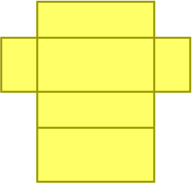
What 3D solid does this net create?
a)
Rectangular Prism
b)
Rectangular Pyramid
c)
Cube
d)
Square Prism
10.
Name the figure
a)
Rectangular Prism
b)
Triangular Prism
c)
Rectangular Pyramid
d)
Triangular Pyramid
e)
Cube
11.
Name the figure
a)
Rectangular Prism
b)
Triangular Prism
c)
Rectangular Pyramid
d)
Triangular Pyramid
e)
Cube
12.
Name the figure
a)
Rectangular Prism
b)
Triangular Prism
c)
Rectangular Pyramid
d)
Triangular Pyramid
e)
Cube
13.
Which 3-D figures will this net make?
a)
square pyramid
b)
cube
c)
hexagonal cube
d)
square
14.
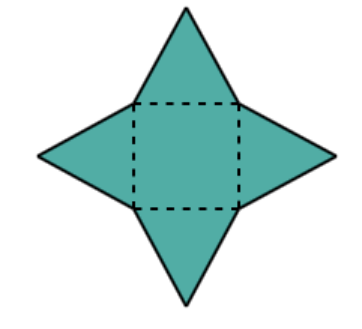
Which 3-D figure will this net make?
a)
Cone
b)
Triangular Prism
c)
Square Pyramid
d)
Cube
15.
Which 3-D figure will this net make?
a)
Triangular Pyramid
b)
Hexagonal Pyramid
c)
Octagonal Pyramid
d)
Cube
16.
a)
95ft2
b)
15ft2
c)
40ft2
d)
35ft2
17.
a)
93in2
b)
84in2
c)
76in2
d)
85in2
18.
Match the following
Cylinder
Rectangular Prism
Triangular Prism
Triangular Pyramid
Square Pyramid
19.
What is the surface area of the cube?
a)
12
b)
64
c)
96
d)
384
20.
What is the surface area?
a)
10 mm2
b)
68 mm2
c)
22 mm2
d)
30 mm2
Answer Key
Nets and Surface Area
Total questions: 20
1.
b)
Net
2.
d)
Surface Area
3.
c)
Pyramid
4.
b)
Triangular Prism
5.
a)
Rectangular Prism
6.
c)
72 cm2
7.
d)
64 cm 2
8.
c)
24 cm2
9.
a) Rectangular Prism
10.
b)
Triangular Prism
11.
c)
Rectangular Pyramid
12.
d)
Triangular Pyramid
13.
b)
cube
14.
c)
Square Pyramid
15.
a)
Triangular Pyramid
16.
d)
35ft2
17.
b)
84in2
18.
-
Cylinder
, -
Rectangular Prism
, -
Triangular Prism
, -
Triangular Pyramid
, -
Square Pyramid
19.
c)
96
20.
b)
68 mm2
140 %
Browse by subjects
Browse by grades
Browse by format
FAQs
What does the Nets and Surface Area worksheet cover?
This Grade 6 math worksheet uses 19 multiple-choice questions and one matching item to practice identifying nets, naming prisms and pyramids, matching nets to the three-dimensional solids they form, and calculating surface area. Students connect the faces shown in a net with the complete solid, then apply that structure to surface-area problems involving cubes, rectangular prisms, and pyramids.
How can I use this worksheet to teach nets and surface area?
Introduce the terms net, face, base, prism, pyramid, and surface area before students begin the identification items. Have students explain which faces in a pictured net become the bases and lateral faces, then use the calculation questions to connect the net’s individual areas to the solid’s total surface area. Review the answer choices afterward by asking students to justify why a net forms a cube, rectangular prism, triangular prism, or pyramid.
What mistakes should I watch for when students complete this worksheet?
Students may confuse a net, which is an unfolded solid, with surface area, which is the sum of the areas of all faces. Watch for confusion between prisms with two parallel congruent bases and pyramids with one polygonal base and triangular side faces. In the calculation items, students may omit a face or choose a net-to-solid match based only on one shape instead of checking every face in the net.
How do I assign and grade the Nets and Surface Area worksheet?
Wayground provides this worksheet as both a printable PDF and a digital quiz, and it includes a complete answer key for the 20-item set. For printable submissions, you can scan student work with the Wayground for Teachers app to support grading.
How can I differentiate this nets and surface area worksheet for my students?
Use the worksheet’s Advanced Settings to adjust font spacing and font size for the vocabulary, answer choices, and net-identification prompts. You can also select a dyslexia-friendly font or translate the worksheet into another language, helping students access the geometric terms and visual questions.
Where can I find more worksheets like this on Wayground?
Wayground offers a comprehensive collection of free printable worksheets and practice problems across all subjects, with downloadable PDFs and answer keys to support mastery of essential skills and concepts. Browse more resources at https://wayground.com/en-us/worksheets.