This free Grade 3 mathematics worksheet gives students practice reading, writing, representing, and comparing 4-digit numbers. Students convert between standard and expanded form, identify the place value of a digit, model a number with base-ten blocks, and evaluate a comparison using greater-than reasoning. The worksheet also extends number sense through skip-counting patterns and rules, including finding missing terms and continuing sequences.
Students apply odd-and-even reasoning by identifying parity from the ones place and completing addition statements about odd and even numbers. Across 17 items—multiple choice, fill-in-the-blank, drawing, and open-ended tasks—learners explain their thinking by creating number patterns and addition examples that demonstrate parity rules. It is suitable for Grade 3 math practice, independent work, review, or formative assessment. The worksheet is available as a free printable PDF and includes a complete answer key for efficient checking.
Worksheet settings
Font size
S
M
L
XL
Worksheets
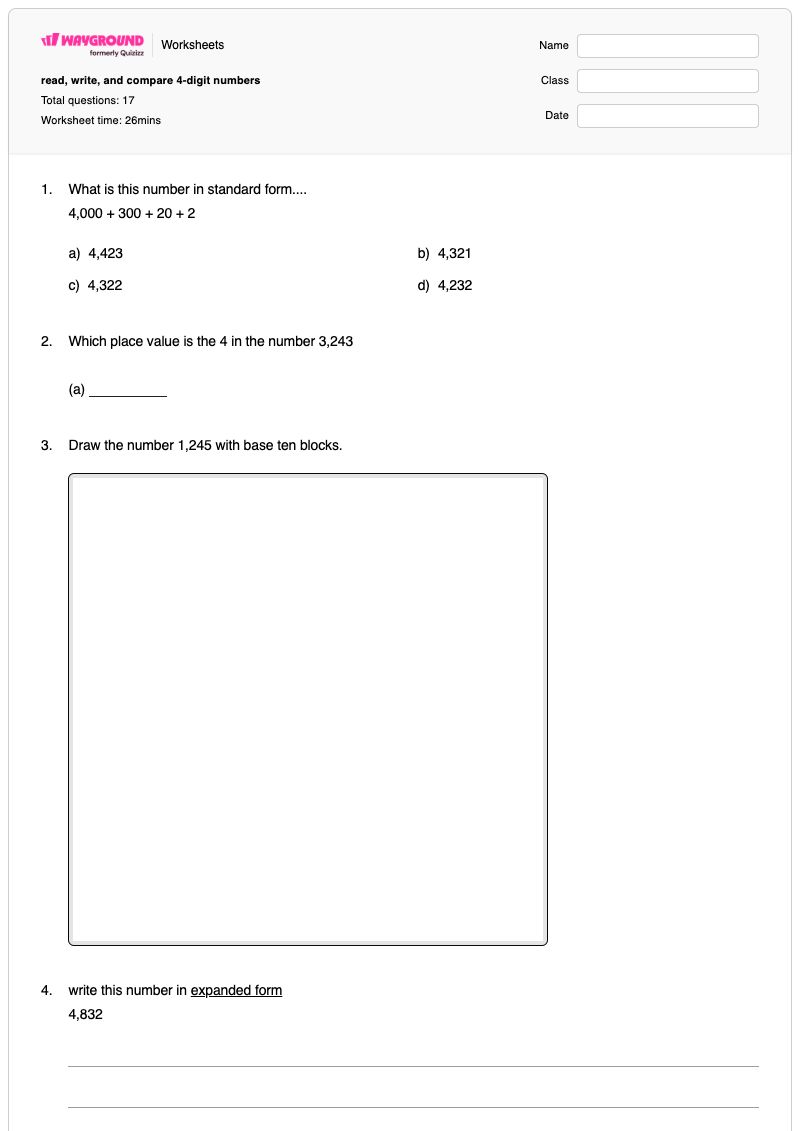
read, write, and compare 4-digit numbers
Total questions: 17
Name
Class
Date
1.
What is this number in standard form....
4,000 + 300 + 20 + 2
a)
4,423
b)
4,321
c)
4,322
d)
4,232
2.
Which place value is the 4 in the number 3,243
(a)
3.
Draw the number 1,245 with base ten blocks.
4.
write this number in expanded form
4,832
4 lines
5.
What is this number in standard form
5,000 + 400 + 20 + 9
(a)
6.
4,432 > 4,433 True or False
a)
true
b)
fase
7.
look at this pattern
2,4,6,8,10,12,14.... what is the rule?
a)
add 3
b)
add 2
c)
add 5
8.
What number is missing in this pattern?
5, 10, 15, 20, 25, 30, _, 40, 45, 50
4 lines
9.
In this pattern...
8, 16, 24, 32, 40 ..... the next two numbers would be
a)
41, 43
b)
48, 56
c)
50, 55
d)
44,m48
10.
What is my rule in this pattern....
10, 20, 30, 40, 50, 60, 70, 80
a)
add 9
b)
add 5
c)
add 2
d)
add 10
11.
Create your own number pattern, you must use at least 5 numbers!
12.
You can tell a number is odd or even by looking at the ones or the tens place?
(a)
13.
An odd number + an odd numbers ALWAYS makes an _
an example would be 11 + 5
a)
even number
b)
odd number
c)
both
14.
Create 3 addition problems that proves an even plus an even equals an even.
even + even = even
15.
BUT an even + an odd = _
an example would be 4 + 5 = 9
(a)
16.
Create an equation that proves
even + odd = odd
17.
How do you feel about number patterns and comparing 4 digit numbers?
a)
ehh it's okay
b)
I feel Great
c)
I'm getting the hang of it
d)
I don't get it at all
Answer Key
read, write, and compare 4-digit numbers
Total questions: 17
1.
c)
4,322
2.
tens, ten
3.
n/a
4.
n/a
5.
5,429, 5429
6.
b)
fase
7.
b)
add 2
8.
n/a
9.
b)
48, 56
10.
d)
add 10
11.
n/a
12.
ones, one
13.
a)
even number
14.
n/a
15.
odd
16.
n/a
17.
n/a
140 %
Browse by subjects
Browse by grades
Browse by format
FAQs
What does this read, write, and compare 4-digit numbers worksheet cover?
This Grade 3 worksheet combines 4-digit number representation with number-pattern and parity reasoning. Its 17 items ask students to write numbers in standard and expanded form, identify place value, draw base-ten models, compare numbers, find pattern rules and missing terms, and use examples to show how odd and even numbers behave when added. Multiple-choice, fill-in-the-blank, drawing, and open-ended formats require students to select answers and produce their own mathematical representations.
How can I use this worksheet to teach 4-digit numbers, patterns, and odd-even addition?
Introduce the number-representation items first by modeling how thousands, hundreds, tens, and ones appear in standard, expanded, and base-ten forms. Then have students identify the rule in the listed sequences before completing missing terms or creating a pattern of their own. Finish with the odd-and-even items, asking students to inspect the ones place and use their drawn addition examples to explain why odd plus odd and even plus odd produce the indicated parity.
What mistakes should I watch for when students complete this worksheet?
Watch for students reversing place-value positions when converting expanded forms, choosing the tens place instead of the ones place to determine whether a number is odd or even, or comparing 4-digit numbers by looking only at the final digit. In the pattern items, students may continue a sequence without identifying its constant rule or miss a term in the middle. For the drawing and open-ended tasks, check that base-ten blocks match the requested number and that created examples actually support the stated odd-even addition rule.
How do I assign and grade this 4-digit numbers worksheet?
Wayground provides this worksheet as a printable PDF and as a digital quiz, with a complete answer key for checking the standard-form, place-value, pattern, comparison, and parity items. You can grade printable submissions by scanning student work with the Wayground for Teachers app. The printable format also gives schools an option for reducing screen time while students practice.
How can I differentiate this worksheet for my students?
Use the worksheet’s Advanced Settings to adjust font spacing and font size so the standard-form, pattern, and open-ended items have the visual space students need. You can also enable a dyslexia-friendly font or translate the worksheet into another language, helping students access the base-ten drawing directions and odd-even reasoning prompts.
Where can I find more worksheets like this on Wayground?
Wayground offers a broad collection of free printable worksheets and practice problems across all subjects, with downloadable PDFs and answer keys to support essential skills and concepts. Browse more resources at https://wayground.com/en-us/worksheets.

 Worksheets