

Wayground
Cell Membrane and Transport Quiz - Printable Science Worksheets class 9 - Wayground

Cell Membrane and Transport Quiz

15 questions

9th - 9th Grade

Science

Cell Membrane and Transport Quiz is a Grade 9 science worksheet that checks students’ understanding of how substances cross the plasma membrane. Its 15 questions focus on movement along or against concentration gradients, ion movement, osmosis, hypertonic solutions, endocytosis, exocytosis, vesicle transport, and ATP-dependent active transport. Students also identify the sodium-potassium pump, the membrane’s role in controlling entry and exit, and the hydrophilic heads and hydrophobic tails of phospholipids. The worksheet uses 14 multiple-choice questions and one multiple-select question, including an item requiring students to select both active transport and the sodium-potassium pump. It is useful for introducing, reviewing, or checking mastery of membrane transport vocabulary and cell responses in different solutions. This is a free printable worksheet with an answer key for Grade 9 science instruction, independent practice, or a formative assessment.

Worksheet settings

Font size

S
M
L
XL
Worksheets

Cell Membrane and Transport Quiz

Total questions: 15

Name
Class
Date
1.

How do molecules move along and against the gradient?

a)

Only along the gradient

b)

Only against the gradient

c)

Both along and against the gradient

d)

None of the above

2.

How do ions move?

a)

Along the gradient

b)

Against the gradient

c)

Both along and against the gradient

d)

It depends on the gradient established across the plasma membrane

e)

none of the above

3.

What is the process of taking in large molecules in bulk

a)

Endocytosis

b)

Exocytosis

c)

Active transport

d)

Facilitated diffusion

4.

What is the process of removing large molecules

a)

Endocytosis

b)

Exocytosis

c)

Active transport

d)

Facilitated diffusion

5.

Which direction does water move based on concentration

a)

From high to low concentration

b)

From low to high concentration

c)

Both from high to low and low to high concentration

d)

Water does not move based on concentration

6.

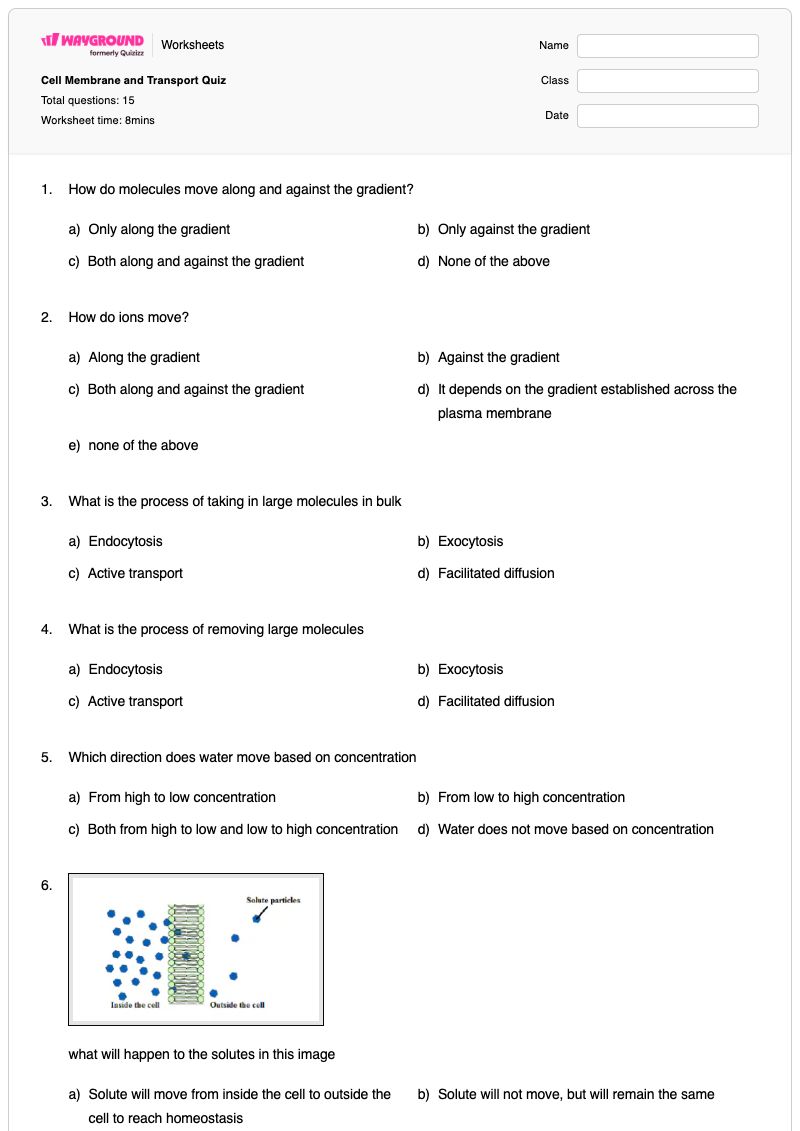
what will happen to the solutes in this image

a)

Solute will move from inside the cell to outside the cell to reach homeostasis

b)

Solute will not move, but will remain the same

c)

Solute will move from outside the cell to inside the cell to reach homeostasis

d)

Solute will evaporate

7.

Hypertonic Solution

a)

is the same as isotonic

b)

Has more solute inside an immersed cell

c)

Has reached equilibrium

d)

Has more solute in the solution

8.

Type of Transport that requires ATP

a)

Passive Transport

b)

Facilitated Diffusion

c)

Active Transport

d)

SImple Diffusion

9.

Sodium and Potassium move across a cell membrane by (2 answers)

a)

Facilitated Diffsuion

b)

Active Transport

c)

Passive Transport

d)

Sodium Potassium Pump

10.

Nuclear Structure that controls entry and exit of the cell

a)

Golgi

b)

Cell Membrane

c)

Nucleus

d)

Lysosomes

11.

How molecules are transported out of the golgi

a)

exocytosis

b)

protein pump

c)

facilitated diffusion

d)

vesicles

12.

Osmosis

a)

moves particles out of the cell

b)

moves water across a semi permeable membrane

c)

removes wastes

d)

requires energy

13.

causes a cell to shrivel

a)

isotonic solution

b)

hypertonic solution

c)

equilibrium

d)

hypertonic solution

14.

pure water would cause a organism from the sea to

a)

nothing would happen

b)

shrink/shrivel

c)

remain the same

d)

swell/burst

15.

Cell membrane has _________ heads and _________ tails

a)

phospholipid, nucleic

b)

hydrophilic, hydrophobic

c)

non polar, polar

d)

hydrophobic, hydrophilic

Answer Key

Cell Membrane and Transport Quiz

Total questions: 15

1.
c)

Both along and against the gradient

2.
d)

It depends on the gradient established across the plasma membrane

3.
a)

Endocytosis

4.
b)

Exocytosis

5.
a)

From high to low concentration

6.
a)

Solute will move from inside the cell to outside the cell to reach homeostasis

7.
d)

Has more solute in the solution

8.
c)

Active Transport

9.
b)

Active Transport

, d)

Sodium Potassium Pump

10.
b)

Cell Membrane

11.
d)

vesicles

12.
b)

moves water across a semi permeable membrane

13.
b)

hypertonic solution

14.
d)

swell/burst

15.
b)

hydrophilic, hydrophobic

FAQs

What does the Cell Membrane and Transport Quiz cover?

This Grade 9 science worksheet assesses cell membrane transport through 14 multiple-choice questions and one multiple-select item. Students distinguish passive and active transport, explain movement along or against gradients, identify endocytosis and exocytosis, interpret osmosis and hypertonic solutions, recognize the sodium-potassium pump, and identify hydrophilic phospholipid heads and hydrophobic tails.

How can I use this worksheet to teach cell membrane transport?

Introduce the worksheet by modeling a concentration gradient and contrasting passive movement with ATP-dependent active transport. Then use the questions on osmosis, hypertonic solutions, bulk transport, and the sodium-potassium pump as discussion checkpoints, asking students to justify the direction of movement before they select an answer.

What mistakes should I watch for when students complete this cell transport worksheet?

Students may confuse movement along a gradient with movement against one, or assume that all ion movement follows the same direction instead of considering the established gradient. Watch for confusion between endocytosis and exocytosis, between osmosis and general particle movement, and between active transport and the sodium-potassium pump; the multiple-select item requires both correct choices.

How do I assign and grade this Cell Membrane and Transport Quiz?

The worksheet is available as a printable PDF and as a digital quiz on Wayground, and it includes a complete answer key. Printable submissions can be graded by scanning student work with the Wayground for Teachers app, while the digital version supports online completion and grading.

How can I differentiate this cell membrane transport worksheet for my students?

In the worksheet’s Advanced Settings, adjust font spacing or choose a larger font size to make the transport questions and answer choices easier to scan. You can also apply a dyslexia-friendly font or translate the worksheet into another language when appropriate for students working with the membrane transport vocabulary.

Where can I find more worksheets like this on Wayground?

Wayground offers a comprehensive collection of free printable worksheets and practice problems across subjects, with downloadable PDFs and answer keys to help students master essential skills and concepts. Browse more resources at https://wayground.com/en-us/worksheets.