

Wayground
Personal Hygiene/ Sleep - Printable Physical Ed Worksheets kindergarten - Wayground

Personal Hygiene/ Sleep

21 questions

6th - 8th Grade

Physical Ed

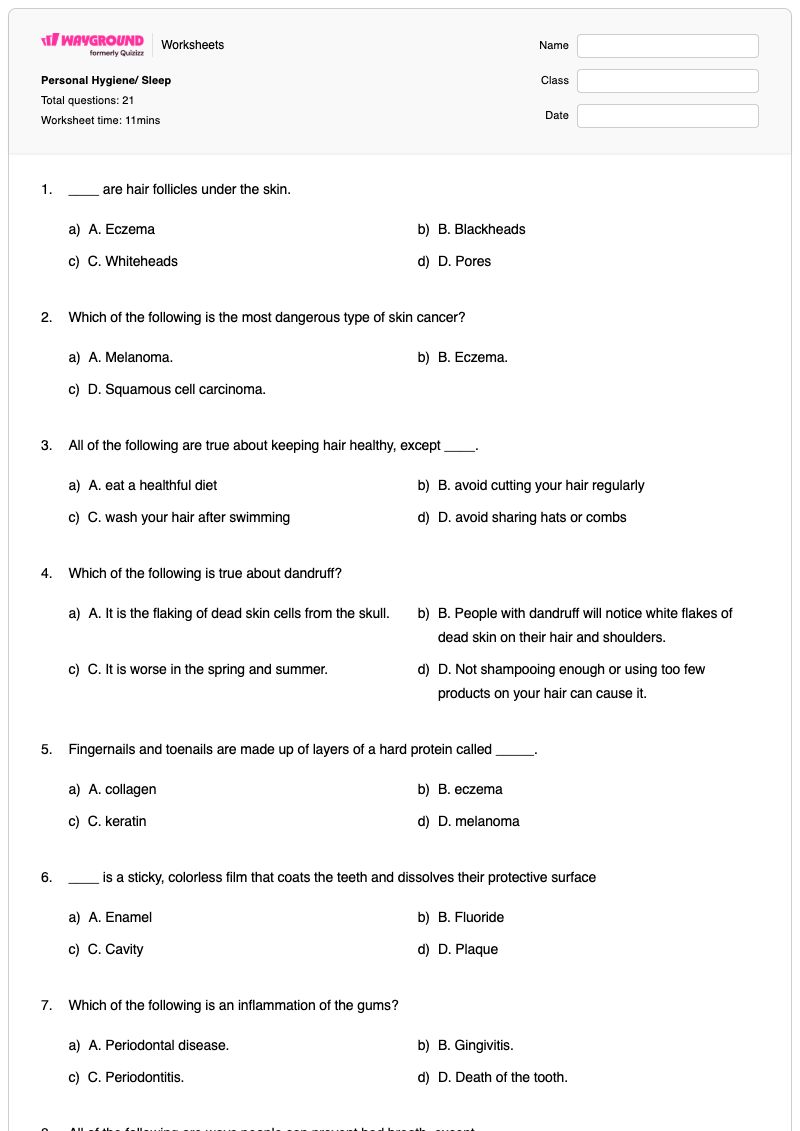
This Grade 6–8 physical education worksheet builds knowledge of personal hygiene and sleep health through 21 selected-response items: 20 multiple-choice questions and one multiple-select question. Students identify terms and concepts related to skin, hair, nails, oral care, eye and hearing protection, recommended sleep, short sleepers, circadian rhythms, dreams, and delayed sleep phase syndrome. Several items also ask students to recognize healthy-care practices and identify exceptions to accurate statements. The worksheet is designed for middle school health instruction, review, or formative assessment. Its varied questions require students to distinguish closely related terms such as pores, plaque, keratin, and gingivitis, connect hygiene practices with prevention, and recall key sleep concepts. This free printable worksheet includes a complete answer key, making it practical for independent practice, classwork, homework, or review before an assessment.

Worksheet settings

Font size

S
M
L
XL
Worksheets

Personal Hygiene/ Sleep

Total questions: 21

Name
Class
Date
1.

____ are hair follicles under the skin.

a)

A. Eczema

b)

B. Blackheads

c)

C. Whiteheads

d)

D. Pores

2.

Which of the following is the most dangerous type of skin cancer?

a)

A. Melanoma.

b)

B. Eczema.

c)

D. Squamous cell carcinoma.

3.

All of the following are true about keeping hair healthy, except ____.

a)

A. eat a healthful diet

b)

B. avoid cutting your hair regularly

c)

C. wash your hair after swimming

d)

D. avoid sharing hats or combs

4.

Which of the following is true about dandruff?

a)

A. It is the flaking of dead skin cells from the skull.

b)

B. People with dandruff will notice white flakes of dead skin on their hair and shoulders.

c)

C. It is worse in the spring and summer.

d)

D. Not shampooing enough or using too few products on your hair can cause it.

5.

Fingernails and toenails are made up of layers of a hard protein called _____.

a)

A. collagen

b)

B. eczema

c)

C. keratin

d)

D. melanoma

6.

____ is a sticky, colorless film that coats the teeth and dissolves their protective surface

a)

A. Enamel

b)

B. Fluoride

c)

C. Cavity

d)

D. Plaque

7.

Which of the following is an inflammation of the gums?

a)

A. Periodontal disease.

b)

B. Gingivitis.

c)

C. Periodontitis.

d)

D. Death of the tooth.

8.

All of the following are ways people can prevent bad breath, except ____.

a)

A. seeing the dentist once every two years for checkups

b)

B. brushing your teeth twice a day

c)

C. using an antiseptic mouth-rinse

d)

D. flossing your teeth to remove food particles

9.

Which of the following is a way to protect your eyes from damage?

a)

A. Wearing protective eyewear when doing something that could create flying debris that could hit the eyes.

b)

B. Only sharing makeup and eye care products with people who you know have good hygiene habits.

c)

C. Flushing your eyes if something gets into them with soapy water.

d)

D. Wearing sunglasses to prevent eye strain when indoors.

10.

All of the following are early signs of hearing damage, except ____.

a)

A. having difficulty hearing relatively soft sounds

b)

B. having difficulty understanding speech during phone conversations

c)

C. experiencing tinnitus after exposure to excessively loud sounds

d)

D. losing the ability to hear suddenly

11.

The average amount of sleep school-age children should get every night is ____ hours.

a)

A. 12–16

b)

B. 10–13

c)

C. 9–12

d)

D. 7–9

12.

A short sleeper is someone who ____.

a)

A. can function well on less sleep

b)

B. needs to sleep less often than others

c)

C. does not experience a sleep deficit

d)

D. goes to sleep early and wakes up early

13.

All of the following are part of the circadian rhythms controlled by the body’s master biological “clock,” except ____.

a)

A. sleep-wake cycle

b)

B. dream cycles

c)

C. hormone (melatonin)levels

d)

D. brain wave activity

14.

Which of the following do researchers believe dreams help people do?

a)

A. Regulate their moods.

b)

B. Forget information.

c)

C. Cause conflicts.

15.

____ is a disorder that results in a person being unable to fall asleep until very late at night and naturally not waking up until much later in the morning. Teens are commonly experiencing this.

a)

A. Delayed sleep phase syndrome

b)

B. Insomnia

c)

C. Parasomnia

d)

D. Sleep apnea

16.

All of the following are common parasomnia disorders, except ____.

a)

A. sleepwalking

b)

B. restless leg syndrome

c)

C. sleep apnea

d)

D. teeth grinding

17.

The stage of sleep where you are falling asleep.

a)

A. Stage 2

b)

B. Stage 3

c)

D. Stage 1

d)

C. Stage 4

18.

All of the following are snacks that contain tryptophan, which can help you fall asleep at night, except ____.

a)

A. turkey sandwich

b)

B. banana

c)

C. chocolate

d)

D. kiwi

19.

Which of the following is a technique you should use to create a comfortable environment for sleeping?

a)

A. Create a small space on your bed where you cannot toss or turn.

b)

B. Reduce the room’s temperature so it isn't too warm.

c)

C. Listen to loud music to drown out other noise.

d)

D. Keep a light on to mimic the moon.

20.

All of the following are examples of how to control exposure to light in order to regulate your sleep schedule, EXCEPT ____.

a)

A. using a night-light in the bathroom to avoid turning on a light in the middle of the night

b)

B. keeping the curtains and blinds closed during the day to reduce the amount of light

c)

C. eating lunch outside or going for a walk in the late afternoon

d)

D. minimizing the time you spend in front of the television or computer screen at the end of the day

21.

What is a way that you can care for your ears?

a)

Ear drops

b)

Wear ear protection (ear plugs)

c)

Wear sunscreen

d)

Be careful around hazard zones.

Answer Key

Personal Hygiene/ Sleep

Total questions: 21

1.
d)

D. Pores

2.
a)

A. Melanoma.

3.
b)

B. avoid cutting your hair regularly

4.
b)

B. People with dandruff will notice white flakes of dead skin on their hair and shoulders.

5.
c)

C. keratin

6.
d)

D. Plaque

7.
b)

B. Gingivitis.

8.
a)

A. seeing the dentist once every two years for checkups

9.
a)

A. Wearing protective eyewear when doing something that could create flying debris that could hit the eyes.

10.
d)

D. losing the ability to hear suddenly

11.
c)

C. 9–12

12.
a)

A. can function well on less sleep

13.
b)

B. dream cycles

14.
a)

A. Regulate their moods.

15.
a)

A. Delayed sleep phase syndrome

16.
c)

C. sleep apnea

17.
c)

D. Stage 1

18.
c)

C. chocolate

19.
b)

B. Reduce the room’s temperature so it isn't too warm.

20.
b)

B. keeping the curtains and blinds closed during the day to reduce the amount of light

21.
b)

Wear ear protection (ear plugs)

FAQs

What does this personal hygiene and sleep worksheet cover?

This Grade 6–8 physical education worksheet uses 20 multiple-choice questions and one multiple-select question to assess personal hygiene, sensory protection, and sleep-health knowledge. Students distinguish terms such as pores, melanoma, keratin, plaque, and gingivitis; recognize ways to protect the eyes and hearing; and identify sleep concepts including recommended hours, circadian rhythms, short sleepers, and delayed sleep phase syndrome.

How can I use this worksheet to teach personal hygiene and sleep health?

Introduce the worksheet by grouping its questions into body care, sensory protection, and sleep-health sections. After students complete each group, ask them to explain why a hygiene or protective practice is correct and to define terms such as plaque, gingivitis, keratin, and circadian rhythm. Use the exception questions and the multiple-select dandruff item to prompt students to justify each choice rather than rely on word recognition.

What mistakes should I watch for when students complete this worksheet?

Students may confuse related health terms, such as plaque with enamel, gingivitis with broader periodontal conditions, or pores with skin conditions. They may also overlook the word “except” in questions about hair care, bad-breath prevention, and signs of hearing damage. On the multiple-select dandruff item, check that students evaluate every option instead of selecting one familiar statement automatically, and watch for confusion between circadian rhythms and dream cycles.

How do I assign and grade this personal hygiene and sleep worksheet?

This worksheet is available as a printable PDF and as a digital quiz on Wayground. It includes a complete answer key for the 20 multiple-choice and one multiple-select items, and printable submissions can be graded by scanning student work with the Wayground for Teachers app. The PDF option also supports schools that want to reduce screen time.

How can I differentiate this personal hygiene and sleep worksheet for my students?

In the worksheet’s Advanced Settings, adjust font spacing and font size to make the health vocabulary and answer choices easier to read. You can also enable a dyslexia-friendly font for students who benefit from that typeface or translate the worksheet into another language while keeping the multiple-choice and multiple-select format.

Where can I find more worksheets like this on Wayground?

Wayground offers a comprehensive collection of free printable worksheets and practice problems across all subjects, with downloadable PDFs and answer keys to support essential skills and concepts. Browse more resources at https://wayground.com/en-us/worksheets.