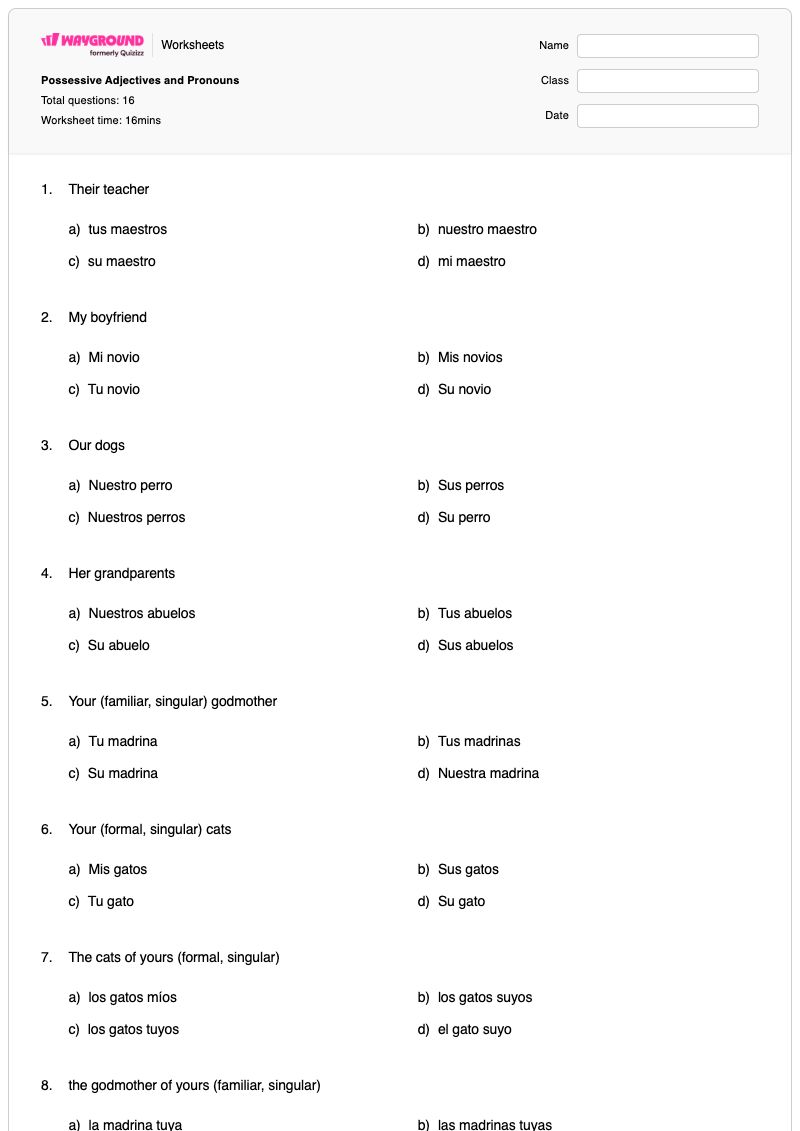
Possessive Adjectives and Pronouns is a free printable Spanish worksheet for students in Grades 9–12. It contains 16 multiple-choice questions that ask learners to identify Spanish possessive forms in English-to-Spanish phrases and complete Spanish sentences. The items include short possessive adjectives such as mi, tu, su, nuestro, and nuestros, as well as longer forms such as mío, tuya, suyo, and suyas.
Students practise matching the possessive form to the person who possesses an item while also checking the noun’s gender and number. The final sentence-completion questions require them to select possessive pronouns that agree with the noun being replaced, such as los míos, suya, and las suyas. Familiar versus formal “your” forms are also tested, helping learners distinguish tu from su and apply singular, plural, masculine, and feminine agreement. The worksheet includes a complete answer key for efficient review and grading.
Worksheet settings
Font size
S
M
L
XL
Worksheets
Possessive Adjectives and Pronouns
Total questions: 16
Name
Class
Date
1.
Their teacher
a)
tus maestros
b)
nuestro maestro
c)
su maestro
d)
mi maestro
2.
My boyfriend
a)
Mi novio
b)
Mis novios
c)
Tu novio
d)
Su novio
3.
Our dogs
a)
Nuestro perro
b)
Sus perros
c)
Nuestros perros
d)
Su perro
4.
Her grandparents
a)
Nuestros abuelos
b)
Tus abuelos
c)
Su abuelo
d)
Sus abuelos
5.
Your (familiar, singular) godmother
a)
Tu madrina
b)
Tus madrinas
c)
Su madrina
d)
Nuestra madrina
6.
Your (formal, singular) cats
a)
Mis gatos
b)
Sus gatos
c)
Tu gato
d)
Su gato
7.
The cats of yours (formal, singular)
a)
los gatos míos
b)
los gatos suyos
c)
los gatos tuyos
d)
el gato suyo
8.
the godmother of yours (familiar, singular)
a)
la madrina tuya
b)
las madrinas tuyas
c)
la madrina suya
d)
la madrina nuestra
9.
The grandparents of her
a)
los abuelos nuestros
b)
los abuelos tuyos
c)
el abuelo suyo
d)
los abuelos suyos
10.
the dogs of ours
a)
el perro nuestro
b)
los perros suyos
c)
los perros nuestros
d)
el perro suyo
11.
the boyfriend of mine
a)
el novio mío
b)
los novios míos
c)
el novio tuyo
d)
el novio suyo
12.
the teacher of theirs
a)
los maestros tuyos
b)
el maestro nuestro
c)
el maestro suyo
d)
el maestro mío
13.
Tus zapatos son rojos, ... son negros.
a)
el mío
b)
la mía
c)
los míos
d)
las mías
14.
La mochila de mi hermano es fea. La mochila vieja es ...
a)
suyo
b)
suya
c)
suyos
d)
suyas
15.
Nuestras tías son simpáticas. ... son antipáticas.
a)
El suyo
b)
La suya
c)
Los suyos
d)
Las suyas
16.
Mis amigos son graciosos. ... son aburridos.
a)
El tuyo
b)
La tuya
c)
Los tuyos
d)
Las tuyas
Answer Key
Possessive Adjectives and Pronouns
Total questions: 16
1.
c)
su maestro
2.
a)
Mi novio
3.
c)
Nuestros perros
4.
d)
Sus abuelos
5.
a)
Tu madrina
6.
b)
Sus gatos
7.
b)
los gatos suyos
8.
a)
la madrina tuya
9.
d)
los abuelos suyos
10.
c)
los perros nuestros
11.
a)
el novio mío
12.
c)
el maestro suyo
13.
c)
los míos
14.
b)
suya
15.
d)
Las suyas
16.
c)
Los tuyos
140 %
Browse by subjects
Browse by grades
Browse by format
FAQs
What does the Possessive Adjectives and Pronouns worksheet cover?
This Grade 9–12 Spanish worksheet uses 16 multiple-choice questions to practise selecting possessive adjectives and pronouns in context. Students identify forms such as mi, tu, su, nuestro, and nuestros, use longer forms such as mío, tuya, and suyo, and match each form to the noun’s gender and number. The items also distinguish familiar and formal singular “your” forms.
How can I use this worksheet to teach Spanish possessive adjectives and pronouns?
Introduce the worksheet by having students identify the possessor in each English phrase, then compare that person with the noun’s gender and number in Spanish. Work through the early phrase-based items to model short forms such as su maestro and nuestros perros, and use the later sentence-completion items to show how pronouns such as los míos, suya, and las suyas replace a noun. Ask students to explain both why the possessive identifies the owner and why its ending agrees with the noun.
What mistakes should I watch for when students complete this possessive adjectives and pronouns worksheet?
Students may choose a form based on the owner alone and overlook agreement with the noun, selecting tu instead of tus for plural nouns or suyo instead of suya for a feminine singular noun. They may also confuse familiar tu with formal su, or fail to change the ending in longer forms such as los gatos suyos and la madrina tuya. In the final sentence items, check that students match the possessive pronoun to the noun being replaced, as in las suyas for feminine plural tías.
How do I assign and grade this Spanish possessive adjectives and pronouns worksheet?
Wayground provides this worksheet as a printable PDF and as a digital quiz, and it includes a complete answer key for all 16 multiple-choice questions. You can grade printable submissions by scanning student work with the Wayground for Teachers app, or review responses from the digital quiz.
How can I differentiate this worksheet for my students?
In the worksheet’s Advanced Settings, adjust font spacing or choose a larger font size to make the English prompts and Spanish answer choices easier to scan. You can also enable a dyslexia-friendly font or translate the worksheet into another language while students practise forms such as tu, su, suyo, and las suyas.
Where can I find more worksheets like this on Wayground?
Wayground offers a comprehensive collection of free printable worksheets and practice problems across subjects, with downloadable PDFs and answer keys to support essential skills and concepts. Browse more resources at https://wayground.com/en-us/worksheets.


 Worksheets