Identify Primary/Secondary Sources and Explain Why?
7 questions
5th - 8th Grade
Social Studies
This free printable worksheet helps students in Grades 5–8 Social Studies distinguish primary sources from secondary sources and explain the evidence behind each classification. Using examples such as President Obama’s autobiography, a YouTube video explaining how the Great Wall of China was built, and a notice directing people of Japanese ancestry to report to designated areas, students identify the source type in multiple-choice questions and justify their reasoning in open-ended responses.
The seven-question worksheet includes three classification questions and three explanation prompts with sentence starters, plus a student information item. It is designed to move students beyond labeling a source: they must connect the source’s creator, purpose, or relationship to the historical information with the terms primary or secondary. The worksheet is useful for introducing source analysis, checking understanding after instruction, or reviewing historical thinking skills. It is available as a free printable worksheet with an answer key.
Worksheet settings
Font size
S
M
L
XL
Worksheets
Identify Primary/Secondary Sources and Explain Why?
Total questions: 7
Name
Class
Date
1.
Type your first and last name and which class you are in 7A or 7B?
4 lines
2.
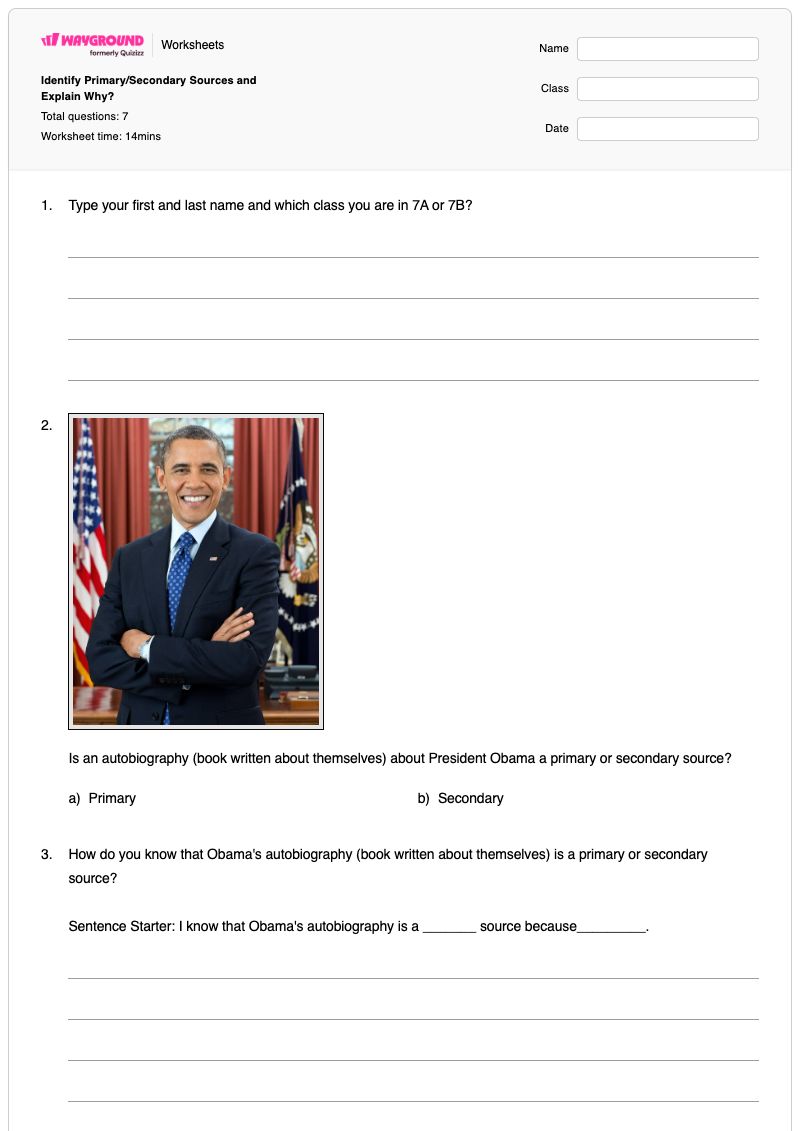
Is an autobiography (book written about themselves) about President Obama a primary or secondary source?
a)
Primary
b)
Secondary
3.
How do you know that Obama's autobiography (book written about themselves) is a primary or secondary source?
Sentence Starter: I know that Obama's autobiography is a _______ source because_________.
4 lines
4.
Is a YouTube video describing how the Great Wall of China was built a primary or secondary source?
a)
Primary
b)
Secondary
5.
How do you know that the Youtube video describing how the Great Wall of China was built is a primary or secondary source?
Sentence Starter: I know that the Youtube video is a _______ source because_________.
4 lines
6.
Is the notice for people of Japanese ancestry to report to certain areas a primary or secondary source?
a)
Primary
b)
Secondary
7.
How do you know that Is the notice for people of Japanese ancestry to report to certain areas a primary or secondary source?
Sentence Starter: I know that the notice for people of Japanese ancestry to report to certain areas is a _______ source because_________.
4 lines
Answer Key
Identify Primary/Secondary Sources and Explain Why?
Total questions: 7
1.
n/a
2.
a)
Primary
3.
n/a
4.
b)
Secondary
5.
n/a
6.
a)
Primary
7.
n/a
140 %
Browse by subjects
Browse by grades
Browse by format
FAQs
What does this worksheet cover?
This worksheet teaches students to classify examples as primary or secondary sources and explain why, using three multiple-choice items and three open-ended justification prompts. Students apply the distinction to an autobiography by President Obama, a video describing how the Great Wall of China was built, and a historical notice, then complete sentence starters that require evidence-based reasoning.
How can I use this worksheet to teach primary and secondary sources?
Introduce the difference between a firsthand source and an account that describes or explains information created by others, then model one classification before students work independently. Have students discuss what makes Obama’s autobiography and the historical notice primary sources, while the Great Wall video is secondary, and use the worksheet’s sentence starters to turn those observations into complete explanations.
What mistakes should I watch for when students complete this worksheet?
Students may label a source based on its topic or format instead of considering who created it and how directly it represents the information. Watch for students calling the Great Wall video primary simply because it is a video, or selecting an answer without explaining the source’s relationship to the event in the open-ended prompts.
How do I assign and grade this worksheet?
You can assign this primary- and secondary-source worksheet as a printable PDF or as a digital quiz on Wayground. It includes a complete answer key, and printable student work can be graded by scanning it with the **Wayground for Teachers** app.
How can I differentiate this primary and secondary sources worksheet?
Use the worksheet’s Advanced Settings to adjust font spacing or choose a larger font size when students need more room to read the source descriptions and complete the sentence starters. You can also apply a dyslexia-friendly font or translate the worksheet into another language while keeping the multiple-choice classifications and written explanations intact.
Where can I find more worksheets like this on Wayground?
Wayground offers a broad collection of free printable worksheets and practice problems across subjects, with downloadable PDFs and answer keys to support essential skills and concepts. Browse more resources at https://wayground.com/en-us/worksheets.

 Worksheets


