

Wayground
Primary and Secondary Sources - Printable Social Studies Worksheets class 8 - Wayground

Primary and Secondary Sources

9 questions

8th - 8th Grade

Social Studies

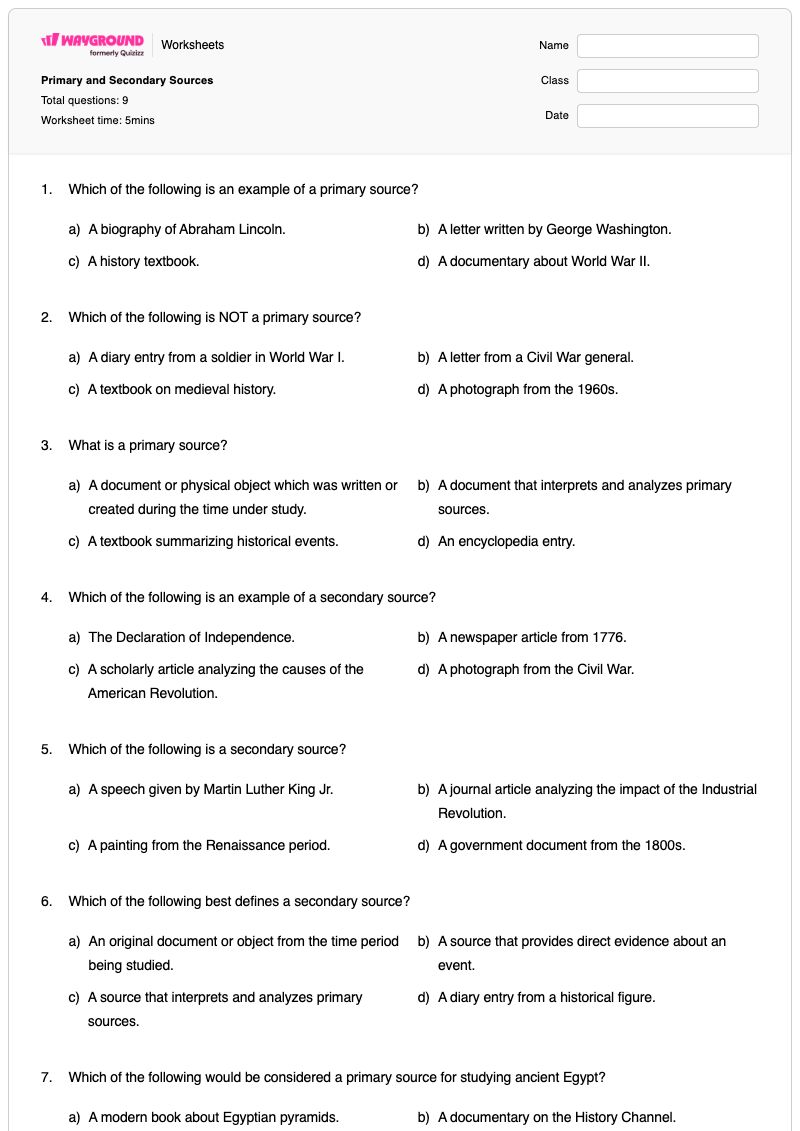
This Grade 8 social studies worksheet helps students distinguish primary sources from secondary sources. Across nine multiple-choice questions, students identify original documents and objects created during the period studied—such as a letter, diary entry, photograph, hieroglyphic inscription, or Roman coin—and separate them from later texts that interpret or summarize the past, such as textbooks, documentaries, and scholarly articles. The questions use examples from the American Revolution, Civil War, World War I, ancient Egypt, the Roman Empire, and other historical contexts, giving students practice applying the definitions across different time periods. Use this free printable worksheet to check whether students can recognize direct historical evidence and analytical sources before beginning source-analysis activities. It includes a complete answer key for efficient review, reteaching, or independent practice.

Worksheet settings

Font size

S
M
L
XL
Worksheets

Primary and Secondary Sources

Total questions: 9

Name
Class
Date
1.

Which of the following is an example of a primary source?

a)

A biography of Abraham Lincoln.

b)

A letter written by George Washington.

c)

A history textbook.

d)

A documentary about World War II.

2.

Which of the following is NOT a primary source?

a)

A diary entry from a soldier in World War I.

b)

A letter from a Civil War general.

c)

A textbook on medieval history.

d)

A photograph from the 1960s.

3.

What is a primary source?

a)

A document or physical object which was written or created during the time under study.

b)

A document that interprets and analyzes primary sources.

c)

A textbook summarizing historical events.

d)

An encyclopedia entry.

4.

Which of the following is an example of a secondary source?

a)

The Declaration of Independence.

b)

A newspaper article from 1776.

c)

A scholarly article analyzing the causes of the American Revolution.

d)

A photograph from the Civil War.

5.

Which of the following is a secondary source?

a)

A speech given by Martin Luther King Jr.

b)

A journal article analyzing the impact of the Industrial Revolution.

c)

A painting from the Renaissance period.

d)

A government document from the 1800s.

6.

Which of the following best defines a secondary source?

a)

An original document or object from the time period being studied.

b)

A source that provides direct evidence about an event.

c)

A source that interprets and analyzes primary sources.

d)

A diary entry from a historical figure.

7.

Which of the following would be considered a primary source for studying ancient Egypt?

a)

A modern book about Egyptian pyramids.

b)

A documentary on the History Channel.

c)

An ancient Egyptian hieroglyphic inscription.

d)

A website summarizing Egyptian history.

8.

Which of the following would be considered a primary source for studying the American Civil War?

a)

A modern analysis of Civil War battles.

b)

A letter written by a soldier during the Civil War.

c)

A history book about the Civil War.

d)

A documentary on the Civil War.

9.

Which of the following is an example of a primary source for studying the history of the Roman Empire?

a)

A modern book about Roman architecture.

b)

A documentary on Roman history.

c)

A Roman coin from the era.

d)

A scholarly article on Roman politics.

Answer Key

Primary and Secondary Sources

Total questions: 9

1.
b)

A letter written by George Washington.

2.
c)

A textbook on medieval history.

3.
a)

A document or physical object which was written or created during the time under study.

4.
c)

A scholarly article analyzing the causes of the American Revolution.

5.
b)

A journal article analyzing the impact of the Industrial Revolution.

6.
c)

A source that interprets and analyzes primary sources.

7.
c)

An ancient Egyptian hieroglyphic inscription.

8.
b)

A letter written by a soldier during the Civil War.

9.
c)

A Roman coin from the era.

FAQs

What does the Primary and Secondary Sources worksheet cover?

This Grade 8 social studies worksheet uses nine multiple-choice questions to help students distinguish primary sources, such as a soldier’s letter, a 1960s photograph, or a Roman coin, from secondary sources, such as textbooks and scholarly analyses. Students apply the definitions across historical settings including ancient Egypt, the American Revolution, the Civil War, and the Roman Empire.

How can I use this worksheet to teach primary and secondary sources?

Introduce the distinction by having students sort the worksheet’s examples into “created during the time” and “interprets the past” categories. Then use the multiple-choice items to discuss why a letter or inscription provides direct evidence, while a textbook, documentary, or scholarly article analyzes earlier evidence. Review the answer key afterward and ask students to explain the clue that determined each classification.

What mistakes should I watch for when students complete this worksheet?

Students may choose a source because it discusses a historical event rather than checking when and how it was created. They may also confuse a modern analysis of the Civil War or Industrial Revolution with a firsthand source, or miss the reversed wording in the “NOT a primary source” question. Remind them that a source’s status depends on whether it is original evidence from the period or a later interpretation.

How do I assign and grade this worksheet?

Wayground provides this worksheet as a printable PDF and as a digital quiz, and it includes a complete answer key for checking all nine multiple-choice responses. Printable submissions can be graded by scanning student work with the Wayground for Teachers app. The PDF option can also support schools that are reducing screen time.

How can I differentiate this primary and secondary sources worksheet for my students?

Use the worksheet’s Advanced Settings to adjust font spacing and font size so the nine source-classification questions are easier to navigate. You can also apply a dyslexia-friendly font or translate the worksheet into another language when those changes support access to the historical examples and definitions.

Where can I find more worksheets like this on Wayground?

Wayground offers a comprehensive collection of free printable worksheets and practice problems across subjects, with downloadable PDFs and answer keys to support essential skills and concepts. Browse more resources at https://wayground.com/en-us/worksheets.