

Wayground
Probability Recap - Printable Math Worksheets 12th Grade - Wayground

Probability Recap

Matthew Goodman

Created by Matthew Goodman

16 questions

12th Grade

Math

Updated Feb 2026

Probability Recap is a free printable Grade 12 mathematics worksheet that strengthens students’ ability to interpret probability notation and calculate probabilities from a two-way table. Across 16 items, students match the meanings of union and intersection symbols, write unreduced fractions for marginal and joint probabilities, and use the addition rule to determine whether mutually exclusive events require an overlap adjustment. The worksheet then moves to conditional probability and independence using contexts involving yoga, swimming, cycling, running, and gender categories. Students identify conditional-probability numerators and denominators, calculate probabilities such as P(Running | Female), and compare fractions to decide whether Swimming and Male are independent. Its mixed format includes matching, math-response, fill-in-the-blank, multiple-choice, drag-and-drop, and multiple-select questions, and it includes a complete answer key for checking student work.

Worksheet settings

Font size

S
M
L
XL
WaygroundWorksheets

Probability Recap

Total questions: 16

Name
Class
Date
1.

Match the symbols with their appropriate meaning and usage.

U

Union -- or

 ∩

Intersection -- and

|

Given -- conditional

2.
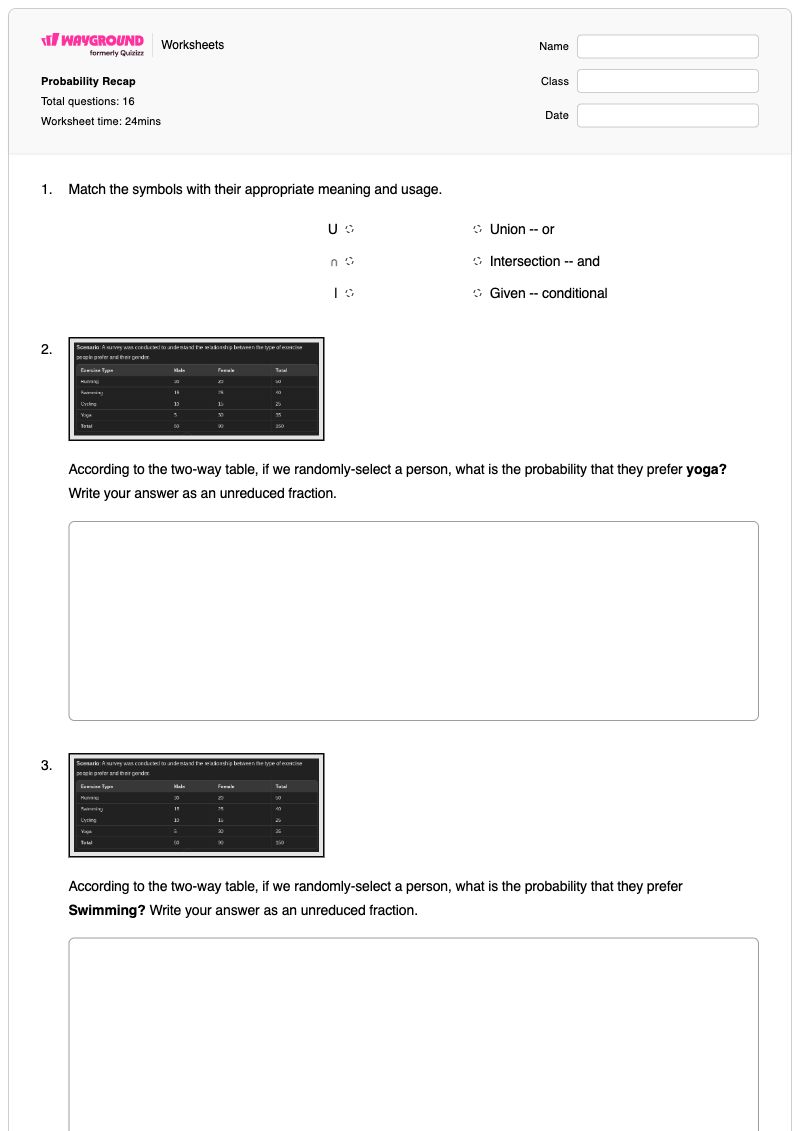
According to the two-way table, if we randomly-select a person, what is the probability that they prefer yoga? Write your…

According to the two-way table, if we randomly-select a person, what is the probability that they prefer yoga? Write your answer as an unreduced fraction.

3.
According to the two-way table, if we randomly-select a person, what is the probability that they prefer Swimming? Write…

According to the two-way table, if we randomly-select a person, what is the probability that they prefer Swimming? Write your answer as an unreduced fraction.

4.
Now, let's use our answers from the previous questions: P(Yoga) = 35/150 and P(Swimming) = 40/150 Calculate P(Yoga U…

Now, let's use our answers from the previous questions:

P(Yoga) = 35/150 and P(Swimming) = 40/150

Calculate P(Yoga U Swimming)

As you saw, U means or. We use the (a)   rule to find these types of probabilities.

5.
Now, let's use our answers from the previous questions: P(Yoga) = 35/150 and P(Swimming) = 40/150 Calculate P(Yoga U…

Now, let's use our answers from the previous questions:

P(Yoga) = 35/150 and P(Swimming) = 40/150

Calculate P(Yoga U Swimming)

Add the two probabilities together. Do NOT subtract yet.

6.
Hopefully, you found the last answer to be 75/150 by adding the two together. Are the events Yoga and Swimming mutually…

Hopefully, you found the last answer to be 75/150 by adding the two together.

Are the events Yoga and Swimming mutually exclusive?

a)

Yes!

b)

No!

c)

What?

7.
Hopefully, you found the last answer to be 75/150 by adding the two together. Based on your answer to the last question, do…

Hopefully, you found the last answer to be 75/150 by adding the two together.

Based on your answer to the last question, do we need to subtract any overlap?

a)

Yes!

b)

No!

c)

What?

8.
Moving on! Suppose we randomly-select an individual. Calculate P(Male ∩ Cycling). Remember, leave fractions unreduced!

Moving on!

Suppose we randomly-select an individual. Calculate P(Male ∩ Cycling). Remember, leave fractions unreduced!

9.
Compute P(Running | Female) Let's break this down. How many females are there in this survey? Another way to think of it:…

Compute P(Running | Female)

Let's break this down. How many females are there in this survey?

Another way to think of it: What is the numerator of the probability of selecting a female?

10.
Compute P(Running | Female) Hopefully, you got 90. Now, out of those 90 people , how many prefer running? In other words,…

Compute P(Running | Female)

Hopefully, you got 90.

Now, out of those 90 people, how many prefer running?

In other words, how many females prefer running as their exercise?

11.
Hopefully, you got 20. Let's put it altogether! Suppose we randomly-select an individual. What is the probability that they…

Hopefully, you got 20.

Let's put it altogether! Suppose we randomly-select an individual. What is the probability that they prefer running, given that they are a female?

12.
Are the events "Swimming" and "Male" Independent? Let's find out. Let A = Swimming and B = Male Here is the general rule for…

Are the events "Swimming" and "Male" Independent?

Let's find out. Let A = Swimming and B = Male

Here is the general rule for independence, which we will break down: P(A) = P(A|B) = P(A|BC)

What is the probability of randomly-selecting an individual who prefers swimming?

13.
Are the events "Swimming" and "Male" Independent? Let's find out. Let A = Swimming and B = Male Here is the general rule for…

Are the events "Swimming" and "Male" Independent?

Let's find out. Let A = Swimming and B = Male

Here is the general rule for independence, which we will break down: P(A) = P(A|B) = P(A|BC)

Write that last fraction down so you don't forget.

What is the probability of randomly-selecting someone who prefers swimming, given that they are male?

14.
Are the events "Swimming" and "Male" Independent? Let's find out. Let A = Swimming and B = Male Here is the general rule for…

Are the events "Swimming" and "Male" Independent?

Let's find out. Let A = Swimming and B = Male

Here is the general rule for independence, which we will break down: P(A) = P(A|B) = P(A|BC)

Write that last fraction down so you don't forget.

What is the probability of randomly-selecting someone who prefers swimming, given they are NOT male? (HINT: What category in this table is not male?)

15.
Let's put those fractions together that you hopefully got: 40/150 = 15/60 = 25/90 Determine if that statement is true. Then,…

Let's put those fractions together that you hopefully got:

40/150 = 15/60 = 25/90

Determine if that statement is true. Then, complete the sentence by dragging the correct terms.

Since these fractions ​ ​ (a)   equal, the events ​ (b)   and​ (c)   are not​ (d)   .

Choose from the below words
are not
Swimming
Male
independent
16.

Great work! If you need to practice this again, please review this Quizizz or look at our recent worksheet. Additionally, please note and questions you have, and I will answer them during class tomorrow.

Select how well you understood this assignment

a)

I understood it very well and have no questions.

b)

I understood it, but have a couple questions.

c)

I kind of got it, but I am still confused.

d)

I am really confused and need help with this material.

WaygroundAnswer Key

Probability Recap

Total questions: 16

1.

U

 - 

Union -- or

, 

 ∩

 - 

Intersection -- and

, 

|

 - 

Given -- conditional

2.

35150\frac{35}{150}

3.

40150\frac{40}{150}

4.
addition
5.

75150\frac{75}{150}

6.
a)

Yes!

7.
b)

No!

8.

10150\frac{10}{150}

9.

9090

10.

2020

11.

2090\frac{20}{90}

12.

40150\frac{40}{150}

13.

1560\frac{15}{60}

14.

2590\frac{25}{90}

15.
are not, Swimming, Male, independent
16.
a)

I understood it very well and have no questions.

, b)

I understood it, but have a couple questions.

, c)

I kind of got it, but I am still confused.

, d)

I am really confused and need help with this material.

FAQs

What does the Probability Recap worksheet cover?

This Grade 12 worksheet develops probability skills using a two-way table and 16 mixed-format questions. Students interpret union and intersection notation, calculate unreduced marginal and joint fractions, apply the addition rule for mutually exclusive events, find conditional probabilities such as P(Running | Female), and test whether Swimming and Male are independent.

How can I use this worksheet to teach union, conditional probability, and independence?

Introduce the matching item first so students connect ∪ with “or” and ∩ with “and,” then have them use the yoga and swimming values to apply the addition rule before discussing why no overlap is subtracted for mutually exclusive events. Next, guide students through the female denominator and running count in the conditional-probability items, and finish by comparing the swimming and male fractions to evaluate independence.

What mistakes should I watch for when students complete this probability worksheet?

Watch for students confusing union and intersection, reducing fractions even though the math-response items request unreduced fractions, or subtracting overlap when the worksheet identifies Yoga and Swimming as mutually exclusive. In the conditional items, students may use the total survey population instead of the female group as the denominator, and in the independence section they may compare the wrong conditional fractions or conclude independence without checking equality.

How do I assign and grade this Probability Recap worksheet?

The worksheet is available on Wayground as a printable PDF and as a digital quiz, and it includes a complete answer key for all 16 items. Printable submissions can be graded by scanning student work with the Wayground for Teachers app, while the PDF option also supports classrooms that are reducing screen time.

How can I differentiate this probability worksheet for my students?

Use the worksheet’s Advanced Settings to adjust font spacing or font size so the probability notation, two-way-table prompts, and multi-step response items are easier to read. You can also apply a dyslexia-friendly font or translate the worksheet into another language while keeping the union, intersection, and conditional-probability tasks in the same format.

Where can I find more worksheets like this on Wayground?

Wayground offers a comprehensive collection of free printable worksheets and practice problems across all subjects, with downloadable PDFs and answer keys to help students master essential skills and concepts. Browse more resources at https://wayground.com/en-us/worksheets.