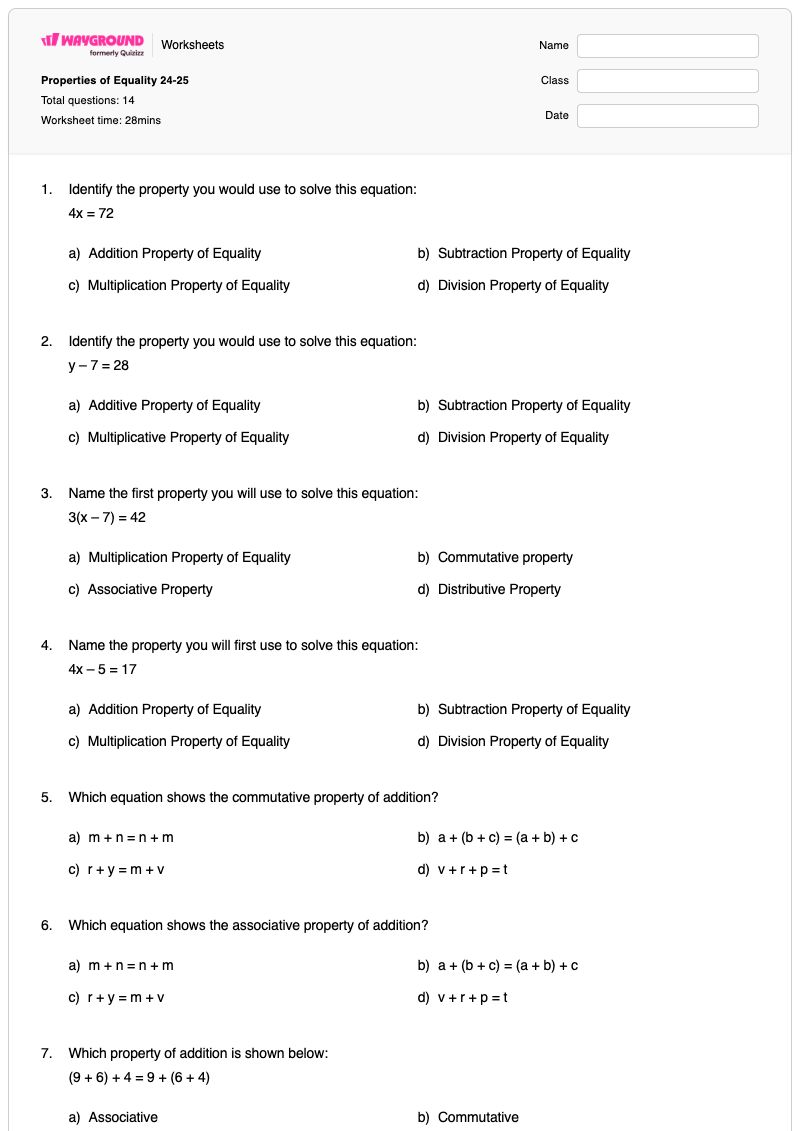
This Grade 9 mathematics worksheet helps students identify and apply properties of equality while solving and simplifying equations. Across 12 multiple-choice questions, students select the correct property for steps such as dividing 4x = 72, adding to both sides of y − 7 = 28, distributing in 3(x − 7) = 42, and combining like terms. They also distinguish the commutative, associative, distributive, and identity-related ideas shown in addition equations and algebraic expressions.
Two drag-and-drop items extend the practice from recognition to reasoning: students place properties into reason columns and match properties to statements that justify equation-solving steps. This format supports accurate mathematical vocabulary, choosing the first appropriate operation, and explaining why each step preserves equality. The free printable worksheet is designed for Grade 9 math practice, review, or assessment and includes an answer key for checking student responses.
Worksheet settings
Font size
S
M
L
XL
Worksheets
Properties of Equality 24-25
Total questions: 14
Name
Class
Date
1.
Identify the property you would use to solve this equation: 4x = 72
a)
Addition Property of Equality
b)
Subtraction Property of Equality
c)
Multiplication Property of Equality
d)
Division Property of Equality
2.
Identify the property you would use to solve this equation: y – 7 = 28
a)
Additive Property of Equality
b)
Subtraction Property of Equality
c)
Multiplicative Property of Equality
d)
Division Property of Equality
3.
Name the first property you will use to solve this equation: 3(x – 7) = 42
a)
Multiplication Property of Equality
b)
Commutative property
c)
Associative Property
d)
Distributive Property
4.
Name the property you will first use to solve this equation: 4x – 5 = 17
a)
Addition Property of Equality
b)
Subtraction Property of Equality
c)
Multiplication Property of Equality
d)
Division Property of Equality
5.
Which equation shows the commutative property of addition?
a)
m + n = n + m
b)
a + (b + c) = (a + b) + c
c)
r + y = m + v
d)
v + r + p = t
6.
Which equation shows the associative property of addition?
a)
m + n = n + m
b)
a + (b + c) = (a + b) + c
c)
r + y = m + v
d)
v + r + p = t
7.
Which property of addition is shown below: (9 + 6) + 4 = 9 + (6 + 4)
a)
Associative
b)
Commutative
c)
Identity
8.
Which property of addition is shown below: (2 + 7) + 4 = (7 + 2) + 4
a)
Associative
b)
Commutative
c)
Identity
9.
Which property is shown below? __________________________ 7n = 21 then n = 3
a)
Division Property
b)
Sorcery
c)
Reduction of Multiples
d)
Distributive Property
10.
If y/4 = 5, then y = 20
a)
Multiplication Property of Equality
b)
Division Property of Equality
c)
Addition Property of Equality
d)
Subtraction Property of Equality
11.
If 3x + 4x - 5 = 10, then 7x - 5 = 10
a)
Addition Property of Equality
b)
Combine Like Terms or Simplify
c)
Subtraction Property of Equality
d)
Transitive Property of Equality
12.
Which property is shown below? __________________________ 4(x+6) = 4x + 4(6)
a)
Reflexive
b)
Distributive
c)
Transitive
d)
Substitution
13.
Move a property into each box of the reason column to justify each step.
a)Multiplication Property of Equality
b)Subtraction Property of Equality
c)Reflexive Property of Equality
d)Division Property of Equality
e)Associative Property
f)Distributive Property
g)Commutative Property
h)Addition Property of Equality
1
2
3
4
1)
2)
3)
4)
14.
Match the correct reason for each statement.
a)Distributive Property
b)Substitution Property
c)Subtraction Property of Equality
d)Division Property of Equality
e)Addition Property of Equality
f)Symmetric Property of Equality
1
2
3
4
1)
2)
3)
4)
Answer Key
Properties of Equality 24-25
Total questions: 14
1.
d) Division Property of Equality
2.
a) Additive Property of Equality
3.
d) Distributive Property
4.
a) Addition Property of Equality
5.
a) m + n = n + m
6.
b) a + (b + c) = (a + b) + c
7.
a) Associative
8.
b) Commutative
9.
a) Division Property
10.
a) Multiplication Property of Equality
11.
b)
Combine Like Terms or Simplify
12.
b) Distributive
13.
f
b
h
d
14.
a
b
c
d
140 %
Browse by subjects
Browse by grades
Browse by format
FAQs
What does the Properties of Equality worksheet cover?
This Grade 9 worksheet practices identifying the correct property of equality or algebraic property for a given equation-solving step. It includes 12 multiple-choice questions on addition, subtraction, multiplication, division, distributive, commutative, associative, and simplifying properties, followed by two drag-and-drop tasks that require students to match properties with reasons. Completing both formats helps students recognize operations and justify why each equation step is valid.
How can I use this worksheet to teach properties of equality?
First model how the operation shown in an equation determines the property used—for example, division for 4x = 72, addition for y − 7 = 28, and distribution for 3(x − 7) = 42. Then have students explain the difference between commutative and associative addition using the worksheet’s equation examples before completing the multiple-choice items. Finish with the drag-and-drop justification tasks so students connect property names to complete algebraic steps rather than only recognizing definitions.
What mistakes should I watch for when students complete this worksheet?
Students may choose the operation appearing in an equation instead of the operation needed to isolate the variable, such as selecting subtraction for y − 7 = 28 rather than the additive property. They may also confuse commutative changes in order with associative changes in grouping, or overlook that 3x + 4x becomes 7x by combining like terms. In the drag-and-drop items, check that students use the property that justifies the specific transition, not merely a property that appears elsewhere in the equation.
How do I assign and grade this worksheet?
The Properties of Equality worksheet is available as a printable PDF and as a digital quiz on Wayground. It includes a complete answer key for the 12 multiple-choice and two drag-and-drop items, and printable submissions can be graded by scanning student work with the Wayground for Teachers app. The printable option can also support schools that are reducing screen time.
How can I differentiate this Properties of Equality worksheet for my students?
Use the worksheet’s Advanced Settings to create an alternate version with wider font spacing or a larger font size, making the multiple-choice equations and drag-and-drop reason columns easier to read. You can also apply a dyslexia-friendly font or translate the worksheet into another language while keeping its property-identification and equation-justification format.
Where can I find more worksheets like this on Wayground?
Wayground has a comprehensive collection of free printable worksheets and practice problems across all subjects, with downloadable PDFs and answer keys to support essential skills and concepts. Browse more resources at https://wayground.com/en-us/worksheets.

 Worksheets