

Wayground
Natural Disasters - Printable English Worksheets class 3 - Wayground

Natural Disasters

19 questions

3rd - 3rd Grade

English

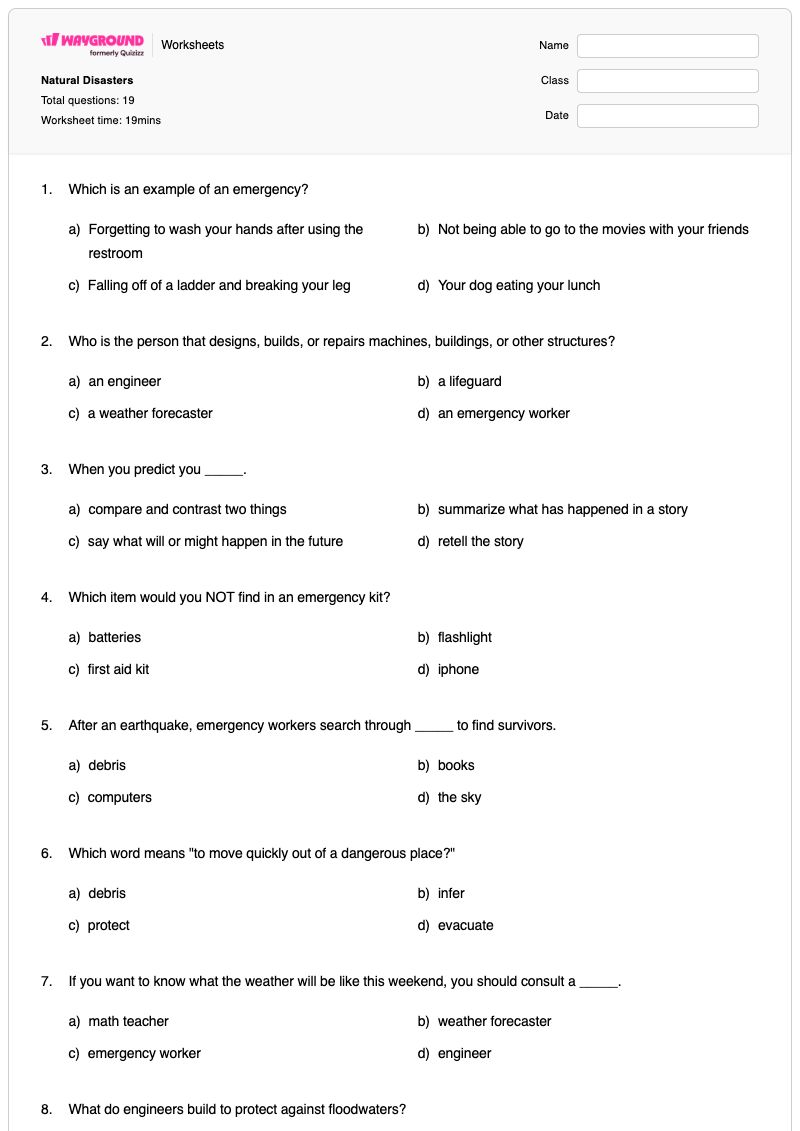
Natural Disasters is a Grade 3 English vocabulary worksheet that helps students use and distinguish words connected to emergencies, earthquakes, floods, and volcanic eruptions. Across 19 questions—16 multiple-choice items and 3 multiple-select items—students identify the meanings and uses of terms such as emergency, engineer, predict, evacuate, debris, gauges, and weather forecaster, while connecting vocabulary to basic safety and disaster-related contexts. Students also apply vocabulary to questions about emergency kits, flood protections such as seawalls and levees, earthquake prediction, volcanic hazards, and the actions scientists and emergency workers take. The multiple-select questions require students to identify every correct response, strengthening careful reading and precise word-meaning recognition. This free printable worksheet is designed for Grade 3 English instruction, review, or vocabulary assessment and includes a complete answer key for efficient checking.

Worksheet settings

Font size

S
M
L
XL
Worksheets

Natural Disasters

Total questions: 19

Name
Class
Date
1.

Which is an example of an emergency?

a)

Forgetting to wash your hands after using the restroom

b)

Not being able to go to the movies with your friends

c)

Falling off of a ladder and breaking your leg

d)

Your dog eating your lunch

2.

Who is the person that designs, builds, or repairs machines, buildings, or other structures?

a)

an engineer

b)

a lifeguard

c)

a weather forecaster

d)

an emergency worker

3.

When you predict you _____.

a)

compare and contrast two things

b)

summarize what has happened in a story

c)

say what will or might happen in the future

d)

retell the story

4.

Which item would you NOT find in an emergency kit?

a)

batteries

b)

flashlight

c)

first aid kit

d)

iphone

5.

After an earthquake, emergency workers search through _____ to find survivors.

a)

debris

b)

books

c)

computers

d)

the sky

6.

Which word means "to move quickly out of a dangerous place?"

a)

debris

b)

infer

c)

protect

d)

evacuate

7.

If you want to know what the weather will be like this weekend, you should consult a _____.

a)

math teacher

b)

weather forecaster

c)

emergency worker

d)

engineer

8.

What do engineers build to protect against floodwaters?

a)

utility lines

b)

seawalls

c)

levees

d)

forts

9.

True or False: Scientists can predict earthquakes.

a)

True

b)

False

10.

______ are used to measure floodwater.

a)

measuring tape

b)

scales

c)

thermomters

d)

gauges

11.

Which can come down mountains after a volcanic eruption?

a)

hot gas

b)

rock

c)

lava

d)

water

12.

To check if lava is rising inside a volcano, scientists _____ its gas.

a)

destroy

b)

collect

c)

smell

d)

dissolve

13.

Airplanes need to fly away from volcanoes after an eruption to avoid

a)

flying birds

b)

another eruption

c)

poisonous gas

d)

ash clouds

14.

What should people wear during and after a volcanic eruption?

a)

face masks

b)

sandals

c)

goggles

d)

a lifejacket

15.

______ can cause mudflows.

a)

tornados

b)

earthquakes

c)

volcanic eruptions

d)

a plane crash

16.

Which word means "to think carefully and give reasons about how important or useful something is?"

a)

evaluate

b)

compare

c)

predict

d)

describe

17.

Which is NOT resistant to water

a)

a raincoat

b)

a book

c)

an umbrella

d)

rainboots

18.

When a train derails, it ______.

a)

is going the wrong direction

b)

goes off the tracks

c)

is late to its destination

d)

is flooded

19.

They built the house on _________ to protect it from floods.

a)

stilts

b)

utility lines

c)

sand

d)

old debris

Answer Key

Natural Disasters

Total questions: 19

1.
c)

Falling off of a ladder and breaking your leg

2.
a)

an engineer

3.
c)

say what will or might happen in the future

4.
d)

iphone

5.
a)

debris

6.
d)

evacuate

7.
b)

weather forecaster

8.
b)

seawalls

, c)

levees

9.
b)

False

10.
d)

gauges

11.
b)

rock

, c)

lava

, a)

hot gas

12.
b)

collect

13.
d)

ash clouds

14.
a)

face masks

15.
c)

volcanic eruptions

16.
a)

evaluate

17.
b)

a book

18.
b)

goes off the tracks

19.
a)

stilts

FAQs

What does the Natural Disasters worksheet cover?

This Grade 3 English worksheet builds vocabulary for emergencies and natural hazards through 19 questions: 16 multiple-choice and 3 multiple-select. Students identify meanings and uses of words such as evacuate, debris, predict, gauges, and weather forecaster, then apply them to earthquake, flood, and volcanic-eruption situations.

How can I use this worksheet to teach natural-disaster vocabulary?

Introduce the vocabulary by grouping the words into roles and actions, emergency equipment, and hazards before students begin the questions. As students work, ask them to explain why terms such as evacuate, seawalls, levees, ash clouds, and debris fit their contexts; use the multiple-select items to discuss why more than one answer may be correct.

What mistakes should I watch for on this natural-disaster vocabulary worksheet?

Watch for students confusing predict with summarize or retell, and emergency workers with engineers or weather forecasters. In the multiple-select questions, students may choose only one correct response instead of identifying all applicable answers, such as both seawalls and levees. Review the distinction between earthquake prediction and monitoring volcanic hazards, including collecting volcanic gas and avoiding ash clouds.

How do I assign and grade this Natural Disasters worksheet?

The worksheet is available as a printable PDF and as a digital quiz on Wayground, so you can use the format that fits your lesson. It includes a complete answer key for the 16 multiple-choice and 3 multiple-select questions, and printable submissions can be graded by scanning student work with the Wayground for Teachers app.

How can I differentiate this natural-disaster vocabulary worksheet for my students?

Use the worksheet’s Advanced Settings to adjust font spacing and font size so the vocabulary choices and question text are easier to follow. You can also apply a dyslexia-friendly font or translate the worksheet into another language to support access to terms such as evacuate, debris, and volcanic eruption.

Where can I find more worksheets like this on Wayground?

Wayground offers a broad collection of free printable worksheets and practice problems across subjects, with downloadable PDFs and answer keys to help students build essential skills and concepts. Browse more resources at https://wayground.com/en-us/worksheets.