

Wayground
Point of View  - Printable English Worksheets class 5 - Wayground

Point of View

21 questions

5th - 5th Grade

English

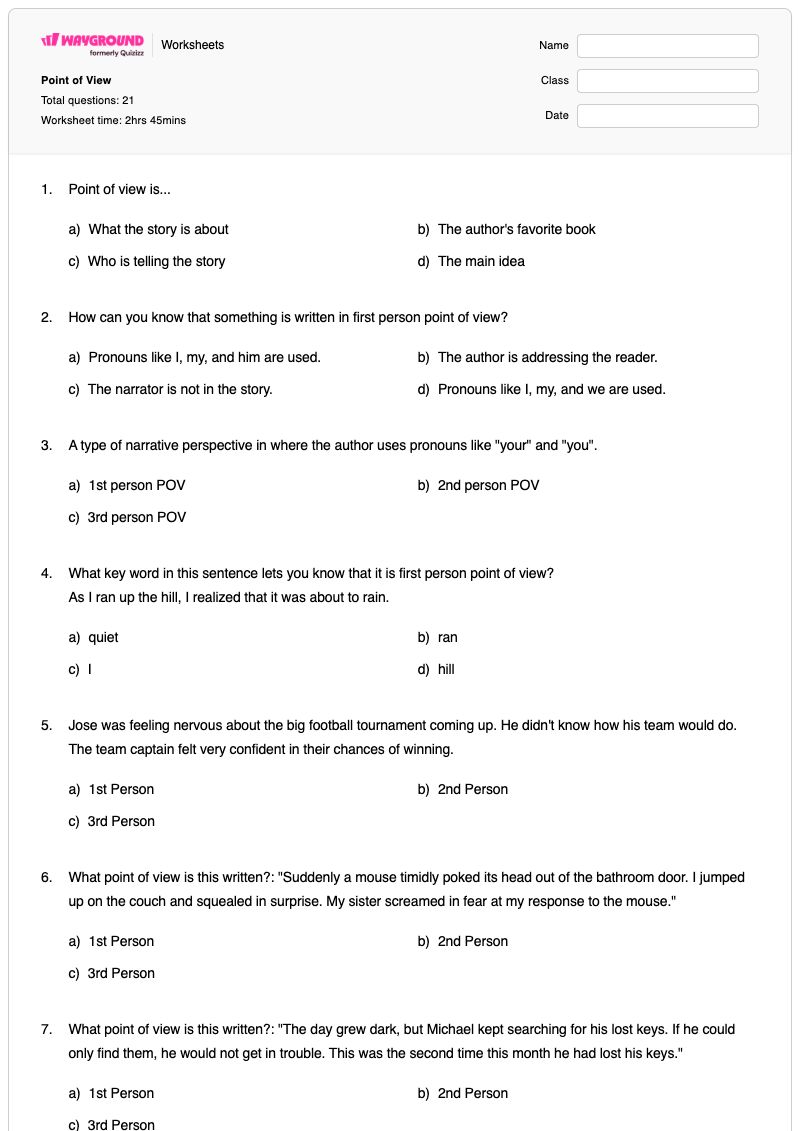
Point of View is a Grade 5 English worksheet that helps students identify who is telling a story and recognize first-, second-, and third-person point of view. Students examine pronouns such as I, me, we, you, your, he, she, and they, then use those clues to classify sentences and short narrative passages. The worksheet includes 21 questions: 20 multiple-choice items and 1 drag-and-drop activity. This free printable worksheet gives students focused practice distinguishing narrative perspective in both direct statements and contextual examples. It supports instruction and review by moving from defining point of view and identifying key pronouns to analyzing complete passages, including first-person narration about a mouse, third-person narration about lost keys, and second-person directions. An answer key is included for efficient checking and feedback.

Worksheet settings

Font size

S
M
L
XL
Worksheets

Point of View

Total questions: 21

Name
Class
Date
1.
Point of view is...
a)
What the story is about
b)
The author's favorite book
c)
Who is telling the story
d)
The main idea 
2.
How can you know that something is written in first person point of view?
a)
Pronouns like I, my, and him are used.
b)
The author is addressing the reader.
c)
The narrator is not in the story.
d)
Pronouns like I, my, and we are used.
3.

A type of narrative perspective in where the author uses pronouns like "your" and "you".

a)

1st person POV

b)

2nd person POV

c)

3rd person POV

4.

What key word in this sentence lets you know that it is first person point of view?

As I ran up the hill, I realized that it was about to rain.

a)

quiet

b)

ran

c)

I

d)

hill

5.

Jose was feeling nervous about the big football tournament coming up. He didn't know how his team would do. The team captain felt very confident in their chances of winning.

a)

1st Person

b)

2nd Person

c)

3rd Person

6.

What point of view is this written?: "Suddenly a mouse timidly poked its head out of the bathroom door. I jumped up on the couch and squealed in surprise. My sister screamed in fear at my response to the mouse."

a)

1st Person

b)

2nd Person

c)

3rd Person

7.

What point of view is this written?: "The day grew dark, but Michael kept searching for his lost keys. If he could only find them, he would not get in trouble. This was the second time this month he had lost his keys."

a)

1st Person

b)

2nd Person

c)

3rd Person

8.

Will you please take your seats? Thank you. I would like you to turn to page 64 in the text book and begin reading the page to yourself. When you are done, answer the question on page 65.

a)

1st Person

b)

2nd Person

c)

3rd Person

9.

The narrator tells the story using the pronouns "I", "me", and "we".

a)

first person POV

b)

second person POV

c)

third person POV

10.

The author tells the story using "he", "she" and "they".

a)

first person POV

b)

second person POV

c)

third person POV

11.

The story is told from the reader's point of view, using the pronouns "you" and "your".

a)

first person POV

b)

second person POV

c)

third person POV

12.

I shouldn't have come to this party. I don't belong at this party.

a)

first person POV

b)

second person POV

c)

third person POV

13.

He began his new life standing up, surrounded by darkness and stale, dusty air. A shudder shook the floor beneath him.

a)

first person POV

b)

second person POV

c)

third person POV

14.

It's finally summer. Go ahead, take a deep breath. You're free. Truth is, you're pretty smart. School comes easy to you.

a)

1st person point of view

b)

2nd person point of view

c)

3rd person point of view

15.

"When you get home you have to call me."

a)

1st Person

b)

2nd Person

c)

3rd Person

16.

"She has the most amazing voice"

a)

1st Person

b)

2nd Person

c)

3rd Person

17.

"We are going to the movies."

a)

1st Person

b)

2nd Person

c)

3rd Person

18.

In 3rd person omniscient, you get to know the thoughts and feelings of...

a)

2 Characters

b)

1 Character

c)

All of the Characters

d)

None of the Characters

19.

In 3rd person limited, you get to know the thoughts and feelings of...

a)

1 Character

b)

None of the Characters

c)

All of the Characters

d)

2 of the Characters

20.

In 3rd person objective, you get to know the thoughts and feelings of...

a)

1 Character

b)

2 Characters

c)

All Characters

d)

None of the Characters

21.

When determining point of view, cross out​ ​ (a)   and highlight ​ (b)   .

Choose from the below words
dialogue
pronouns
Answer Key

Point of View

Total questions: 21

1.
c) Who is telling the story
2.
d) Pronouns like I, my, and we are used.
3.
b)

2nd person POV

4.
c)

I

5.
c)

3rd Person

6.
a)

1st Person

7.
c)

3rd Person

8.
b)

2nd Person

9.
a)
10.
c)
11.
b)
12.
a)
13.
c)
14.
b)
15.
b)

2nd Person

16.
c)

3rd Person

17.
a)

1st Person

18.
c)

All of the Characters

19.
a)

1 Character

20.
d)

None of the Characters

21.
dialogue, pronouns

FAQs

What does this Point of View worksheet help Grade 5 students learn?

This worksheet helps students identify whether a sentence or passage uses first-, second-, or third-person point of view. Through 20 multiple-choice questions and a drag-and-drop activity, students use pronoun clues such as I, we, you, he, she, and they to determine who is telling the story and classify short examples.

How can I use this worksheet to teach first-, second-, and third-person point of view?

Begin by modeling how pronouns reveal the narrator: I, me, and we signal first person; you and your signal second person; and he, she, and they commonly signal third person. Then have students work through the worksheet from the definition and pronoun-identification items to the short passages, asking them to underline the clue before selecting a point of view.

What mistakes should I watch for when students complete this point-of-view worksheet?

Students may confuse the character being discussed with the narrator, especially in third-person passages such as the example about Michael searching for his keys. They may also overlook second-person narration in directions or commands that use you and your, or select first person because a passage contains a speaker’s thoughts without checking which pronouns tell the story.

How do I assign and grade this Point of View worksheet?

You can use this worksheet as a printable PDF or assign it as a digital quiz on Wayground. It includes a complete answer key, and printable submissions can be graded by scanning student work with the Wayground for Teachers app.

How can I differentiate this point-of-view worksheet for my students?

In the worksheet’s Advanced Settings, adjust font spacing or choose a larger font size to make the pronoun-identification questions and short passages easier to read. You can also apply a dyslexia-friendly font or translate the worksheet into another language while students practice classifying first-, second-, and third-person point of view.

Where can I find more worksheets like this on Wayground?

Wayground offers a comprehensive collection of free printable worksheets and practice problems across all subjects, with downloadable PDFs and answer keys to support essential skills and concepts. Browse more resources at https://wayground.com/en-us/worksheets.