

Wayground
Rhyme Scheme - Printable ELA Worksheets class 6 - Wayground

Rhyme Scheme

Kelli Wingate

Created by Kelli Wingate

20 questions

6th Grade

ELA

Updated Sep 2026

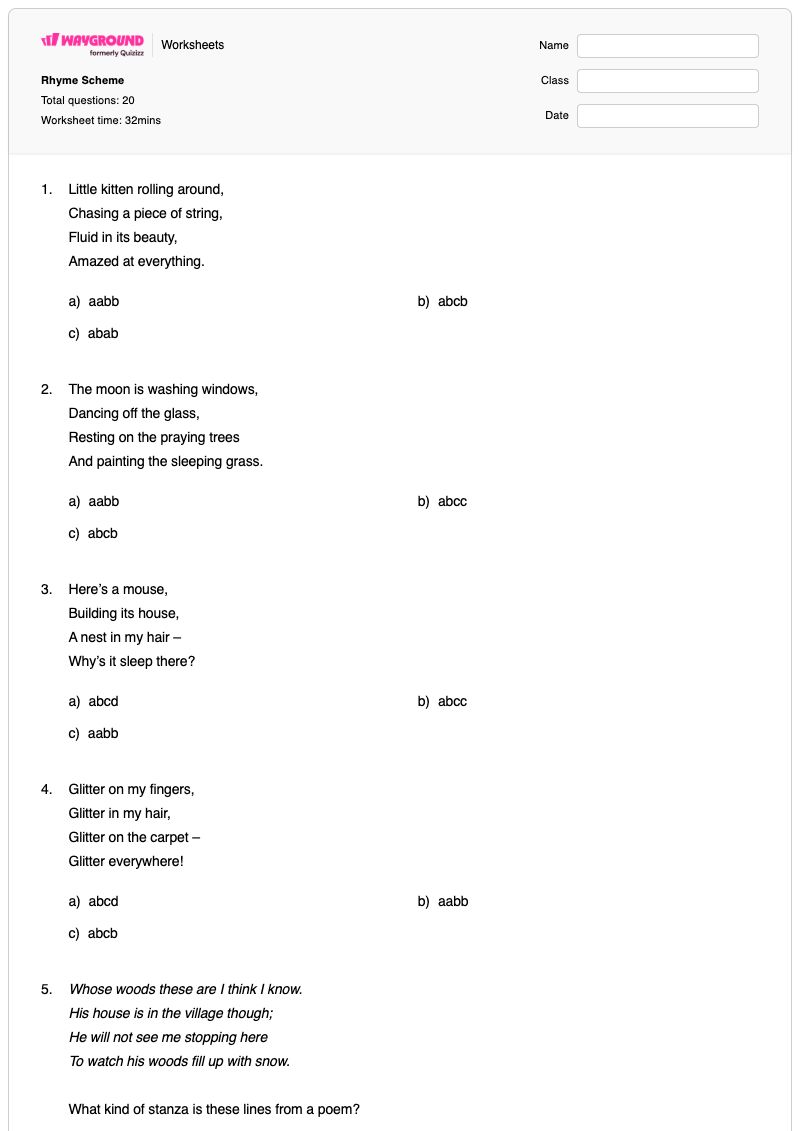
This Grade 6 English worksheet builds students’ ability to identify rhyme and analyze rhyme schemes in poetry. Across 20 questions—19 multiple-choice items and one matching item—students examine short poems and excerpts, determine patterns such as AABB, ABAB, ABCB, and ABCCB, and distinguish rhyme from rhyme scheme. They also classify stanzas as couplets, tercets, or quatrains by considering the number of lines and the pattern presented. The worksheet supports vocabulary development and close reading by asking students to connect ending sounds with letter-based patterns and recognize how poems are organized. It is useful for introducing rhyme scheme notation, guided practice, independent review, or a quick Grade 6 English assessment. This is a free printable worksheet with a complete answer key, giving teachers a ready-to-use resource for checking students’ understanding of poetic structure.

Worksheet settings

Font size

S
M
L
XL
WaygroundWorksheets

Rhyme Scheme

Total questions: 20

Name
Class
Date
1.

Little kitten rolling around,

Chasing a piece of string,

Fluid in its beauty,

Amazed at everything.

a)

aabb

b)

abcb

c)

abab

2.

The moon is washing windows,

Dancing off the glass,

Resting on the praying trees

And painting the sleeping grass.

a)

aabb

b)

abcc

c)

abcb

3.

Here’s a mouse,

Building its house,

A nest in my hair –

Why’s it sleep there?

a)

abcd

b)

abcc

c)

aabb

4.

Glitter on my fingers,

Glitter in my hair,

Glitter on the carpet –

Glitter everywhere!

a)

abcd

b)

aabb

c)

abcb

5.

Whose woods these are I think I know.

His house is in the village though;

He will not see me stopping here

To watch his woods fill up with snow.


What kind of stanza is these lines from a poem?

a)

couplet (two lines rhyme)

b)

tercet (three lines rhyme)

c)

quatrain (four lines rhyme)

6.

The lady who has loved you as you've grown

Will always love and cherish you for all time.

She has the greatest heart ever known.


What kind of stanza is these lines from a poem?

a)

couplet

b)

tercet

c)

quatrain

7.

I saw a little hermit crab

His coloring was oh so drab


These line make a...

a)

couplet

b)

tercet

c)

quatrain

8.

Tell me not, in mournful numbers,

Life is but an empty dream!—

For the soul is dead that slumbers,

And things are not what they seem.


What is the rhyme scheme of these lines from a poem?

a)

AABB

b)

ABAB

c)

ABBA

9.

On the beach I find myself

Happily patrolling the shore

I see many ships sailing about

And wonder what they're for

a)

AABB

b)

DEFE

c)

ABCB

10.

The fallen leaves are cornflakes

That fills the lawn's wide dish,

And night and noon

The wind's a spoon

That stirs them with a swish

a)

AABBB

b)

ABABC

c)

ABCCB

11.

True friends are by your side

through it all

True friends are there

to catch you when you fall

a)

ABCB

b)

AABB

c)

ABAB

12.

When you wish upon a star,

makes no difference who you are,

anything you heart desires will come to you

a)

BAC

b)

AAA

c)

AAB

13.

Read the following poem. What is the rhyme scheme?


I love the sun

I love the moon

I love having fun

I love a nice tune

I love life!


I love my cars

I love my home

I love the stars

I love to roam.

I love life!

a)

ababa, ababa

b)

aabbc, aabbx

c)

ababc, ababc

d)

abca, abca

14.

Rhyme Scheme is...

a)

A word inside a line rhymes with another word on the same line

b)

A pattern of rhyme (usually end rhyme, but not always).

c)

Words sound alike because they share the same ending vowel and consonant sounds.

d)

A word at the end of one line rhymes with a word at the end of another line

15.

Rhyme is...

a)

A word inside a line rhymes with another word on the same line

b)

A pattern of rhyme (usually end rhyme, but not always).

c)

Words sound alike because they share the same ending vowel and consonant sounds.

d)

A word at the end of one line rhymes with a word at the end of another line

16.

Match the following sound effects:

This beat can be created by can be created by meter, rhyme, alliteration and refrain.

Rhythm

Words that imitate the sound they are

Onomatopoeia

The use of a word, phrase, or line more than once

Repetition

17.

Which word rhymes with all three?

butterfly

shy

multiply

a)

bite

b)

eye

18.

What is the most logical line to complete the poem?

Mary had a little poodle

All day long she ate a __________

a)

noodle

b)

lamb

19.

Instead of a paragraph, in poetry we call the chunks...

a)

stanzas

b)

sections

20.

When you wish upon a star,

makes no difference who you are,

anything you heart desires will come to you

a)

AAB

b)

AAA

WaygroundAnswer Key

Rhyme Scheme

Total questions: 20

1.
b)

abcb

2.
c)

abcb

3.
c)

aabb

4.
c)

abcb

5.
c)

quatrain (four lines rhyme)

6.
b)

tercet

7.
a)

couplet

8.
b)

ABAB

9.
c)

ABCB

10.
c)

ABCCB

11.
a)

ABCB

12.
c)

AAB

13.
c)

ababc, ababc

14.
b)

A pattern of rhyme (usually end rhyme, but not always).

15.
c)

Words sound alike because they share the same ending vowel and consonant sounds.

16.

This beat can be created by can be created by meter, rhyme, alliteration and refrain.

 - 

Rhythm

, 

Words that imitate the sound they are

 - 

Onomatopoeia

, 

The use of a word, phrase, or line more than once

 - 

Repetition

17.
b)

eye

18.
a)

noodle

19.
a)

stanzas

20.
a)

AAB

FAQs

What does this rhyme scheme worksheet cover?

This Grade 6 English worksheet asks students to identify rhyme, label rhyme schemes in short poems using letter patterns such as AABB, ABAB, ABCB, and ABCCB, and classify excerpts as couplets, tercets, or quatrains. Its 19 multiple-choice questions and one matching item build students’ ability to connect repeated ending sounds with the structure of a stanza.

How can I use this worksheet to teach rhyme scheme and stanza types?

Introduce rhyme by having students read the final words in each line and listen for matching sounds before assigning letters to the pattern. Then use the worksheet’s poem excerpts to model one example of a repeated pattern and one example of a couplet, tercet, or quatrain; students can complete the remaining multiple-choice and matching items independently or explain their choices with a partner.

What mistakes should I watch for when students complete this worksheet?

Students may assign different letters to words that rhyme, treat the pattern as based on spelling instead of ending sounds, or begin a new letter sequence incorrectly when the same pattern returns. They may also confuse a stanza’s name with its rhyme scheme—for example, identifying a four-line excerpt as a quatrain does not by itself determine whether its pattern is AABB, ABAB, or another arrangement.

How do I assign and grade this rhyme scheme worksheet?

Wayground provides this worksheet as a printable PDF and as a digital quiz, and it includes a complete answer key for the 20 items. You can grade printable submissions by scanning student work with the Wayground for Teachers app, or review responses through the digital quiz.

What is the difference between rhyme and rhyme scheme in this worksheet?

In this worksheet, rhyme refers to words that share the same ending vowel and consonant sounds, while rhyme scheme is the pattern those rhymes create across lines, represented with letters such as ABAB or AAB. Students use both ideas when analyzing the poem excerpts and selecting the correct pattern.

Where can I find more worksheets like this on Wayground?

Wayground offers a broad collection of free printable worksheets and practice problems across subjects, with downloadable PDFs and answer keys to help students master essential skills and concepts. Browse more resources at https://wayground.com/en-us/worksheets.