

Wayground
The Tragedy of Romeo and Juliet, Act 3 - Printable ELA Worksheets 9th Grade - Wayground

The Tragedy of Romeo and Juliet, Act 3

Jodi D'Agostino

Created by Jodi D'Agostino

13 questions

9th Grade

ELA

Updated May 2026

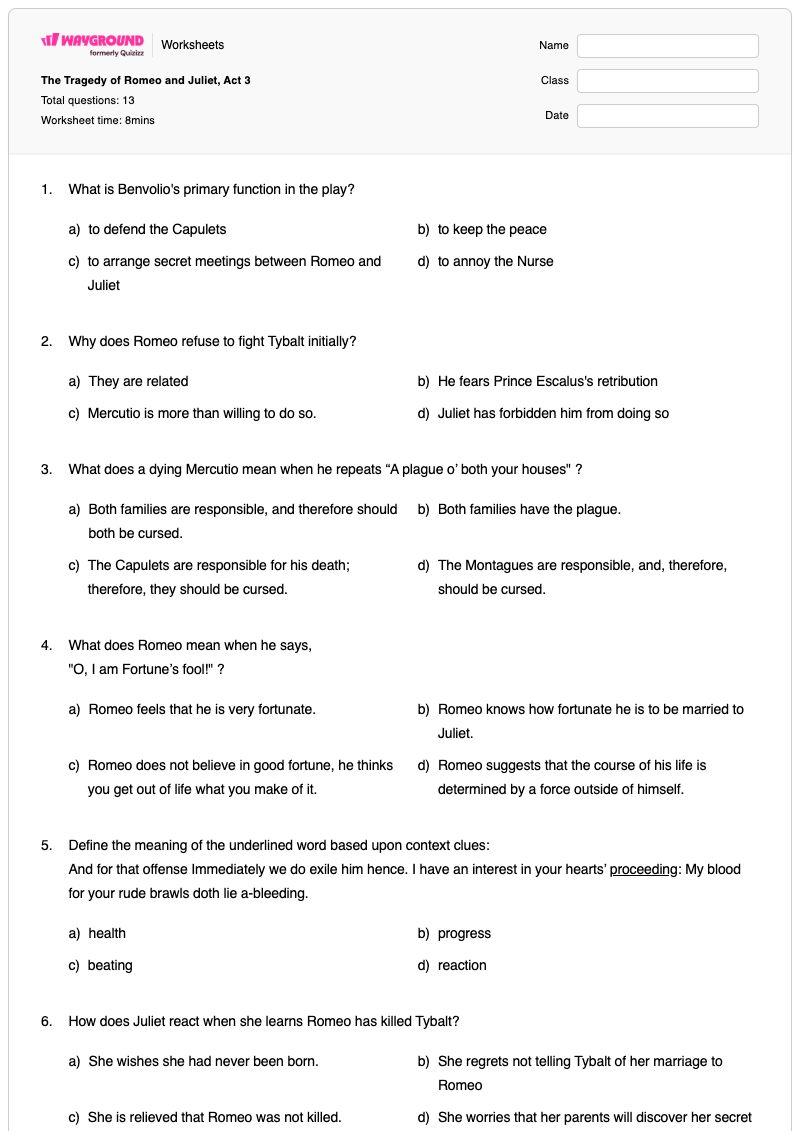
This Grade 9 English worksheet checks students’ understanding of Act 3 of The Tragedy of Romeo and Juliet through 12 multiple-choice questions and one chronological-ordering task. Students examine character roles and motivations, interpret lines such as “A plague o’ both your houses” and “O, I am Fortune’s fool!”, analyze Juliet’s reactions and prophecy, and identify how other characters misunderstand her grief. Four multiple-choice items also build vocabulary skills by asking students to determine the meanings of words such as reaction, tedious, effeminate, fickle, and dishonorable from their dramatic context. The ordering item requires students to sequence key events from Act 3, reinforcing plot development and cause-and-effect relationships. This free printable worksheet is designed for Grade 9 English instruction, review, or assessment and includes a complete answer key.

Worksheet settings

Font size

S
M
L
XL
WaygroundWorksheets

The Tragedy of Romeo and Juliet, Act 3

Total questions: 13

Name
Class
Date
1.

What is Benvolio's primary function in the play?

a)

to defend the Capulets

b)

to keep the peace

c)

to arrange secret meetings between Romeo and Juliet

d)

to annoy the Nurse

2.

Why does Romeo refuse to fight Tybalt initially?

a)

They are related

b)

He fears Prince Escalus's retribution

c)

Mercutio is more than willing to do so.

d)

Juliet has forbidden him from doing so

3.

What does a dying Mercutio mean when he repeats “A plague o’ both your houses" ?

a)

Both families are responsible, and therefore should both be cursed.

b)

Both families have the plague.

c)

The Capulets are responsible for his death; therefore, they should be cursed.

d)

The Montagues are responsible, and, therefore, should be cursed.

4.

What does Romeo mean when he says,

"O, I am Fortune’s fool!" ?

a)

Romeo feels that he is very fortunate.

b)

Romeo knows how fortunate he is to be married to Juliet.

c)

Romeo does not believe in good fortune, he thinks you get out of life what you make of it.

d)

Romeo suggests that the course of his life is determined by a force outside of himself.

5.

Define the meaning of the underlined word based upon context clues:

And for that offense Immediately we do exile him hence. I have an interest in your hearts’ proceeding: My blood for your rude brawls doth lie a-bleeding.

a)

health

b)

progress

c)

beating

d)

reaction

6.

How does Juliet react when she learns Romeo has killed Tybalt?

a)

She wishes she had never been born.

b)

She regrets not telling Tybalt of her marriage to Romeo

c)

She is relieved that Romeo was not killed.

d)

She worries that her parents will discover her secret marriage.

7.

What does Juliet prophesize when Romeo leaves her in Act 3?

a)

She will see Romeo again soon.

b)

They will live together in Verona.

c)

Romeo will be dead the next time she sees him.

d)

Romeo will abandon her for Rosaline.

8.

How do the Capulets account for Juliet's grief?

a)

Lord and Lady Capulet believe the Nurse has upset Juliet.

b)

Lord and Lady Capulet believe Juliet is overwhelmed by their demands on her time.

c)

Lord and Lady Capulet believe Juliet’s endless tears are for her cousin Tybalt, when in fact she cries for Romeo.

d)

Lord and Lady Capulet believe Juliet’s endless tears are for Romeo, when in fact she cries for her cousin Tybalt.

9.

Define the meaning of the underlined word using context clues:

So tedious is this day As is the night before some festival To an impatient child that hath new robes And may not wear them.

a)

extremely unpleasant or offensive

b)

changing often, particularly one's loyalty and affection

c)

having qualities or traits considered to be associated with women

d)

boring, long, and slow

10.

Define the meaning of the underlined word using context clues:

O sweet Juliet, Thy beauty hath made me effeminate And in my temper softened valor’s steel.

a)

extremely unpleasant or offensive

b)

having qualities or traits considered to be associated with women

c)

extremely unpleasant or offensive

d)

boring, long, and slow

11.

Define the meaning of the underlined word using context clues:

O Fortune, Fortune, all men call thee fickle. If thou art fickle, what dost thou with him That is renowned for faith? Be fickle, Fortune, For then I hope thou wilt not keep him long, But send him back.

a)

changing often, particularly one's loyalty and affection

b)

extremely unpleasant or offensive

c)

boring, long, and slow

d)

having qualities or traits considered to be associated with women

12.

Define the meaning of the underlined word using context clues:

O calm, dishonorable, vile submission! Alla stoccato carries it away. Tybalt, you ratcatcher, will you walk?f

a)

boring, long, and slow

b)

having qualities or traits considered to be associated with women

c)

changing often, particularly one's loyalty and affection

d)

extremely unpleasant or offensive

13.

Reorder the following according to chronological sequence in Act 3

a)

Tybalt kills Mercutio

b)

Juliet refuses to marry Paris

c)

Romeo and Juliet spend the night together

d)

Romeo kills Tybalt

1)
2)
3)
4)
WaygroundAnswer Key

The Tragedy of Romeo and Juliet, Act 3

Total questions: 13

1.
b)

to keep the peace

2.
a)

They are related

3.
a)

Both families are responsible, and therefore should both be cursed.

4.
d)

Romeo suggests that the course of his life is determined by a force outside of himself.

5.
d)

reaction

6.
c)

She is relieved that Romeo was not killed.

7.
c)

Romeo will be dead the next time she sees him.

8.
c)

Lord and Lady Capulet believe Juliet’s endless tears are for her cousin Tybalt, when in fact she cries for Romeo.

9.
d)

boring, long, and slow

10.
b)

having qualities or traits considered to be associated with women

11.
a)

changing often, particularly one's loyalty and affection

12.
d)

extremely unpleasant or offensive

13.
a, b, c, d

FAQs

What does this Romeo and Juliet Act 3 worksheet help students learn?

This Grade 9 worksheet builds Act 3 comprehension through 12 multiple-choice questions and one chronological-ordering item. Students interpret character motivations, explain the meaning of key quotations, analyze Juliet’s responses and other characters’ misunderstandings, determine vocabulary meanings from context, and sequence major events in the act.

How can I use this worksheet to teach Act 3 of Romeo and Juliet?

Use the multiple-choice items after students read or discuss Act 3 to revisit why Romeo initially refuses to fight Tybalt, what Mercutio’s curse means, and how Juliet responds to Romeo’s banishment. Ask students to justify each selected answer with a line or event from the play, then have them explain how the ordering task shows the consequences of the conflict between the families.

What mistakes should I watch for when students complete this Act 3 worksheet?

Students may confuse Romeo’s initial refusal to fight Tybalt with fear of punishment instead of recognizing their family relationship, or misread Mercutio’s curse as blaming only one household. They may also confuse the grief the Capulets think Juliet feels with her actual grief for Romeo, overlook context clues in the vocabulary excerpts, or place the Act 3 events out of chronological order.

How do I assign and grade this Romeo and Juliet Act 3 worksheet?

Wayground provides this worksheet as a printable PDF and as a digital quiz, with a complete answer key for the multiple-choice and ordering questions. Teachers can grade printable submissions by scanning student work with the Wayground for Teachers app, while the digital version supports online completion and grading.

How can I differentiate this Romeo and Juliet Act 3 worksheet?

In the worksheet’s Advanced Settings, adjust font spacing or font size to make the quotation-based multiple-choice items and event-ordering task easier to read. You can also apply a dyslexia-friendly font or translate the worksheet into another language while preserving its Act 3 comprehension and contextual-vocabulary format.

Where can I find more worksheets like this on Wayground?

Wayground offers a comprehensive collection of free printable worksheets and practice problems across all subjects, including downloadable PDFs and answer keys to support essential skills and concepts. Browse more resources at https://wayground.com/en-us/worksheets.