
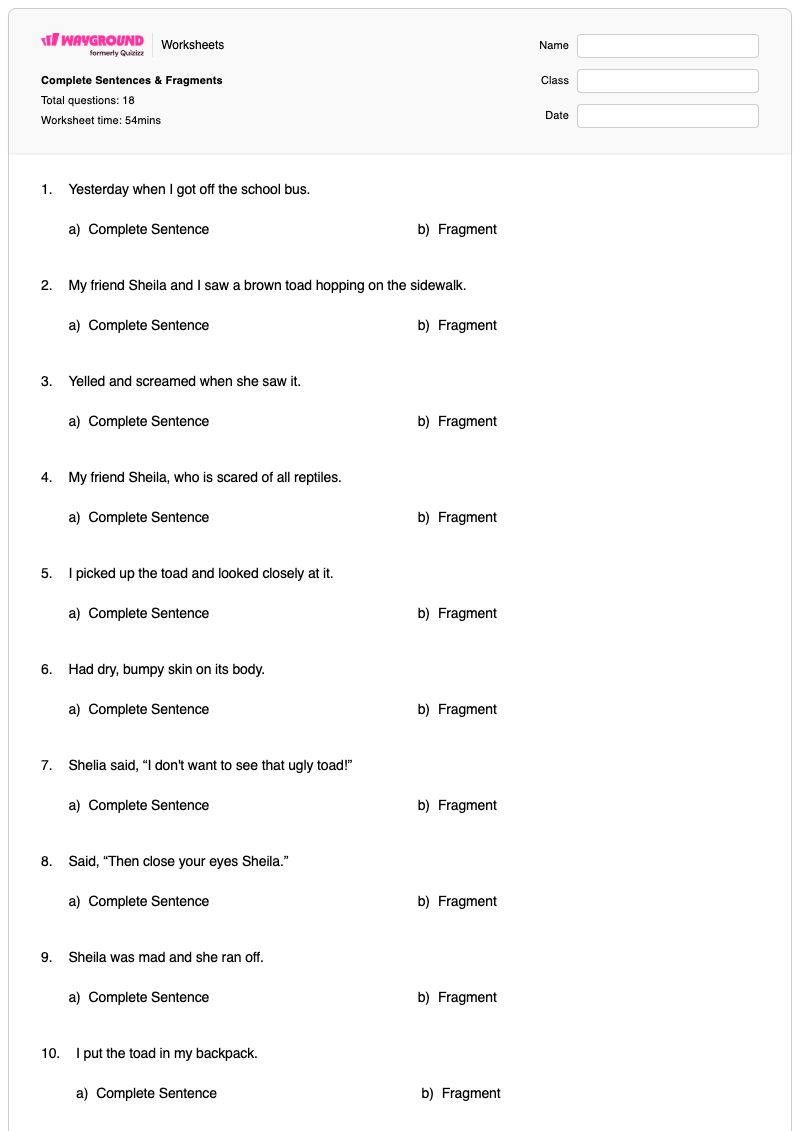

Complete Sentences & Fragments is a Grade 4 English worksheet that helps students decide whether a group of words is a complete sentence or a fragment. Across 18 multiple-choice items, students classify examples drawn from a connected story about a child, a friend named Sheila, and a toad. The sentences include complete thoughts as well as incomplete clauses and phrases such as “Yelled and screamed when she saw it” and “My friend Sheila, who is scared of all reptiles.”
This free printable worksheet gives students focused practice recognizing whether each item communicates a complete idea, an important foundation for editing and writing clear sentences. Teachers can use the answer key to review why an item is complete or incomplete and to identify students who need more practice distinguishing dependent clauses or phrases from complete thoughts. The worksheet is suitable for Grade 4 English instruction, independent practice, homework, or review.
Worksheet settings
Font size
S
M
L
XL
Worksheets
Complete Sentences & Fragments
Total questions: 18
Name
Class
Date
1.
Yesterday when I got off the school bus.
a)
Complete Sentence
b)
Fragment
2.
My friend Sheila and I saw a brown toad hopping on the sidewalk.
a)
Complete Sentence
b)
Fragment
3.
Yelled and screamed when she saw it.
a)
Complete Sentence
b)
Fragment
4.
My friend Sheila, who is scared of all reptiles.
a)
Complete Sentence
b)
Fragment
5.
I picked up the toad and looked closely at it.
a)
Complete Sentence
b)
Fragment
6.
Had dry, bumpy skin on its body.
a)
Complete Sentence
b)
Fragment
7.
Shelia said, “I don't want to see that ugly toad!”
a)
Complete Sentence
b)
Fragment
8.
Said, “Then close your eyes Sheila.”
a)
Complete Sentence
b)
Fragment
9.
Sheila was mad and she ran off.
a)
Complete Sentence
b)
Fragment
10.
I put the toad in my backpack.
a)
Complete Sentence
b)
Fragment
11.
Took it home to show my brother.
a)
Complete Sentence
b)
Fragment
12.
My brother wasn't home from school yet.
a)
Complete Sentence
b)
Fragment
13.
Then I put the backpack on the living room sofa.
a)
Complete Sentence
b)
Fragment
14.
The toad was still inside.
a)
Complete Sentence
b)
Fragment
15.
My mother opened the backpack to see what homework I had.
a)
Complete Senence
b)
Fragment
16.
Hopped out of the backpack and began jumping around the living room floor.
a)
Complete Sentence
b)
Fragment
17.
Screamed loudly!
a)
Complete Sentence
b)
Fragment
18.
Do you think my mother will let me keep the little brown toad?
a)
Complete Sentence
b)
Fragment
Answer Key
Complete Sentences & Fragments
Total questions: 18
1.
b)
Fragment
2.
a)
Complete Sentence
3.
b)
Fragment
4.
b)
Fragment
5.
a)
Complete Sentence
6.
b)
Fragment
7.
a)
Complete Sentence
8.
b)
Fragment
9.
a)
Complete Sentence
10.
a)
Complete Sentence
11.
b)
Fragment
12.
a)
Complete Sentence
13.
a)
Complete Sentence
14.
a)
Complete Sentence
15.
a)
Complete Senence
16.
b)
Fragment
17.
b)
Fragment
18.
a)
Complete Sentence
140 %
Browse by subjects
Browse by grades
Browse by format
FAQs
What does the Complete Sentences & Fragments worksheet cover?
This Grade 4 English worksheet asks students to classify 18 multiple-choice items as either a Complete Sentence or a Fragment. The examples include complete thoughts such as actions involving the child, Sheila, and the toad, along with incomplete clauses and phrases. Completing the classifications helps students recognize whether a group of words communicates a finished idea.
How can I use this worksheet to teach complete sentences and fragments?
Before students begin, have them read each item aloud and ask who or what the sentence is about and what happened. Then use the worksheet’s toad-centered examples to compare a complete thought, such as a statement about picking up the toad, with an incomplete item beginning with a verb such as “Yelled” or “Took.” After students choose an answer, ask them to explain what subject or complete idea is missing from each fragment.
What mistakes should I watch for when students complete this worksheet?
Students may label an item a complete sentence simply because it begins with a capital letter or ends with punctuation. Watch especially for fragments that contain a verb but omit the subject, such as the items beginning “Yelled,” “Had,” “Said,” and “Took,” and for dependent clauses such as “Yesterday when I got off the school bus.” Students may also mistake the clause beginning “My friend Sheila, who...” for a complete thought even though it does not finish the idea.
How do I assign and grade this worksheet?
You can assign Complete Sentences & Fragments as a printable PDF or as a digital quiz on Wayground. It includes a complete answer key for checking the 18 multiple-choice classifications, and printable submissions can be graded by scanning student work with the Wayground for Teachers app. The printable option also supports classrooms that are reducing screen time.
How can I differentiate this sentence-classification worksheet for my students?
In the worksheet’s Advanced Settings, adjust font spacing or choose a larger font size to make the 18 multiple-choice sentence and fragment items easier to read. You can also enable a dyslexia-friendly font or translate the worksheet into another language when those options support access to the sentence-classification task.
Where can I find more worksheets like this on Wayground?
Wayground offers a comprehensive collection of free printable worksheets and practice problems across subjects, with downloadable PDFs and answer keys to help students master essential skills and concepts. Browse more resources at https://wayground.com/en-us/worksheets.