
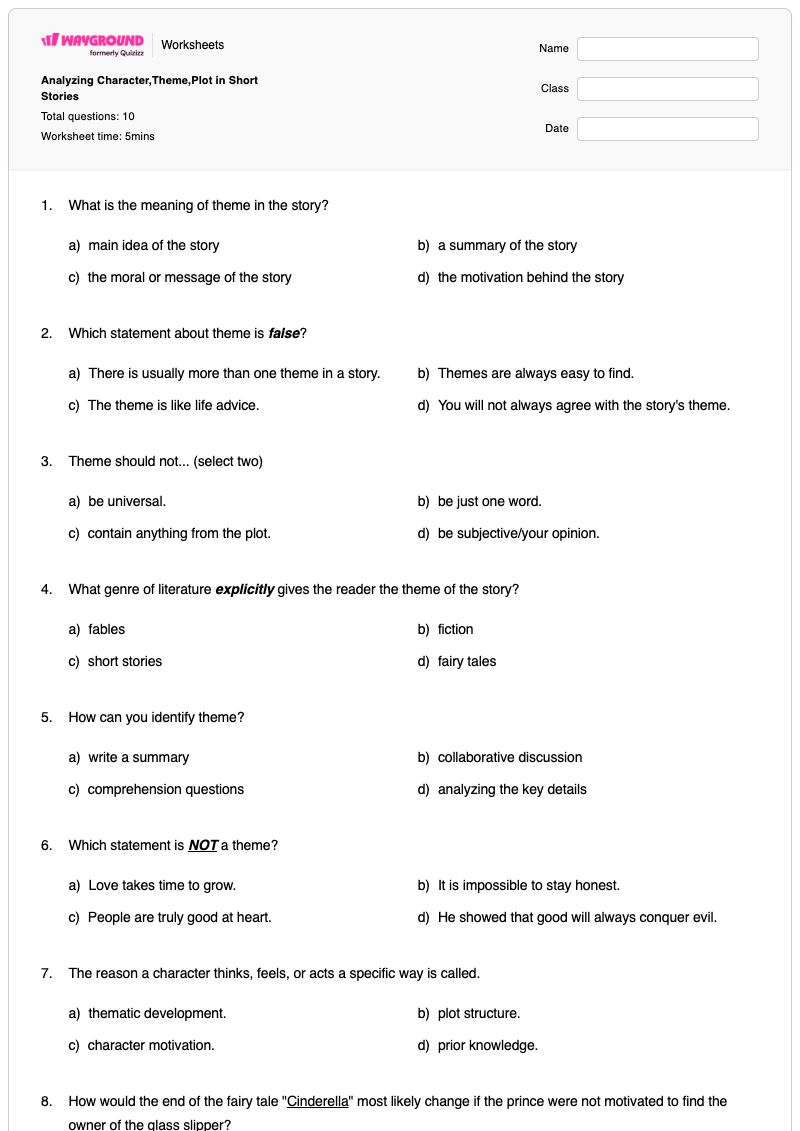

This Grade 8 English worksheet builds students’ ability to analyze theme, character motivation, and plot development in short stories and familiar fairy tales. Across 10 items—9 multiple-choice questions and 1 multiple-select question—students distinguish a story’s moral or message from a summary, recognize that themes should express broader ideas rather than a single word or isolated plot detail, and identify how key details reveal theme.
Students also define character motivation, apply it to a change in Cinderella’s plot, and connect motivation to forward plot movement. A final question asks students to identify the resolution of Sleeping Beauty, reinforcing how stories conclude. This free printable worksheet with a complete answer key is designed for Grade 8 English instruction, guided practice, independent review, or formative assessment. Its varied questions check both literary vocabulary and students’ ability to apply concepts to story events.
Worksheet settings
Font size
S
M
L
XL
Worksheets
Analyzing Character,Theme,Plot in Short Stories
Total questions: 10
Name
Class
Date
1.
What is the meaning of theme in the story?
a)
main idea of the story
b)
a summary of the story
c)
the moral or message of the story
d)
the motivation behind the story
2.
Which statement about theme is false?
a)
There is usually more than one theme in a story.
b)
Themes are always easy to find.
c)
The theme is like life advice.
d)
You will not always agree with the story's theme.
3.
Theme should not... (select two)
a)
be universal.
b)
be just one word.
c)
contain anything from the plot.
d)
be subjective/your opinion.
4.
What genre of literature explicitly gives the reader the theme of the story?
a)
fables
b)
fiction
c)
short stories
d)
fairy tales
5.
How can you identify theme?
a)
write a summary
b)
collaborative discussion
c)
comprehension questions
d)
analyzing the key details
6.
Which statement is NOTa theme?
a)
Love takes time to grow.
b)
It is impossible to stay honest.
c)
People are truly good at heart.
d)
He showed that good will always conquer evil.
7.
The reason a character thinks, feels, or acts a specific way is called.
a)
thematic development.
b)
plot structure.
c)
character motivation.
d)
prior knowledge.
8.
How would the end of the fairy tale "Cinderella" most likely change if the prince were not motivated to find the owner of the glass slipper?
a)
The prince would marry one of Cinderella’s sisters.
b)
Cinderella would continue to live a miserable life.
c)
The prince would become impoverished, like Cinderella.
d)
Cinderella would ask her stepmother to find the prince.
9.
How does character motivation affect a story's plot?
a)
It clarifies the theme of the plot.
b)
It offers inferences about the plot.
c)
It determines the plot elements.
d)
It helps move the plot forward.
10.
Which statement best describes the resolution of "Sleeping Beauty"?
a)
Aurora turns 16.
b)
The prince rescues Aurora.
c)
The Queen throws herself into the pit of reptiles.
d)
Maleficent casts a spell.
Answer Key
Analyzing Character,Theme,Plot in Short Stories
Total questions: 10
1.
c)
the moral or message of the story
2.
b)
Themes are always easy to find.
3.
b)
be just one word.
, c)
contain anything from the plot.
4.
a)
fables
5.
d)
analyzing the key details
6.
d)
He showed that good will always conquer evil.
7.
c)
character motivation.
8.
b)
Cinderella would continue to live a miserable life.
9.
d)
It helps move the plot forward.
10.
c)
The Queen throws herself into the pit of reptiles.
140 %
Browse by subjects
Browse by grades
Browse by format
FAQs
What does this worksheet cover about theme, character, and plot?
This Grade 8 worksheet uses 9 multiple-choice questions and 1 multiple-select question to assess how students identify a story’s moral or message, analyze key details, and distinguish a theme from a summary or plot statement. It also builds understanding of character motivation and asks students to apply it to Cinderella’s plot, then identify the resolution of Sleeping Beauty.
How can I use this worksheet to teach theme and character motivation?
Introduce theme as a story’s broader moral or message, then have students examine how key details support that idea rather than simply summarizing events. Before students complete the Cinderella items, discuss what motivates the prince and how removing that motivation changes the plot; use the Sleeping Beauty question afterward to connect plot development with resolution.
What mistakes should I watch for when students complete this worksheet?
Students may choose a one-word topic, a summary, or a specific plot statement as the theme instead of expressing a broader message supported by story details. They may also confuse character motivation with a plot element, overlook that motivation moves the plot forward, or select an earlier event rather than the resolution in the Sleeping Beauty question.
How do I assign and grade this worksheet?
This worksheet is available as a printable PDF and as a digital quiz on Wayground, and it includes a complete answer key for the 10 questions. You can grade printable submissions by scanning student work with the Wayground for Teachers app, while the digital version supports online completion and grading.
How can I differentiate this theme and plot analysis worksheet for my students?
In the worksheet’s Advanced Settings, adjust font spacing or font size to make the multiple-choice and multiple-select items easier to read. You can also apply a dyslexia-friendly font or translate the worksheet into another language when those file-level options support access to the theme, motivation, and resolution questions.
Where can I find more free worksheets like this on Wayground?
Wayground offers a comprehensive collection of free printable worksheets and practice problems across subjects, with downloadable PDFs and answer keys to help students master essential skills and concepts. Browse more resources at https://wayground.com/en-us/worksheets.