

Wayground
States of Matter Quiz - Printable Science Worksheets class 6 - Wayground

States of Matter Quiz

15 questions

6th - 6th Grade

Science

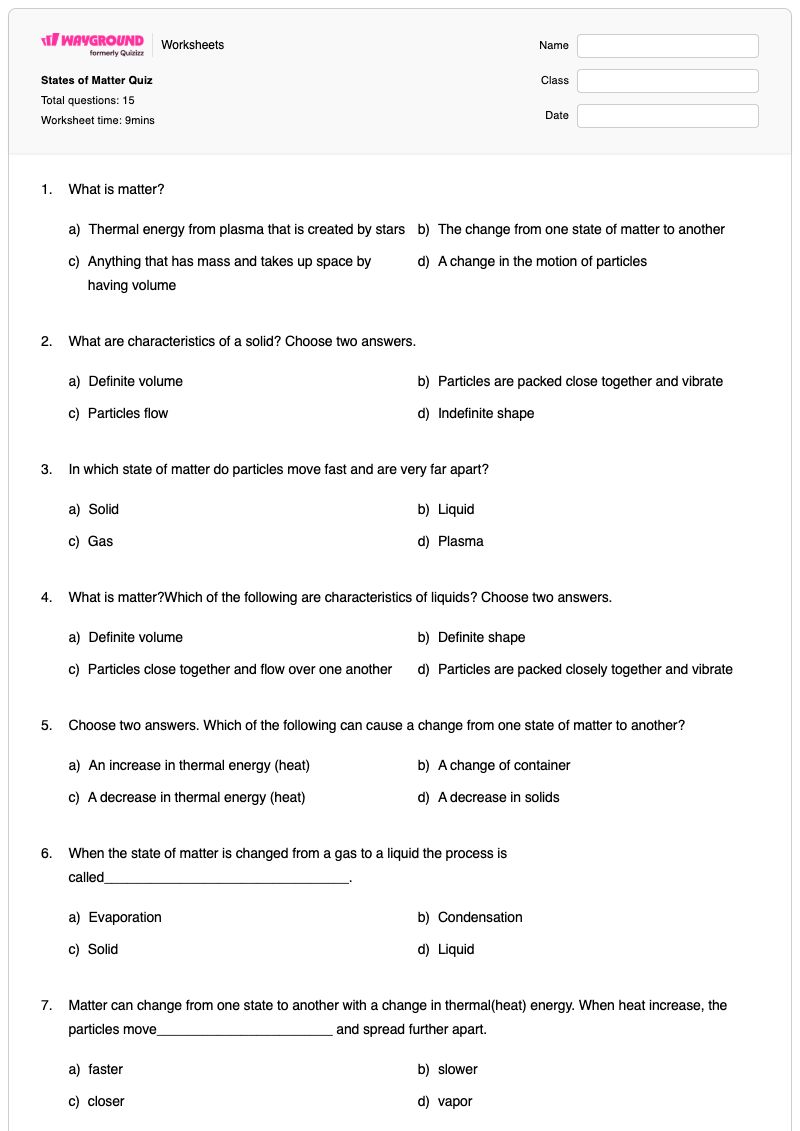
States of Matter Quiz is a Grade 6 science worksheet that checks students’ understanding of what matter is and how solids, liquids, gases, and plasma differ. It includes 15 questions: 11 multiple-choice items and 4 multiple-select items. Students identify properties such as shape, volume, particle spacing, particle motion, and plasma’s electrical charge, selecting two correct characteristics when required. The worksheet also connects thermal energy to changes of state. Students identify condensation, vaporization, freezing, and sublimation; explain how particle motion changes when matter gains or loses heat; and apply these ideas to situations such as disappearing puddles, seasonal ice, and a balloon placed in a freezer. This free printable worksheet includes a complete answer key for efficient review, independent practice, or assessment.

Worksheet settings

Font size

S
M
L
XL
Worksheets

States of Matter Quiz

Total questions: 15

Name
Class
Date
1.

What is matter?

a)

Thermal energy from plasma that is created by stars

b)

The change from one state of matter to another

c)

Anything that has mass and takes up space by having volume

d)

A change in the motion of particles

2.

What are characteristics of a solid? Choose two answers.

a)

Definite volume

b)

Particles are packed close together and vibrate

c)

Particles flow

d)

Indefinite shape

3.

In which state of matter do particles move fast and are very far apart?

a)

Solid

b)

Liquid

c)

Gas

d)

Plasma

4.

What is matter?Which of the following are characteristics of liquids? Choose two answers.

a)

Definite volume

b)

Definite shape

c)

Particles close together and flow over one another

d)

Particles are packed closely together and vibrate

5.

Choose two answers. Which of the following can cause a change from one state of matter to another?

a)

An increase in thermal energy (heat)

b)

A change of container

c)

A decrease in thermal energy (heat)

d)

A decrease in solids

6.

When the state of matter is changed from a gas to a liquid the process is called________________________________.

a)

Evaporation

b)

Condensation

c)

Solid

d)

Liquid

7.

Matter can change from one state to another with a change in thermal(heat) energy. When heat increase, the particles move_______________________ and spread further apart.

a)

faster

b)

slower

c)

closer

d)

vapor

8.

What happens to the motion of the particles when going from a solid to a liquid?

a)

The motion of the particles decreases(moves slower).

b)

The motion of the particles increases (moves faster).

c)

The motion stops.

d)

The motion decreases and increases.

9.

What happens to the motion of particles when freezing occurs?

a)

The motion of the particles decreases(move slower).

b)

The motion of the particles stops.

c)

The motion of the particles freezes.

d)

The motion of the particles increases(move faster).

10.

What is a characteristic of plasma and not gas?

a)

Particles packed closely together

b)

Indefinite volume

c)

Indefinite shape

d)

Electrical charge

11.

What are the characteristics of plasma? Pick two answers.

a)

Indefinite shape

b)

Indefinite volume

c)

Expands to fill its container

d)

Definite shape

12.

After a heavy rainstorm puddles form on the ground. After a couple of hours on a hot day, the puddles disappear. What happened to the puddles?

a)

The puddles froze into water vapor.

b)

The puddles condensed into ice.

c)

The puddles vaporized into water vapor.

d)

The puddles stayed the same and did not change in size.

13.

In the phase of sublimation a solid state changes to a gas state of matter. What happens to the motion of the particles?

a)

The motion of the particles increases.

b)

The motion of the particles decreases.

c)

The motion of the particles stays the same.

d)

There is a decrease in motion and then an increase.

14.

During winter, Mike and his friends can sometimes ice skate on the lake. Why can't they ice skate on the lake during other seasons?

a)

The lake does not have plasma which keeps people from ice skating there.

b)

The lake may have fish and prevent people from ice skating there.

c)

The lake is not a solid, which keeps people from being able to ice skate there.

d)

The lake does not have enough water, which keeps people from ice skating there.

15.

Placing a balloon in a freezer will cause the balloon to expand.

a)

True

b)

False

Answer Key

States of Matter Quiz

Total questions: 15

1.
c)

Anything that has mass and takes up space by having volume

2.
a)

Definite volume

, b)

Particles are packed close together and vibrate

3.
c)

Gas

4.
a)

Definite volume

, c)

Particles close together and flow over one another

5.
a)

An increase in thermal energy (heat)

, c)

A decrease in thermal energy (heat)

6.
b)

Condensation

7.
a)

faster

8.
b)

The motion of the particles increases (moves faster).

9.
a)

The motion of the particles decreases(move slower).

10.
d)

Electrical charge

11.
a)

Indefinite shape

, b)

Indefinite volume

12.
c)

The puddles vaporized into water vapor.

13.
a)

The motion of the particles increases.

14.
c)

The lake is not a solid, which keeps people from being able to ice skate there.

15.
b)

False

FAQs

What does the States of Matter Quiz help students learn?

This Grade 6 science worksheet helps students classify solids, liquids, gases, and plasma by their shape, volume, particle arrangement, motion, and other properties. Its 11 multiple-choice and 4 multiple-select questions also require students to connect thermal energy with condensation, vaporization, freezing, and sublimation, including changes in particle motion.

How can I use this worksheet to teach states of matter and phase changes?

Introduce the worksheet by having students describe how particles are arranged and move in a solid, liquid, gas, and plasma. Then use the multiple-select items to have pairs justify why two characteristics fit solids or liquids, and discuss the phase-change scenarios involving puddles, ice, and sublimation before students complete the quiz independently.

What mistakes should I watch for when students complete this states of matter quiz?

Watch for students choosing a definite shape for liquids, treating gas particles as close together, or confusing plasma’s electrical charge with a property shared by gases. Students may also reverse condensation and vaporization, overlook that heating increases particle motion while freezing decreases it, or select fewer or more than two answers on the multiple-select questions.

How do I assign and grade the States of Matter Quiz?

The worksheet is available as a printable PDF and as a digital quiz on Wayground, and it includes a complete answer key for all 15 questions. You can grade printable submissions by scanning student work with the **Wayground for Teachers** app, while the digital version supports online completion and grading.

How can I differentiate this states of matter worksheet for my students?

Under the worksheet’s Advanced Settings, adjust font spacing or font size to make the particle descriptions, phase-change scenarios, and answer choices easier to read. You can also apply a dyslexia-friendly font or translate the worksheet into another language while keeping its multiple-choice and multiple-select format.

Where can I find more worksheets like this on Wayground?

Wayground offers a comprehensive collection of free printable worksheets and practice problems across all subjects, with downloadable PDFs and answer keys to support essential skills and concepts. Browse more resources at https://wayground.com/en-us/worksheets.