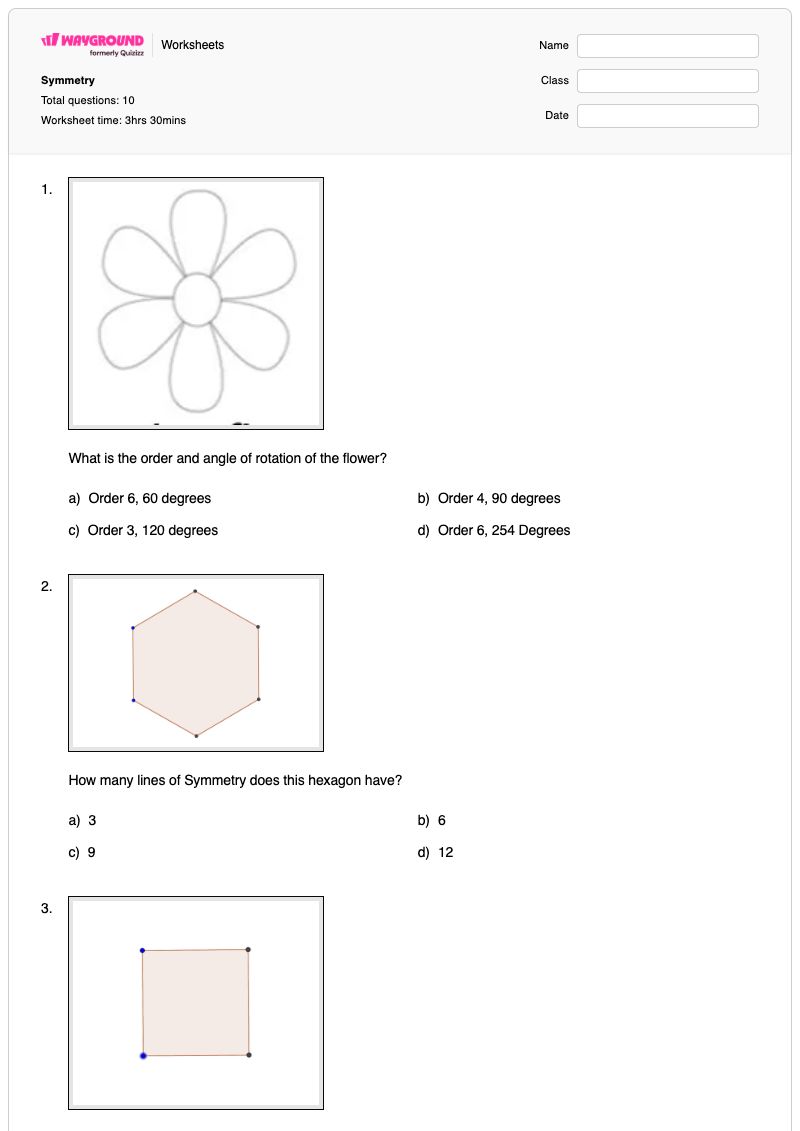
This Grade 9 mathematics worksheet develops students’ understanding of line symmetry and rotational symmetry through 10 visual and vocabulary-based questions. Students identify the number of lines of symmetry in figures, determine whether shapes and letters have line or rotational symmetry, and recognize terms such as line of symmetry and order of symmetry.
The worksheet also asks students to connect rotational order with the smallest angle that maps a figure onto itself, including examples involving flowers, squares, hexagons, rectangles, and other figures. With nine multiple-choice questions and one multiple-select question, it gives students focused practice distinguishing symmetry types and stating both the order and angle of rotation when required. This free printable worksheet is suitable for Grade 9 math practice, review, or formative assessment and includes an answer key.
Worksheet settings
Font size
S
M
L
XL
Worksheets
Symmetry
Total questions: 10
Name
Class
Date
1.
What is the order and angle of rotation of the flower?
a)
Order 6, 60 degrees
b)
Order 4, 90 degrees
c)
Order 3, 120 degrees
d)
Order 6, 254 Degrees
2.
How many lines of Symmetry does this hexagon have?
a)
3
b)
6
c)
9
d)
12
3.
What are the angles of rotation for a square?
a)
multiples of 30
b)
multiples of 45
c)
multiples of 90
d)
multiples of 180
4.
How many lines of symmetry does this shape have?
a)
1
b)
2
c)
3
d)
4
5.
Which of the following letters does not have a line symmetry, but has a rotational symmetry:
a)
H
b)
I
c)
Z
d)
X
6.
A rectangle has ...
a)
line symmetry
b)
rotational symmetry
c)
both line and rotaional symmetry
d)
neither line nor rotational symmetry
7.
Identify the smallest angle of rotation that maps the image to itself.
a)
60°
b)
None
c)
51.4°
d)
45°
8.
State whether the figure has rotational symmetry. Write yes or no. If so, state the order and magnitude of symmetry.
a)
Yes
b)
No
c)
order is 4, magnitude of symmetry is 90°
d)
order is 8, magnitude of symmetry is 45°
9.
The number of times a figure maps onto itself as it rotates from 0° to 360° is called the ____.
a)
line symmetry
b)
magnitude of symmetry
c)
rotational symmetry
d)
order of symmetry
10.
If a figure is folded across a straight line and the halves match exactly, the fold line is called the ____.
a)
line of reflection
b)
glide reflection
c)
line of symmetry
d)
axis of symmetry
Answer Key
Symmetry
Total questions: 10
1.
a) Order 6, 60 degrees
2.
b) 6
3.
c) multiples of 90
4.
a) 1
5.
c) Z
6.
c) both line and rotaional symmetry
7.
c) 51.4°
8.
a)
Yes
, d)
order is 8, magnitude of symmetry is 45°
9.
d)
order of symmetry
10.
c)
line of symmetry
140 %
Browse by subjects
Browse by grades
Browse by format
FAQs
What does this symmetry worksheet help Grade 9 students learn?
This worksheet helps students distinguish line symmetry from rotational symmetry and identify the order and smallest angle of rotation for figures. Across nine multiple-choice items and one multiple-select item, students count lines of symmetry, classify shapes and letters, apply the relationship between rotational order and angle, and use key symmetry vocabulary.
How can I use this worksheet to teach line and rotational symmetry?
Introduce the worksheet by having students test whether a figure can be folded into matching halves, then compare that idea with rotating a figure until it maps onto itself. As students work through the flower, hexagon, square, rectangle, and letter examples, ask them to explain how they found the number of lines or the smallest rotation angle. Use the final multiple-select item to reinforce that a rotational-symmetry response may require both the presence of symmetry and its order and angle.
What mistakes should I watch for when students complete this symmetry worksheet?
Students may confuse the order of rotational symmetry with the angle of rotation, or choose the order without calculating the smallest angle that maps a figure onto itself. They may also treat line symmetry and rotational symmetry as the same property, particularly when classifying letters and rectangles. In the multiple-select question, check that students select both “Yes” and the correct order-and-angle statement rather than selecting only the existence of rotational symmetry.
How do I assign and grade this symmetry worksheet?
This symmetry worksheet is available as a printable PDF and as a digital quiz on Wayground, and it includes a complete answer key. Assign the PDF for paper practice or use the digital version for online responses; printable submissions can be graded by scanning student work with the Wayground for Teachers app.
How can I differentiate this symmetry worksheet for my students?
Use the worksheet’s Advanced Settings to adjust font spacing or choose a larger font size so the symmetry figures, answer choices, and terminology are easier to read. You can also enable a dyslexia-friendly font or translate the worksheet into another language while students practise identifying lines of symmetry and rotational order.
Where can I find more worksheets like this on Wayground?
Wayground offers a comprehensive collection of free printable worksheets and practice problems across subjects, with downloadable PDFs and answer keys to support essential skills and concepts. Browse more resources at https://wayground.com/en-us/worksheets.

 Worksheets


