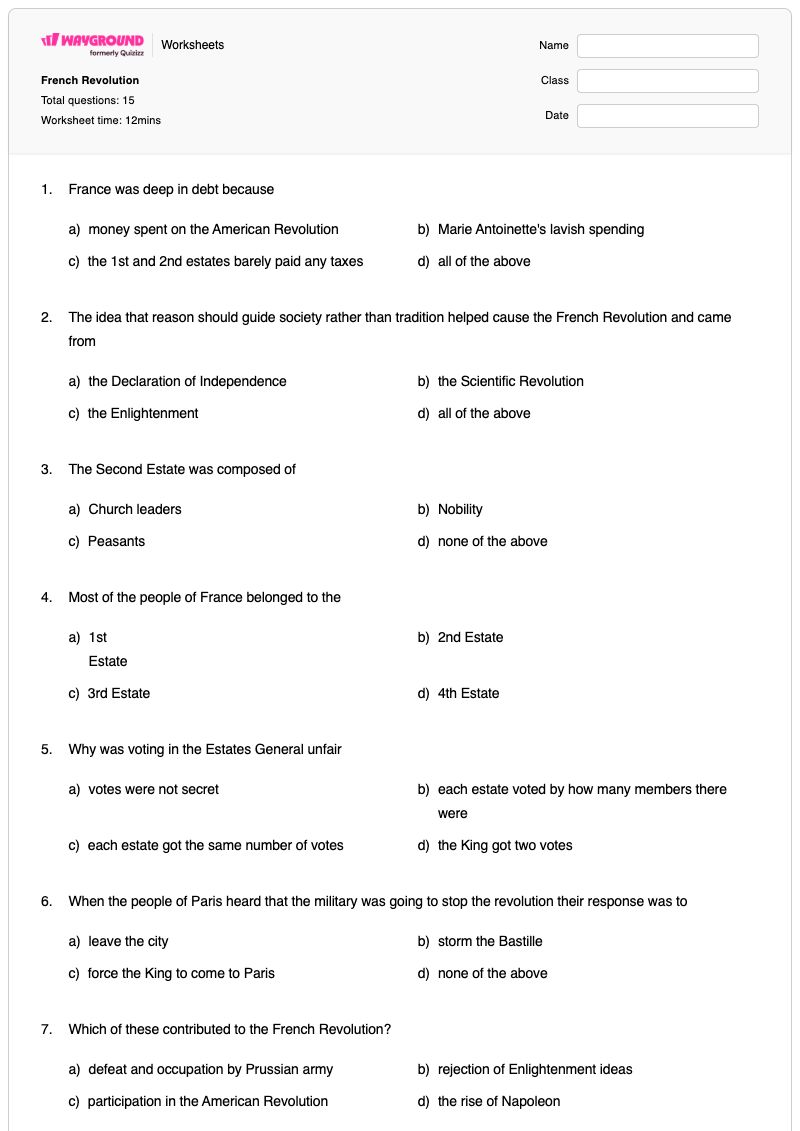
This Grade 9 history worksheet helps students review the causes, key groups, documents, and early events of the French Revolution. Its 15 multiple-choice questions ask students to identify why France was in debt, distinguish the First, Second, and Third Estates, recognize the influence of Enlightenment ideas, and explain why the Estates General voting system was unfair. Students also identify the storming of the Bastille, the Declaration of the Rights of Man and the Citizen, the Tennis Court Oath, the National Assembly’s constitutional goal, and Louis XVI.
Use this free printable worksheet to check whether students can connect economic inequality, unequal taxation, political representation, and Enlightenment influence to the revolution’s beginnings. The answer key supports quick review of factual knowledge and helps teachers identify whether students are confusing people, estates, documents, and events. It is suitable for a Grade 9 World History lesson, review activity, homework assignment, or formative assessment, and it includes a complete answer key.
Worksheet settings
Font size
S
M
L
XL
Worksheets
French Revolution
Total questions: 15
Name
Class
Date
1.
France was deep in debt because
a)
money spent on the American Revolution
b)
Marie Antoinette's lavish spending
c)
the 1st and 2nd estates barely paid any taxes
d)
all of the above
2.
The idea that reason should guide society rather than tradition helped cause the French Revolution and came from
a)
the Declaration of Independence
b)
the Scientific Revolution
c)
the Enlightenment
d)
all of the above
3.
The Second Estate was composed of
a)
Church leaders
b)
Nobility
c)
Peasants
d)
none of the above
4.
Most of the people of France belonged to the
a)
1st Estate
b)
2nd Estate
c)
3rd Estate
d)
4th Estate
5.
Why was voting in the Estates General unfair
a)
votes were not secret
b)
each estate voted by how many members there were
c)
each estate got the same number of votes
d)
the King got two votes
6.
When the people of Paris heard that the military was going to stop the revolution their response was to
a)
leave the city
b)
storm the Bastille
c)
force the King to come to Paris
d)
none of the above
7.
Which of these contributed to the French Revolution?
a)
defeat and occupation by Prussian army
b)
rejection of Enlightenment ideas
c)
participation in the American Revolution
d)
the rise of Napoleon
8.
Which of the following was an underlying, or deep-rooted, cause of the French Revolution?
a)
unequal tax burdens
b)
equal land ownership
c)
a law granting peasants more freedom
d)
a growing French empire
9.
This document was important in creating the French constitution and declaring its citizens equal.
a)
Declaration of Rights of Man and the Citizen
b)
Declaration of Sentiments
c)
Declaration of French Independence
d)
Declaration of Citizen and Rights
10.
When the Third Estate was locked out of the Estates General, they pledged never to disband until a new constitution was created. This event is known as:
a)
Women's March on Versailles
b)
Reign of Terror
c)
The Great Fear
d)
Tennis Court Oath
11.
Who belonged to the First Estate?
a)
nobles
b)
clergy
c)
peasants
d)
royalty
12.
The king of France during the French Revolution:
a)
Napoleon
b)
Leoverture
c)
Louis XVI
d)
Robespierre
13.
What did the National Assembly promise to do in the Tennis Court Oath?
a)
To execute the king
b)
To write a new constitution
c)
To stage a Coup d'etat
d)
To make France independent
14.
The French Revolution was inspired by _______________ thinkers.
a)
Scientific Revolution
b)
Clergy
c)
Enlightenment
d)
Revolutionary
15.
Which estate paid the majority of the taxes in France prior to the French Revolution?
a)
1st Estate
b)
2nd Estate
c)
3rd Estate
Answer Key
French Revolution
Total questions: 15
1.
d)
all of the above
2.
c)
the Enlightenment
3.
b) Nobility
4.
c) 3rd Estate
5.
c) each estate got the same number of votes
6.
b) storm the Bastille
7.
c) participation in the American Revolution
8.
a) unequal tax burdens
9.
a)
Declaration of Rights of Man and the Citizen
10.
d) Tennis Court Oath
11.
b) clergy
12.
c) Louis XVI
13.
b) To write a new constitution
14.
c) Enlightenment
15.
c)
3rd Estate
140 %
Browse by subjects
Browse by grades
Browse by format
FAQs
What does this French Revolution worksheet cover, and how does it help students learn the topic?
This Grade 9 worksheet uses 15 multiple-choice questions to assess students’ understanding of the French Revolution’s causes, the three estates, Enlightenment influence, and early events. Students identify details such as unequal tax burdens, the Third Estate’s role, the Estates General voting problem, the storming of the Bastille, the Tennis Court Oath, and the Declaration of the Rights of Man and the Citizen. Completing the set helps students connect specific people, groups, documents, and events to the revolution’s beginnings.
How can I use this worksheet to teach the causes and early events of the French Revolution?
Introduce the topic by having students organize the worksheet’s ideas into causes, social groups, documents, and events. Before students answer independently, review the First Estate as the clergy, the Second Estate as the nobility, and the Third Estate as most of the population and the main taxpayer. Afterward, discuss how Enlightenment ideas and unequal representation relate to the Tennis Court Oath and the storming of the Bastille.
What mistakes should I watch for when students complete this French Revolution worksheet?
Watch for students who confuse the First, Second, and Third Estates, especially identifying nobles as the First Estate or overlooking that the Third Estate paid most of the taxes. Students may also select the Scientific Revolution instead of the Enlightenment when asked about reason guiding society, or confuse the Tennis Court Oath with the storming of the Bastille. Review whether they can distinguish a cause, such as participation in the American Revolution or unequal taxation, from a later event or person.
How do I assign and grade this French Revolution worksheet?
The worksheet is available as a printable PDF and as a digital quiz on Wayground, with a complete answer key for all 15 multiple-choice questions. Assign the digital version for online responses, or print the PDF for handwritten work and grade submissions by scanning student work with the Wayground for Teachers app. The printable option can also support schools that are reducing screen time.
How can I differentiate this French Revolution multiple-choice worksheet for my students?
Use the worksheet’s Advanced Settings to adjust font spacing or increase the font size so the 15 multiple-choice questions and answer choices are easier to read. You can also apply a dyslexia-friendly font or translate the worksheet into another language when that supports access to the questions about the estates, Enlightenment ideas, and revolutionary events.
Where can I find more worksheets like this on Wayground?
Wayground offers a broad collection of free printable worksheets and practice problems across subjects, with downloadable PDFs and answer keys to help students master essential skills and concepts. Browse more resources at https://wayground.com/en-us/worksheets.

 Worksheets