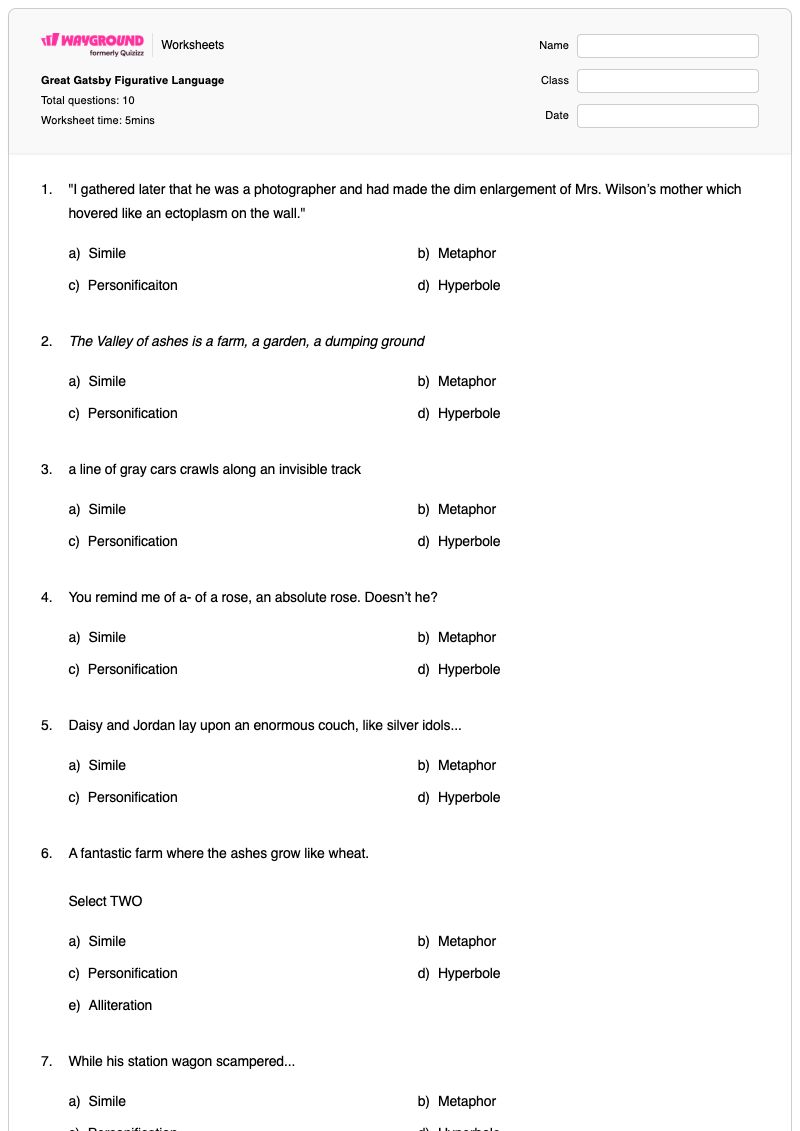
Great Gatsby Figurative Language is a Grade 11 English worksheet that helps students identify figurative language in excerpts from F. Scott Fitzgerald’s novel. Students classify nine quotations as simile, metaphor, personification, or hyperbole, then complete one multiple-select item that requires them to identify both simile and alliteration. Examples include the comparison involving an ectoplasm, the metaphor describing the Valley of Ashes, and personification applied to cars, a station wagon, and houses.
This worksheet strengthens close reading by requiring students to distinguish how Fitzgerald uses comparison, exaggeration, human actions, and sound patterns in literary language. It works well for independent practice, guided analysis, or a quick formative assessment after introducing figurative language in The Great Gatsby. The resource is a free printable worksheet with a complete answer key, making it easy to review why each classification fits the quoted passage.
Worksheet settings
Font size
S
M
L
XL
Worksheets
Great Gatsby Figurative Language
Total questions: 10
Name
Class
Date
1.
"I gathered later that he was a photographer and had made the dim enlargement of Mrs. Wilson’s mother which hovered like an ectoplasm on the wall."
a)
Simile
b)
Metaphor
c)
Personificaiton
d)
Hyperbole
2.
The Valley of ashes is a farm, a garden, a dumping ground
a)
Simile
b)
Metaphor
c)
Personification
d)
Hyperbole
3.
a line of gray cars crawls along an invisible track
a)
Simile
b)
Metaphor
c)
Personification
d)
Hyperbole
4.
You remind me of a- of a rose, an absolute rose. Doesn’t he?
a)
Simile
b)
Metaphor
c)
Personification
d)
Hyperbole
5.
Daisy and Jordan lay upon an enormous couch, like silver idols...
a)
Simile
b)
Metaphor
c)
Personification
d)
Hyperbole
6.
A fantastic farm where the ashes grow like wheat.
Select TWO
a)
Simile
b)
Metaphor
c)
Personification
d)
Hyperbole
e)
Alliteration
7.
While his station wagon scampered...
a)
Simile
b)
Metaphor
c)
Personification
d)
Hyperbole
8.
And only let me leave it in the soap dish when she saw that it was coming to pieces like snow
a)
Simile
b)
Metaphor
c)
Personification
d)
Hyperbole
9.
The next day was broiling
a)
Simile
b)
Metaphor
c)
Personification
d)
Hyperbole
10.
And as the moon rose higher the inessential houses began to melt away until gradually.
a)
Simile
b)
Metaphor
c)
Personification
d)
Hyperbole
Answer Key
Great Gatsby Figurative Language
Total questions: 10
1.
a)
Simile
2.
b)
Metaphor
3.
c)
Personification
4.
b)
Metaphor
5.
a)
Simile
6.
e)
Alliteration
, a)
Simile
7.
c)
Personification
8.
a)
Simile
9.
d)
Hyperbole
10.
c)
Personification
140 %
Browse by subjects
Browse by grades
Browse by format
FAQs
What does this Great Gatsby figurative language worksheet cover?
This Grade 11 English worksheet uses 10 excerpts from The Great Gatsby to assess figurative-language identification: nine multiple-choice questions cover simile, metaphor, personification, and hyperbole, while one multiple-select question asks students to identify simile and alliteration together. Classifying lines such as the comparison to an ectoplasm, the Valley of Ashes metaphor, and the station wagon that scampered helps students connect literary devices to Fitzgerald’s wording.
How can I use this worksheet to teach figurative language in The Great Gatsby?
Introduce the four primary answer categories by modeling one excerpt, such as the line containing like an ectoplasm, and ask students what language signals a comparison. Then have students explain why phrases such as cars that crawl or a station wagon that scampered fit personification, before assigning the remaining items independently or in pairs. Use the multiple-select farm excerpt to discuss how one quotation can contain more than one device, including alliteration.
What mistakes should I watch for on this Great Gatsby figurative language worksheet?
Students may confuse similes and metaphors, especially when a comparison is stated directly rather than introduced with like or as, as in the rose comparison. They may also label any vivid expression as hyperbole instead of examining the device used, or overlook that the farm excerpt requires two selections: simile and alliteration. Remind students to read the entire quoted line before choosing a category.
How do I assign and grade this Great Gatsby worksheet?
The worksheet is available as a printable PDF and as a digital quiz on Wayground, so you can use the nine multiple-choice items and one multiple-select item for independent practice or assessment. It includes a complete answer key for grading, and printable submissions can be graded by scanning student work with the Wayground for Teachers app. The printable format also supports classrooms that are reducing screen time.
How can I differentiate this figurative language worksheet for my students?
In the worksheet’s Advanced Settings, adjust font spacing or choose a larger font size to make the short literary excerpts and answer choices easier to track. You can also enable a dyslexia-friendly font or translate the worksheet into another language while keeping the simile, metaphor, personification, hyperbole, and alliteration questions in the same format.
Where can I find more free worksheets like this on Wayground?
Wayground offers a comprehensive collection of free printable worksheets and practice problems across subjects, with downloadable PDFs and answer keys to support mastery of essential skills and concepts. Browse more resources at https://wayground.com/en-us/worksheets.

 Worksheets