

Wayground
Human Effects on the Environment - Printable Social Studies Worksheets class 3 - Wayground

Human Effects on the Environment

17 questions

3rd - 3rd Grade

Social Studies

Human Effects on the Environment is a Grade 3 social studies worksheet that builds understanding of how people affect natural resources, habitats, agriculture, cities, and wildlife. Students identify and define deforestation, urbanization, crop rotation, pollution, and environment, then distinguish helpful and harmful human actions, such as using renewable resources, clearing land for food, and finding clean water. The 17-item worksheet combines 13 multiple-choice questions, two multiple-select questions, and two open-ended prompts. Students identify causes of oil spills, recognize crop-rotation benefits, explain how oil spills affect wildlife, and connect everyday needs with environmental changes such as landfills, farming, paper production, and clean-water sources. This free printable worksheet includes a complete answer key for classroom practice, review, or assessment.

Worksheet settings

Font size

S
M
L
XL
Worksheets

Human Effects on the Environment

Total questions: 17

Name
Class
Date
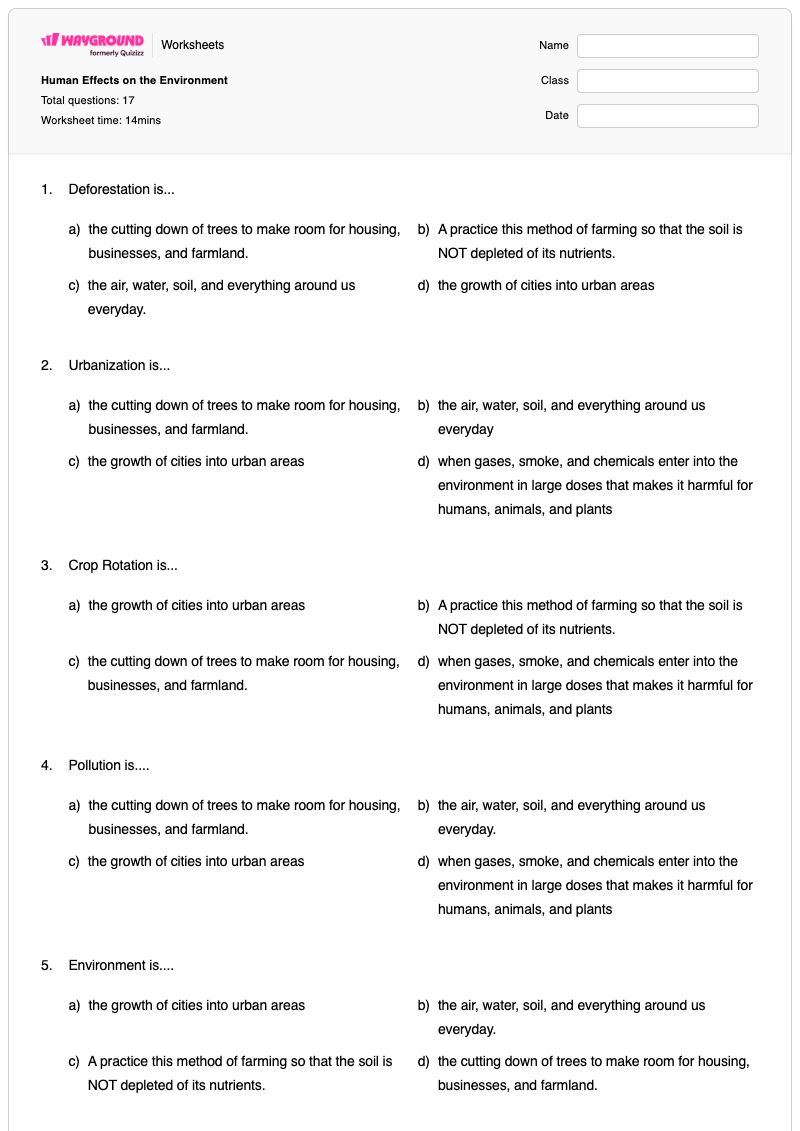
1.

Deforestation is...

a)

the cutting down of trees to make room for housing, businesses, and farmland.

b)

A practice this method of farming so that the soil is NOT depleted of its nutrients.

c)

the air, water, soil, and everything around us everyday.

d)

the growth of cities into urban areas

2.

Urbanization is...

a)

the cutting down of trees to make room for housing, businesses, and farmland.

b)

the air, water, soil, and everything around us everyday

c)

the growth of cities into urban areas

d)

when gases, smoke, and chemicals enter into the environment in large doses that makes it harmful for humans, animals, and plants

3.

Crop Rotation is...

a)

the growth of cities into urban areas

b)

A practice this method of farming so that the soil is NOT depleted of its nutrients.

c)

the cutting down of trees to make room for housing, businesses, and farmland.

d)

when gases, smoke, and chemicals enter into the environment in large doses that makes it harmful for humans, animals, and plants

4.

Pollution is....

a)

the cutting down of trees to make room for housing, businesses, and farmland.

b)

the air, water, soil, and everything around us everyday.

c)

the growth of cities into urban areas

d)

when gases, smoke, and chemicals enter into the environment in large doses that makes it harmful for humans, animals, and plants

5.

Environment is....

a)

the growth of cities into urban areas

b)

the air, water, soil, and everything around us everyday.

c)

A practice this method of farming so that the soil is NOT depleted of its nutrients.

d)

the cutting down of trees to make room for housing, businesses, and farmland.

6.

Deforestation does NOT help animal and plant habitats thrive and grow.

a)

True

b)

False

7.

Which of the following is NOT a benefit of crop rotation?

a)

Reduces pests

b)

replenishes nutrients in soil

c)

Use of chemicals on crops

d)

crops are more colorful

8.

Which of the following IS a cause of oil spills? (3 correct answers)

a)

Oil rigs have leaks in their pipes

b)

High tides flood the oil rig

c)

Natural disasters like hurricanes and tornadoes

d)

An oil tanker leaks oil into the ocean or gulf

9.

Humans can have a positive impact on the environment by:

a)

generating waste products as a result of technological advances

b)

using resources that are renewable

c)

increasing planting large areas of one crop

d)

increasing the use of pesticides

10.

How can you clean an oil spill?

4 lines
11.

How are oil spills bad for wildlife?

4 lines
12.

Which of these encouraged urbanization? (2 correct answers)

a)

New inventions

b)

adventure and excitement

c)

bad weather

d)

no jobs

13.

In order to take a bath you need....

a)

Landfills must be dug to store trash and waste items

b)

Land must be cleared so vegetables can cold morning be grown.

c)

Trees must be cut down to make paper.

d)

Sources of clean water must keep being found.

14.

In order to eat dinner...

a)

Landfills must be dug to store trash and waste items

b)

Land must be cleared so vegetables can cold morning be grown.

c)

Trees must be cut down to make paper.

d)

Sources of clean water must keep being found.

15.

In order to take out the trash...

a)

Landfills must be dug to store trash and waste items

b)

Land must be cleared so vegetables can cold morning be grown.

c)

Trees must be cut down to make paper.

d)

Sources of clean water must keep being found.

16.

What is an oil boom?

a)

device for recovering spilled oil from the water's surface

b)

temporary floating barrier used to contain an oil spill

17.

What is a skimmer?

a)

device for recovering spilled oil from the water's surface

b)

temporary floating barrier used to contain an oil spill

Answer Key

Human Effects on the Environment

Total questions: 17

1.
a)

the cutting down of trees to make room for housing, businesses, and farmland.

2.
c)

the growth of cities into urban areas

3.
b)

A practice this method of farming so that the soil is NOT depleted of its nutrients.

4.
d)

when gases, smoke, and chemicals enter into the environment in large doses that makes it harmful for humans, animals, and plants

5.
b)

the air, water, soil, and everything around us everyday.

6.
a)

True

7.
c)

Use of chemicals on crops

8.
a)

Oil rigs have leaks in their pipes

, c)

Natural disasters like hurricanes and tornadoes

, d)

An oil tanker leaks oil into the ocean or gulf

9.
b)

using resources that are renewable

10.
n/a
11.
n/a
12.
a)

New inventions

, b)

adventure and excitement

13.
d)

Sources of clean water must keep being found.

14.
b)

Land must be cleared so vegetables can cold morning be grown.

15.
a)

Landfills must be dug to store trash and waste items

16.
b)

temporary floating barrier used to contain an oil spill

17.
a)

device for recovering spilled oil from the water's surface

FAQs

What does the Human Effects on the Environment worksheet cover?

This Grade 3 social studies worksheet asks students to identify key terms including deforestation, urbanization, crop rotation, pollution, and environment. Its 17 items use multiple-choice, multiple-select, and open-ended formats to help students distinguish positive and harmful human impacts, identify oil-spill causes, and connect everyday needs with resources such as clean water, farmland, trees, and landfills.

How can I use this worksheet to teach human effects on the environment?

Introduce the vocabulary by having students compare the definition choices for deforestation, urbanization, crop rotation, pollution, and environment. Then use the oil-spill and everyday-needs questions to discuss cause and effect: ask students to explain how human activities support daily life while also affecting land, water, plants, animals, and habitats. Finish with the open-ended oil-spill prompts so students apply the terms in their own explanations.

What mistakes should I watch for when students complete this environment worksheet?

Students may confuse deforestation with urbanization, or pollution with the broader term environment, because the multiple-choice items place these definitions together. Watch for students selecting every possible oil-spill cause instead of the three supported causes, or treating a crop-rotation benefit such as replenishing soil nutrients as a harmful effect. In the everyday-needs items, students may also overlook the resource connection—for example, clean water is needed for bathing, while land clearing supports growing vegetables.

How do I assign and grade this Human Effects on the Environment worksheet?

You can assign it as a printable PDF or as a digital quiz on Wayground. The worksheet includes a complete answer key for the multiple-choice and multiple-select items, while the two open-ended responses can be reviewed for students’ explanations of cleaning oil spills and effects on wildlife. For printable submissions, scan student work with the Wayground for Teachers app to support grading.

How can I differentiate this environment worksheet for my students?

Use the worksheet’s Advanced Settings to adjust font spacing and font size so the environmental vocabulary and answer choices are easier to read. You can also apply a dyslexia-friendly font or translate the worksheet into another language, which may support access to terms such as deforestation, urbanization, and crop rotation.

Where can I find more worksheets like this on Wayground?

Wayground offers a comprehensive collection of free printable worksheets and practice problems across subjects, with downloadable PDFs and answer keys to help students master essential skills and concepts. Browse more resources at https://wayground.com/en-us/worksheets.