

Wayground
Four Types of Sentences - Printable ELA Worksheets 7th Grade - Wayground

Four Types of Sentences

Traci Robinson

Created by Traci Robinson

20 questions

7th Grade

ELA

Updated Oct 2026

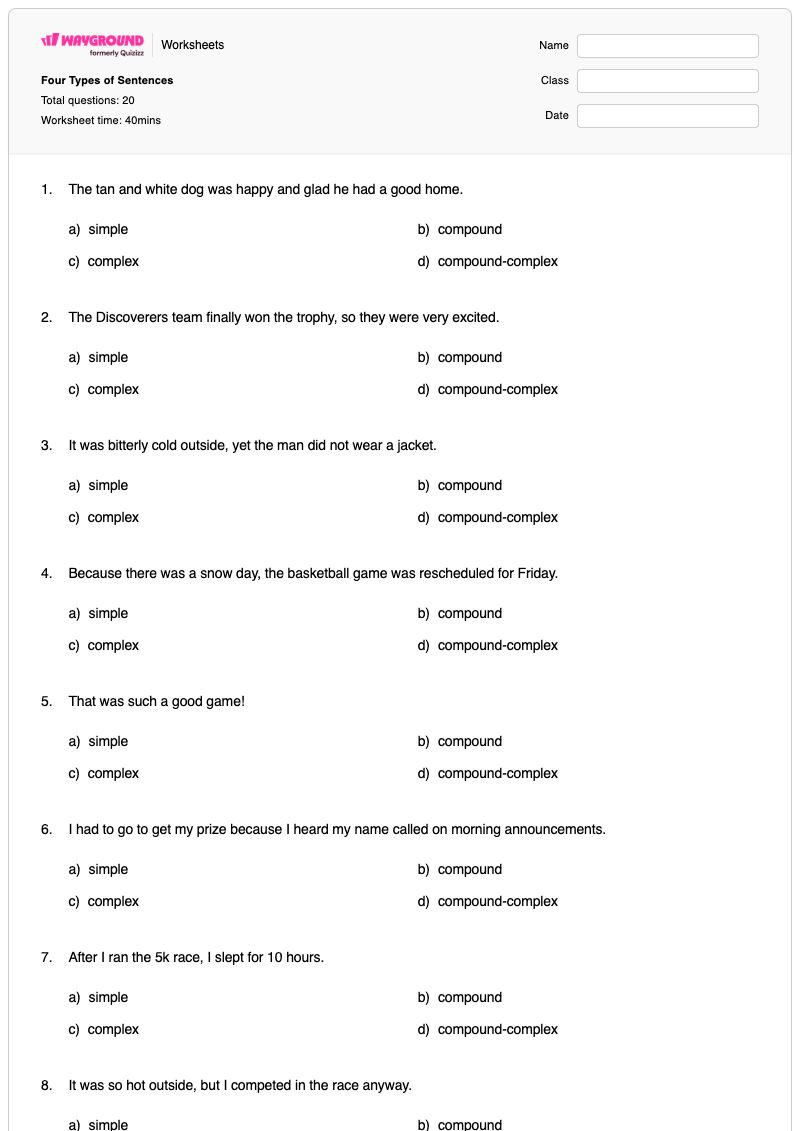
Four Types of Sentences is a free Grade 7 English worksheet with 20 multiple-choice questions that asks students to classify sentences as simple, compound, complex, or compound-complex. The examples include coordinating conjunctions such as “so,” “yet,” and “but,” as well as dependent-clause markers such as “because,” “after,” “although,” and “if,” giving students practice analyzing sentence structure rather than relying on sentence length alone. Students build fluency in identifying independent and dependent clauses and distinguishing sentences with one clause from those with coordinated or subordinated ideas. The worksheet also includes more challenging examples with relative clauses and multiple clause relationships, helping students recognize compound-complex structures in context. It is suitable for Grade 7 English instruction, guided practice, independent review, or formative assessment, and includes a complete answer key for efficient checking.

Worksheet settings

Font size

S
M
L
XL
WaygroundWorksheets

Four Types of Sentences

Total questions: 20

Name
Class
Date
1.

The tan and white dog was happy and glad he had a good home.

a)

simple

b)

compound

c)

complex

d)

compound-complex

2.

The Discoverers team finally won the trophy, so they were very excited.

a)

simple

b)

compound

c)

complex

d)

compound-complex

3.

It was bitterly cold outside, yet the man did not wear a jacket.

a)

simple

b)

compound

c)

complex

d)

compound-complex

4.

Because there was a snow day, the basketball game was rescheduled for Friday.

a)

simple

b)

compound

c)

complex

d)

compound-complex

5.

That was such a good game!

a)

simple

b)

compound

c)

complex

d)

compound-complex

6.

I had to go to get my prize because I heard my name called on morning announcements.

a)

simple

b)

compound

c)

complex

d)

compound-complex

7.

After I ran the 5k race, I slept for 10 hours.

a)

simple

b)

compound

c)

complex

d)

compound-complex

8.

It was so hot outside, but I competed in the race anyway.

a)

simple

b)

compound

c)

complex

d)

compound-complex

9.

Although the sea turtle was tired, she walked to the shore of the Atlantic Ocean.

a)

simple

b)

compound

c)

complex

d)

compound-complex

10.

We had time to talk to the guidance counselor, but she wasn't in her office.

a)

simple

b)

compound

c)

complex

d)

compound-complex

11.

I enjoy playing basketball, but I also like to play golf when I have spare time.

a)

simple

b)

compound

c)

complex

d)

compound-complex

12.

The maple leaf, which is Canada's national emblem, has been associated with the country since the 1700s.

a)

simple

b)

compound

c)

complex

d)

compound-complex

13.

If we can't find an inexpensive hotel for the Fourth of July weekend, we can always stay with my parents.

a)

simple

b)

compound

c)

complex

d)

compound-complex

14.

As cold weather approaches, you must protect your water pipes against freezing, or they can rupture and cause significant damage to your home.

a)

simple

b)

compound

c)

complex

d)

compound-complex

15.

During last night's thunderstorm, a flurry of tiny hailstones danced across the roof of our house.

a)

simple

b)

compound

c)

complex

d)

compound-complex

16.

Blake took several incredible panoramic photographs of the sweeping view from the top of Table Mountain.

a)

simple

b)

compound

c)

complex

d)

compound-complex

17.

As Tucker sat down on the rickety old chair, it abruptly collapsed beneath him.

a)

simple

b)

compound

c)

complex

d)

compound-complex

18.

After a parrotfish eats algae-covered coral, the coral travels through the fish's digestive system, and then it is deposited in the reef as white coral sand.

a)

simple

b)

compound

c)

complex

d)

compound-complex

19.
The largest area of rain forest is the Amazon rain forest in the Amazon River basin. 
a)
simple
b)
compound
c)
complex
d)
compound-complex
20.
David wanted a camera, and he was determined to buy one when he had the money.  
a)
simple
b)
compound
c)
complex
d)
compound-complex
WaygroundAnswer Key

Four Types of Sentences

Total questions: 20

1.
a)

simple

2.
b)

compound

3.
b)

compound

4.
c)

complex

5.
a)

simple

6.
c)

complex

7.
c)

complex

8.
b)

compound

9.
c)

complex

10.
b)

compound

11.
d)

compound-complex

12.
c)

complex

13.
c)

complex

14.
d)

compound-complex

15.
a)

simple

16.
a)

simple

17.
c)

complex

18.
d)

compound-complex

19.
a) simple
20.
d) compound-complex

FAQs

What does the Four Types of Sentences worksheet cover?

This Grade 7 worksheet uses 20 multiple-choice items to have students classify sentences as simple, compound, complex, or compound-complex. Students examine clause relationships, coordinating conjunctions, and subordinating words such as “because,” “although,” “after,” and “if,” building the ability to identify sentence structure in complete examples.

How can I use this worksheet to teach the four types of sentences?

First review how independent and dependent clauses function, then model one item by marking the clauses and the word connecting them. Have students explain why examples beginning with “because,” “after,” or “although” are complex, and why a sentence joining two independent ideas with “but” or “so” is compound. Use the compound-complex examples as a final step after students can identify each clause type separately.

What mistakes should I watch for when students complete this sentence-types worksheet?

Students may label a sentence simple because it is short, or mistake multiple adjectives—such as “tan and white” or “happy and glad”—for multiple clauses. They may also confuse compound and complex sentences by treating a subordinating word such as “because” or “although” like a coordinating conjunction. Watch especially for compound-complex items in which students notice only one clause relationship and overlook the additional independent or dependent clause.

How do I assign and grade this Four Types of Sentences worksheet?

The worksheet is available as a printable PDF and as a digital quiz on Wayground, and it includes a complete answer key for all 20 sentence-classification questions. You can grade printable submissions by scanning student work with the Wayground for Teachers app, or review responses from the digital quiz. The printable format also supports classrooms that are reducing screen time.

How can I differentiate this sentence-classification worksheet for my students?

In the worksheet’s Advanced Settings, adjust font spacing or choose a larger font size so the sentence examples and four answer choices are easier to read. You can also enable a dyslexia-friendly font for the classification items or translate the worksheet into another language when language access supports comprehension of the sentence structures.

Where can I find more worksheets like this on Wayground?

Wayground offers a comprehensive collection of free printable worksheets and practice problems across all subjects, with downloadable PDFs and answer keys to support essential skills and concepts. Browse more resources at https://wayground.com/en-us/worksheets.