

Wayground
Identifying Types of Sentences - Printable ELA Worksheets 4th Grade - Wayground

Identifying Types of Sentences

BELINDA CANCINO

Created by BELINDA CANCINO

28 questions

4th Grade

ELA

Updated Sep 2025

Identifying Types of Sentences is a Grade 4 English worksheet that helps students distinguish among comma splices, run-on sentences, and sentence fragments. Its 28 multiple-choice questions also ask students to classify underlined word groups as dependent or independent clauses, connecting sentence-error identification with clause structure. Students examine sentence examples involving missing punctuation, incorrectly joined independent clauses, incomplete phrases, and dependent-clause openings before selecting the correct label. This free printable worksheet supports independent practice, review, or a quick formative check of sentence recognition skills. It includes a complete answer key for efficient teacher feedback and grading.

Worksheet settings

Font size

S
M
L
XL
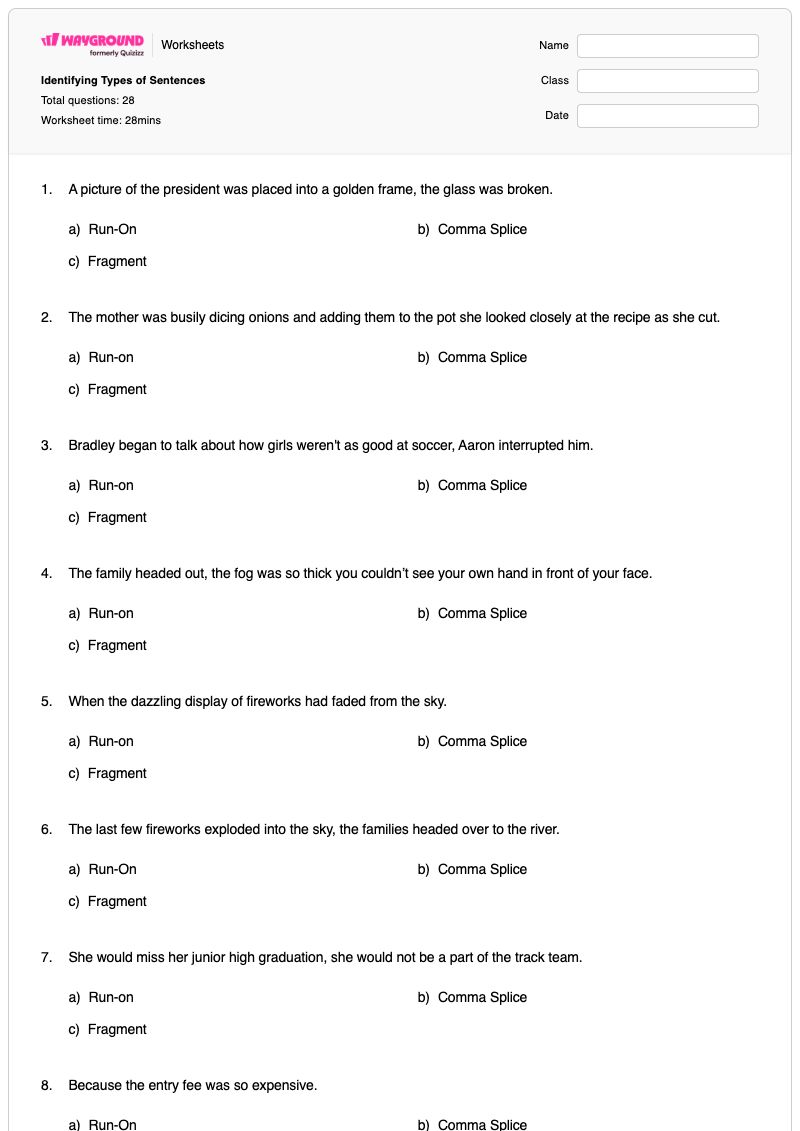
WaygroundWorksheets

Identifying Types of Sentences

Total questions: 28

Name
Class
Date
1.

A picture of the president was placed into a golden frame, the glass was broken.

a)

Run-On

b)

Comma Splice

c)

Fragment

2.

The mother was busily dicing onions and adding them to the pot she looked closely at the recipe as she cut.

a)

Run-on

b)

Comma Splice

c)

Fragment

3.

Bradley began to talk about how girls weren't as good at soccer, Aaron interrupted him.

a)

Run-on

b)

Comma Splice

c)

Fragment

4.

The family headed out, the fog was so thick you couldn’t see your own hand in front of your face.

a)

Run-on

b)

Comma Splice

c)

Fragment

5.

When the dazzling display of fireworks had faded from the sky.

a)

Run-on

b)

Comma Splice

c)

Fragment

6.

The last few fireworks exploded into the sky, the families headed over to the river.

a)

Run-On

b)

Comma Splice

c)

Fragment

7.

She would miss her junior high graduation, she would not be a part of the track team.

a)

Run-on

b)

Comma Splice

c)

Fragment

8.

Because the entry fee was so expensive.

a)

Run-On

b)

Comma Splice

c)

Fragment

9.

The bright yellow room of the schoolhouse nursery.

a)

Run-On

b)

Comma Splice

c)

Fragment

10.
Should be able to visit.
a)
Correct
b)
Comma Splice
c)
Fragment
d)
Fused
11.
I rode my bike over the glass, I got a flat tire.
a)
Fragment
b)
Comma Splice
c)
Fused
d)
Correct
12.
She runs two kilometres every day, she is very healthy.
a)
Fused
b)
Correct
c)
Fragment
d)
Comma Splice
13.

Are the underlined group of words a dependent clause or an independent clause?

When we arrived at the campground, the rain had stopped.

a)

dependent clause

b)

independent clause

14.

Are the underlined group of words a dependent clause or an independent clause?

After we ate our supper, we went for a hike.

a)

dependent clause

b)

independent clause

15.

Are the underlined group of words a dependent clause or an independent clause?

We hiked until the sun set.

a)

dependent clause

b)

independent clause

16.

Are the underlined group of words a dependent clause or an independent clause?

I would run if I saw a bear.

a)

dependent clause

b)

independent clause

17.

Are the underlined group of words a dependent clause or an independent clause?

Before we went to bed, we lit a campfire.

a)

dependent clause

b)

independent clause

18.

Are the underlined group of words a dependent clause or an independent clause?

Although we started late, we hiked fifteen miles.

a)

dependent clause

b)

independent clause

19.

Are the underlined group of words a dependent clause or an independent clause?

As we slowly moved away, the bear looked up.

a)

dependent clause

b)

independent clause

20.

Are the underlined group of words a dependent clause or an independent clause?

Before we left the campground, we saw two more bears.

a)

dependent clause

b)

independent clause

21.

Lilly ran away seven times in one morning.

a)

Simple

b)

Compund

c)

Complex

22.

When no one was looking, Lilly had her own ideas.

a)

Simple

b)

Compound

c)

Complex

23.

When you're done with your homework, you may go play outside.

a)

Complex Sentence

b)

Comma Splice

24.

He finished his homework, he went to play outside.

a)

Complex Sentence

b)

Comma Splice

25.

She loves pizza very much, she ate five slices.

a)

Complex Sentence

b)

Comma Splice

26.

Because she loves pizza so much, she ate five slices.

a)

Complex Sentence

b)

Comma Splice

27.

She loves pizza so much she ate five slices.

a)

Complete Sentence

b)

Run-on

28.

She wants to go to the movies she doesn't have any money.

a)

Complete Sentence

b)

Run-on

WaygroundAnswer Key

Identifying Types of Sentences

Total questions: 28

1.
b)

Comma Splice

2.
a)

Run-on

3.
b)

Comma Splice

4.
b)

Comma Splice

5.
c)

Fragment

6.
b)

Comma Splice

7.
b)

Comma Splice

8.
c)

Fragment

9.
c)

Fragment

10.
c) Fragment
11.
b) Comma Splice
12.
d) Comma Splice
13.
a)

dependent clause

14.
b)

independent clause

15.
a)

dependent clause

16.
b)

independent clause

17.
a)

dependent clause

18.
a)

dependent clause

19.
b)

independent clause

20.
a)

dependent clause

21.
a)

Simple

22.
c)

Complex

23.
a)

Complex Sentence

24.
b)

Comma Splice

25.
b)

Comma Splice

26.
a)

Complex Sentence

27.
b)

Run-on

28.
b)

Run-on

FAQs

What does the Identifying Types of Sentences worksheet cover?

This Grade 4 English worksheet uses 28 multiple-choice items to help students identify comma splices, run-on sentences, and fragments, then distinguish dependent clauses from independent clauses. Students analyze whether sentences are incorrectly joined, incomplete, or grammatically complete, building the recognition skills needed to revise sentence errors accurately.

How can I use this worksheet to teach sentence types and clause structure?

Introduce the worksheet by modeling how to locate complete thoughts on both sides of punctuation and how dependent-clause starters such as “when,” “after,” and “because” affect sentence completeness. Work through one comma splice, one run-on, and one fragment together, then have students explain why each example fits its label before completing the multiple-choice items independently.

What mistakes should I watch for when students complete this worksheet?

Students may confuse a comma splice with a run-on sentence because both incorrectly join complete thoughts; prompt them to inspect whether the clauses are joined only by a comma or have no joining punctuation at all. They may also label a dependent clause as a fragment without recognizing its clause role, or mistake a phrase such as “The bright yellow room of the schoolhouse nursery” for a complete sentence.

How do I assign and grade this Identifying Types of Sentences worksheet?

Wayground provides this worksheet as a printable PDF and as a digital quiz, and both versions include a complete answer key for its 28 multiple-choice questions. You can grade printable submissions by scanning student work with the Wayground for Teachers app, while the digital quiz supports online completion and grading.

How can I differentiate this worksheet for my students?

Use the worksheet’s Advanced Settings to adjust font spacing and font size so the 28 multiple-choice items are easier to navigate, or enable a dyslexia-friendly font for students who benefit from that presentation. You can also translate the sentence-classification questions and clause-identification items into another language while keeping the original practice focus.

Where can I find more worksheets like this on Wayground?

Wayground offers a broad collection of free printable worksheets and practice problems across subjects, with downloadable PDFs and answer keys to support essential skills and concepts. Browse more resources at https://wayground.com/en-us/worksheets.