This Grade 7–10 mathematics worksheet builds skill in finding the volume of rectangular prisms, cubes, and cylinders. Its 14 questions include 12 multiple-choice items and 2 math-response prompts, requiring students to calculate volume, select an equation for a cylindrical container, compare cylinder volumes, round a cylinder measurement, and enter numeric answers for prism and cube problems.
The worksheet also applies volume reasoning to real-world contexts, including a rectangular hay bale and a cylindrical bale whose mass is determined from density. Students practice choosing the correct measurements, using appropriate volume relationships, interpreting cubic units, and connecting volume to a practical quantity. This free printable worksheet includes a complete answer key and is suitable for guided practice, independent work, review, or assessment.
Worksheet settings
Font size
S
M
L
XL
Worksheets
Volume of prism+cylinder
Total questions: 14
Name
Class
Date
1.
Calculate the Volume
a)
84 cm3
b)
420 cm3
c)
402 cm3
d)
60 cm3
2.
Volume is the amount of space an object takes up.
a)
True
b)
False
3.
Calculate the volume.
a)
576 ft3
b)
23 ft3
c)
288 ft3
4.
a)
44 yd3
b)
165 yd3
c)
22 yd3
d)
330 yd3
5.
What is the volume of this cube ?
a)
81 cubic units
b)
27 cubic units
c)
9 cubic units
d)
72 cubic units
6.
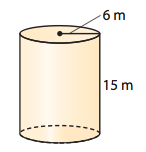
What is the volume of this cylinder?
a)
4239 m3
b)
1695.6 m3
c)
282.6 m3
d)
565.2 m3
7.
Which cylinder has the greater volume?
a)
Cylinder A
b)
Cylinder B
8.
What is the volume of this cylinder?
a)
157 cm3
b)
62.8 cm3
c)
31.4 cm3
9.
The container has a diameter of 3 inches and a height of 30 inches. Which equation can be used to find the volume of the container?
a)
V=π(3)2
b)
V=π(3)2(30)
c)
V=π(1.5)2(30)
d)
V=π(30)2(3)
10.
What is the volume a 2 string bale of hay with dimensions 14" high by 18" wide by 35" long ?
a)
252 in3
b)
8820 in3
c)
23738.4 in3
11.
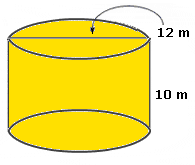
What is the volume of this cylinder rounded to n
a)
1130.97 m3
b)
4523.89 m3
c)
3769.91 m3
12.
What is the volume of this rectangular prism?
Numeric answer only, no units please
13.
What is the volume of this cube?
Numeric answer only, no units
14.
This round bale has a diameter of 6' and a height of 5'. How much does this bale weigh if the density of the hay is 11 pounds per cubic foot?
a)
6217.2 lbs
b)
565.2 lbs
c)
141.3 lbs
d)
1554.3 lbs
Answer Key
Volume of prism+cylinder
Total questions: 14
1.
b)
420 cm3
2.
a) True
3.
c)
288 ft3
4.
d) 330 yd3
5.
b)
27 cubic units
6.
b)
1695.6 m3
7.
a) Cylinder A
8.
b)
62.8 cm3
9.
c)
V=π(1.5)2(30)
10.
b)
8820 in3
11.
a)
1130.97 m3
12.
24
13.
64
14.
d)
1554.3 lbs
140 %
Browse by subjects
Browse by grades
Browse by format
FAQs
What does this volume of prisms and cylinders worksheet cover?
This worksheet provides 12 multiple-choice questions and 2 math-response prompts on calculating the volume of rectangular prisms, cubes, and cylinders. Students also select a suitable volume equation, compare cylinder volumes, round a cylinder result, and apply volume to hay-bale and density problems, building accuracy with both computation and real-world applications.
How can I use this worksheet to teach volume of prisms and cylinders?
Introduce the worksheet by reviewing how dimensions identify a rectangular prism, cube, or cylinder and by distinguishing a cylinder’s diameter from its radius. Model one calculation and one equation-selection item, then have students explain which measurements and formula they used before completing the remaining multiple-choice and numeric-response questions. Use the hay-bale items to discuss how volume can support practical calculations involving density.
What mistakes should I watch for when students complete this volume worksheet?
Watch for students using a cylinder’s diameter where the radius is required, confusing area with volume, or multiplying the wrong dimensions in the prism and cube items. Students may also choose an equation without identifying the given measurements, omit rounding when requested, or enter a math-response answer with units even though those prompts request numbers only. In the density problem, check that students connect the calculated cylindrical volume to the stated density rather than treating the volume as the final weight.
How do I assign and grade this volume worksheet?
On Wayground, assign the worksheet as a printable PDF or as a digital quiz. It includes a complete answer key for the multiple-choice and math-response items, and printable submissions can be graded by scanning student work with the Wayground for Teachers app. The printable format can also support schools that are reducing screen time.
How can I differentiate this volume of prisms and cylinders worksheet for my students?
Use the worksheet’s Advanced Settings to adjust font spacing and font size so the measurement diagrams, volume choices, and numeric-response prompts are easier to read. You can also enable a dyslexia-friendly font or translate the worksheet into another language when appropriate. These options change the worksheet file while preserving its prism, cube, cylinder, and density practice.
Where can I find more worksheets like this on Wayground?
Wayground offers a broad collection of free printable worksheets and practice problems across subjects, with downloadable PDFs and answer keys to support mastery of essential skills and concepts. Browse more resources at https://wayground.com/en-us/worksheets.


 Worksheets