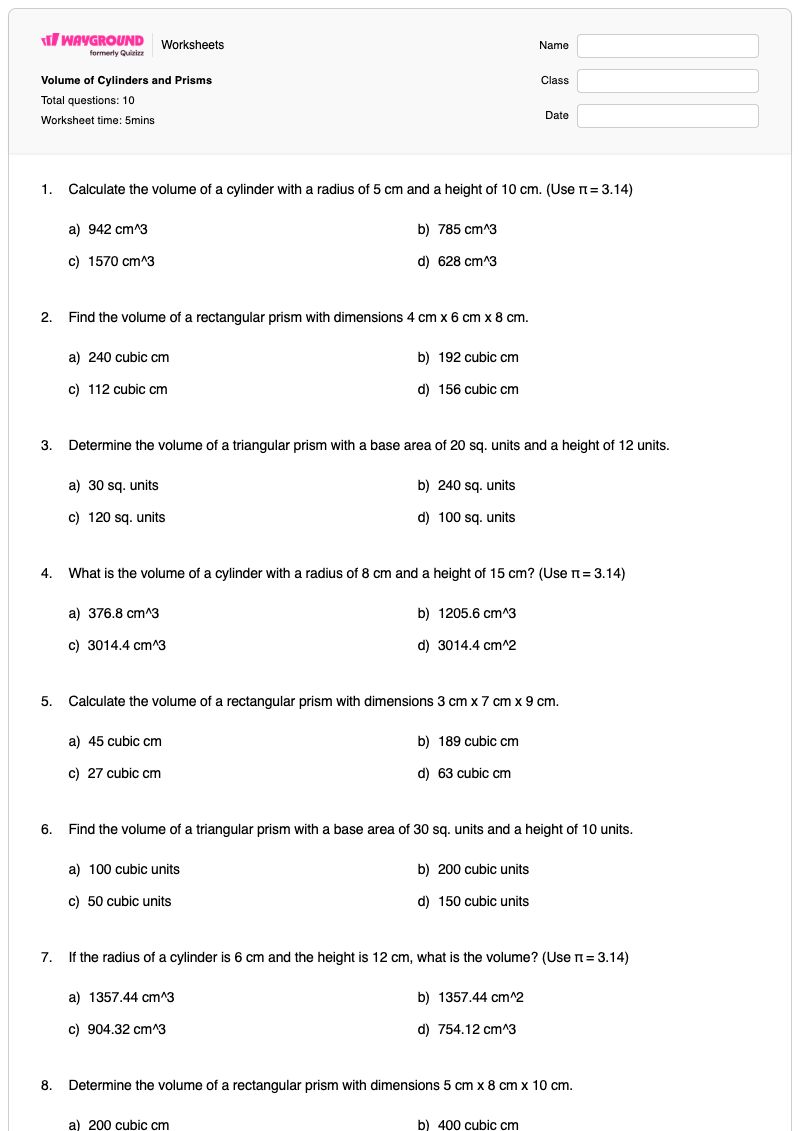
Volume of Cylinders and Prisms is a Grade 5 mathematics worksheet that helps students calculate the volume of three-dimensional figures. Across 10 multiple-choice questions, students find the volume of cylinders using V = πr²h with π = 3.14, rectangular prisms by multiplying three dimensions, and triangular prisms by multiplying a given base area by prism height. The items use centimeters, cubic centimeters, square units, and cubic units, giving students practice connecting calculations with correct volume units.
This free printable worksheet with an answer key is useful for guided practice, independent work, homework, or a quick formative assessment. Its repeated examples with varied dimensions allow teachers to check whether students can select the appropriate formula, substitute measurements accurately, and distinguish cubic units from square units. The multiple-choice format also helps reveal common calculation and unit errors through the answer choices, while the digital version provides an additional way to assign the same practice.
Worksheet settings
Font size
S
M
L
XL
Worksheets
Volume of Cylinders and Prisms
Total questions: 10
Name
Class
Date
1.
Calculate the volume of a cylinder with a radius of 5 cm and a height of 10 cm. (Use π = 3.14)
a)
942 cm^3
b)
785 cm^3
c)
1570 cm^3
d)
628 cm^3
2.
Find the volume of a rectangular prism with dimensions 4 cm x 6 cm x 8 cm.
a)
240 cubic cm
b)
192 cubic cm
c)
112 cubic cm
d)
156 cubic cm
3.
Determine the volume of a triangular prism with a base area of 20 sq. units and a height of 12 units.
a)
30 sq. units
b)
240 sq. units
c)
120 sq. units
d)
100 sq. units
4.
What is the volume of a cylinder with a radius of 8 cm and a height of 15 cm? (Use π = 3.14)
a)
376.8 cm^3
b)
1205.6 cm^3
c)
3014.4 cm^3
d)
3014.4 cm^2
5.
Calculate the volume of a rectangular prism with dimensions 3 cm x 7 cm x 9 cm.
a)
45 cubic cm
b)
189 cubic cm
c)
27 cubic cm
d)
63 cubic cm
6.
Find the volume of a triangular prism with a base area of 30 sq. units and a height of 10 units.
a)
100 cubic units
b)
200 cubic units
c)
50 cubic units
d)
150 cubic units
7.
If the radius of a cylinder is 6 cm and the height is 12 cm, what is the volume? (Use π = 3.14)
a)
1357.44 cm^3
b)
1357.44 cm^2
c)
904.32 cm^3
d)
754.12 cm^3
8.
Determine the volume of a rectangular prism with dimensions 5 cm x 8 cm x 10 cm.
a)
200 cubic cm
b)
400 cubic cm
c)
450 cubic cm
d)
600 cubic cm
9.
What is the volume of a triangular prism with a base area of 25 sq. units and a height of 15 units?
a)
112.5 cubic units
b)
375 cubic units
c)
250 cubic units
d)
187.5 cubic units
10.
Calculate the volume of a cylinder with a radius of 10 cm and a height of 20 cm. (Use π = 3.14)
a)
6280 cm^3
b)
9420 cm^3
c)
1256 cm^3
d)
3140 cm^3
Answer Key
Volume of Cylinders and Prisms
Total questions: 10
1.
b)
785 cm^3
2.
b)
192 cubic cm
3.
c)
120 sq. units
4.
c)
3014.4 cm^3
5.
b)
189 cubic cm
6.
d)
150 cubic units
7.
a)
1357.44 cm^3
8.
b)
400 cubic cm
9.
d)
187.5 cubic units
10.
a)
6280 cm^3
140 %
Browse by subjects
Browse by grades
Browse by format
FAQs
What does this volume of cylinders and prisms worksheet cover?
This Grade 5 worksheet contains 10 multiple-choice questions on calculating the volume of cylinders, rectangular prisms, and triangular prisms. Students use V = 3.14r²h for cylinders, multiply length × width × height for rectangular prisms, and multiply a triangular prism’s given base area by its height, reporting answers in cubic units.
How can I use this worksheet to teach volume formulas?
Introduce the three volume strategies before students begin: square the cylinder’s radius and multiply by 3.14 and height, multiply the three dimensions of a rectangular prism, and multiply a triangular prism’s base area by its height. Work through one example from each shape, asking students to identify the measurements and expected cubic unit before completing the remaining multiple-choice items independently or with a partner.
What mistakes should I watch for on this volume worksheet?
Students may multiply a cylinder’s radius by itself incorrectly, use diameter instead of radius, or select an answer in square centimeters rather than cubic centimeters. For prisms, watch for skipped dimensions in rectangular-prism multiplication and confusion between a triangular prism’s base area and its prism height; the decimal result in the final triangular-prism item also requires careful multiplication.
How do I assign and grade this volume worksheet?
Wayground provides this worksheet as a printable PDF and as a digital quiz, and it includes a complete answer key for all 10 multiple-choice questions. For printable submissions, scan student work with the Wayground for Teachers app to grade responses efficiently. The printable format can also support schools that are reducing screen time.
How can I differentiate this worksheet for my students?
Use the worksheet’s Advanced Settings to adjust font spacing or choose a larger font size so the cylinder and prism measurements and answer choices are easier to read. You can also enable a dyslexia-friendly font or translate the worksheet into another language while keeping the 10 multiple-choice volume questions in the same format.
Where can I find more worksheets like this on Wayground?
Wayground offers a comprehensive collection of free printable worksheets and practice problems across subjects, with downloadable PDFs and answer keys to help students master essential skills and concepts. Browse more resources at https://wayground.com/en-us/worksheets.


 Worksheets