

Wayground
Revolution and War: The Making of Modern Russia - Printable Social studies Worksheets class 9 - Wayground

Revolution and War: The Making of Modern Russia

Chris Bond

Created by Chris Bond

6 questions

9th Grade

Social studies

Updated May 2025

Revolution and War: The Making of Modern Russia is a Grade 9 social studies worksheet that reviews how revolution, political ideology, leadership, and war shaped modern Russia and the Soviet Union. Students examine key figures such as Karl Marx, Friedrich Engels, the Bolsheviks, and Joseph Stalin; identify major developments including the 1917 Russian Revolution, the Russian Civil War, the Battle of Stalingrad, and the Cold War; and interpret terms such as communism, USSR, NKVD, and Gulags. This free printable worksheet includes 15 items: a comprehension video question, 12 multiple-choice questions, one multiple-select question, and one matching item. The varied formats ask students to recall facts, distinguish among historical outcomes and strategies, identify more than one correct example of coercion, and connect related terms. It is designed for Grade 9 review, guided practice, or a formative check of students’ understanding, and includes a complete answer key for efficient grading.

Worksheet settings

Font size

S
M
L
XL
WaygroundWorksheets

Revolution and War: The Making of Modern Russia

Total questions: 6

Name
Class
Date

1-9.

Answer the questions below after watching the video

1.

Who were the main authors of the Communist Manifesto?

a)

Vladimir Lenin and Joseph Stalin

b)

Karl Marx and Friedrich Engels

c)

Leon Trotsky and Vladimir Lenin

d)

Joseph Stalin and Leon Trotsky

2.

What was a significant outcome of the Russian Revolution of 1917?

a)

The overthrow of the monarchy and rise of the Bolsheviks

b)

The beginning of World War I

c)

The establishment of a democratic government

d)

The unification of Germany

3.

What was the main cause of death during the Russian Civil War?

a)

Battlefield casualties

b)

Starvation

c)

Disease

d)

Foreign intervention

4.
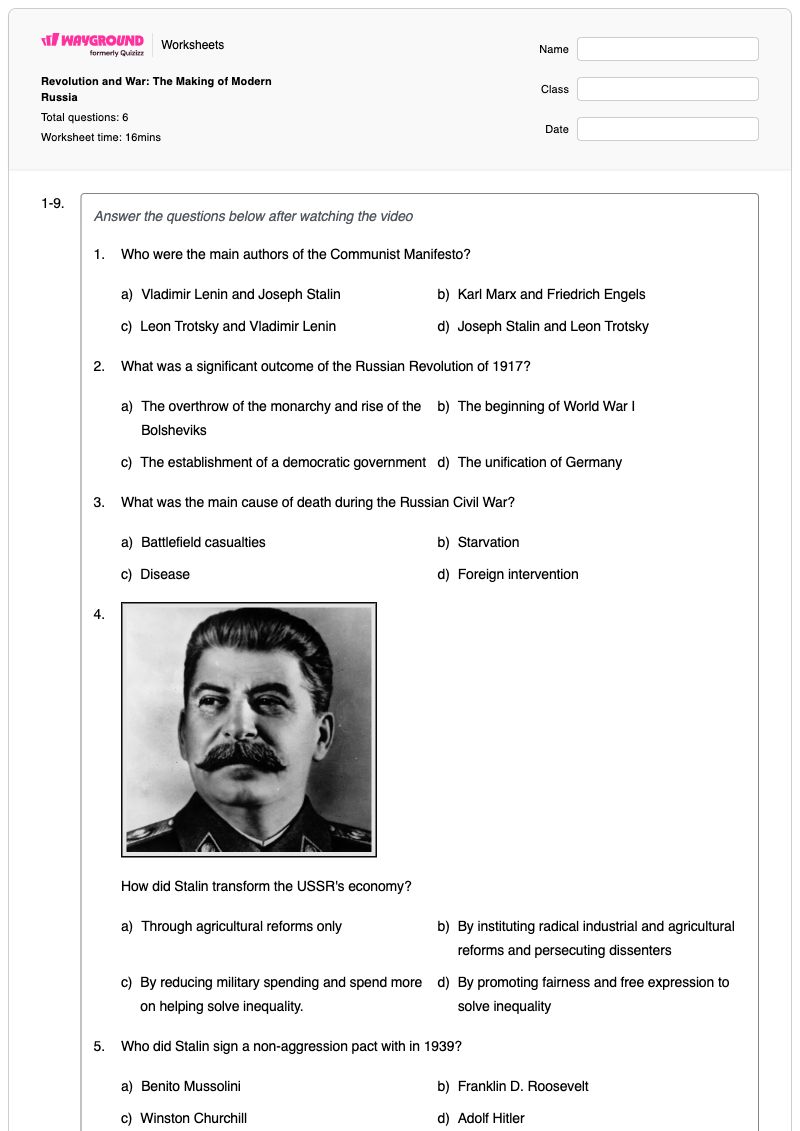
How did Stalin transform the USSR's economy?

How did Stalin transform the USSR's economy?

a)

Through agricultural reforms only

b)

By instituting radical industrial and agricultural reforms and persecuting dissenters

c)

By reducing military spending and spend more on helping solve inequality.

d)

By promoting fairness and free expression to solve inequality

5.

Who did Stalin sign a non-aggression pact with in 1939?

a)

Benito Mussolini

b)

Franklin D. Roosevelt

c)

Winston Churchill

d)

Adolf Hitler

6.

What was the result of the Battle of Stalingrad?

a)

A turning point in favor of the Soviet Union

b)

The beginning of the Cold War

c)

A stalemate between the opposing forces

d)

A decisive victory for Nazi Germany

7.

What strategy did the Red Army employ to defeat the German Army?

a)

Large-scale counter-offensives

b)

Naval blockades

c)

Guerrilla warfare

d)

Cyber warfare

8.

What marked the beginning of the Cold War?

a)

The fall of the Berlin Wall

b)

The establishment of NATO

c)

The division of Europe and the Iron Curtain

d)

The signing of the Treaty of Versailles

9.

What was a major factor in Russia's history of revolutionaries?

a)

The invasion by Napoleon

b)

The signing of the Magna Carta

c)

The discovery of oil

d)

The invention of the steam engine

10.

This form of government is described as having no private ownership, no class system and no religious organizations. Everything is distributed equally.

a)

Democracy

b)

Federation

c)

Theocracy

d)

Communism

11.

Who were the Bolsheviks?

a)

Communist Revolutionaries

b)

Secret Police Members

c)

Members of Parliament

d)

Soldiers in White Army

12.
Which of the following did Stalin use to help "coerce" his people into supporting and following the Soviet Union's new…

Which of the following did Stalin use to help "coerce" his people into supporting and following the Soviet Union's new policies under his leadership? (there may be more than one correct answer)

a)

The NKVD (The Russian Secret Police)

b)

The Gulags (Russian work camps)

c)

Death Camps he created for Jewish Russians

d)

A court system that interpreted the new Russian Constitution which outlined the rights of the people.

13.

Match the following

Working Class

Proletariat

Wealthy Class

Bourgeoise

Big Changes

Revolutionary Ideas

14.

What does USSR stand for

a)

United Soviet Socialist Republics

b)

Union of the Soviet Socialist Republics

WaygroundAnswer Key

Revolution and War: The Making of Modern Russia

Total questions: 6

1-9.
1.
b)

Karl Marx and Friedrich Engels

2.
a)

The overthrow of the monarchy and rise of the Bolsheviks

3.
b)

Starvation

4.
b)

By instituting radical industrial and agricultural reforms and persecuting dissenters

5.
d)

Adolf Hitler

6.
a)

A turning point in favor of the Soviet Union

7.
a)

Large-scale counter-offensives

8.
c)

The division of Europe and the Iron Curtain

9.
a)

The invasion by Napoleon

10.
d)

Communism

11.
a)

Communist Revolutionaries

12.
a)

The NKVD (The Russian Secret Police)

, b)

The Gulags (Russian work camps)

13.

Working Class

 - 

Proletariat

, 

Wealthy Class

 - 

Bourgeoise

, 

Big Changes

 - 

Revolutionary Ideas

14.
b)

Union of the Soviet Socialist Republics

FAQs

What does this Revolution and War worksheet cover?

This Grade 9 worksheet covers key developments in modern Russian and Soviet history, including the 1917 Russian Revolution, the Civil War, Stalin’s rule, the Battle of Stalingrad, and the origins of the Cold War. Its 12 multiple-choice questions, multiple-select item, matching task, and comprehension video question build students’ ability to identify historical figures, explain major outcomes, recognize political terms, and select multiple examples of Soviet coercion.

How can I use this worksheet to teach the making of modern Russia?

Use the worksheet after introducing a timeline from the Russian Revolution through the Cold War so students can place its people, policies, and conflicts in context. Before the multiple-choice review, discuss how the Bolsheviks, Stalin’s economic reforms, and World War II changed the Soviet Union; then have students justify answers about Stalingrad, the Iron Curtain, and Soviet coercion using evidence from class materials or the video item.

What mistakes should I watch for when students complete this Russia history worksheet?

Watch for students confusing Karl Marx and Friedrich Engels with Russian revolutionary leaders, or treating the Russian Revolution as the start of World War I rather than the overthrow of the monarchy and rise of the Bolsheviks. In the multiple-select question, students must choose both the NKVD and the Gulags, not a single option, and they may also confuse the Battle of Stalingrad’s turning-point significance with a German victory or the beginning of the Cold War.

How do I assign and grade this Revolution and War worksheet?

You can assign this worksheet as a printable PDF or as a digital quiz on Wayground. The complete answer key supports grading the video comprehension, multiple-choice, multiple-select, and matching items, and printable submissions can be graded by scanning student work with the Wayground for Teachers app. The printable format also gives schools an option for reducing screen time.

How can I differentiate this worksheet for my students?

Use the worksheet’s Advanced Settings to adjust font spacing and font size when students need more room to read the historical questions and answer choices. You can also enable a dyslexia-friendly font or translate the worksheet into another language, which can make the political terms, Soviet-era vocabulary, and matching item more accessible.

Where can I find more worksheets like this on Wayground?

Wayground offers a comprehensive collection of free printable worksheets and practice problems across subjects, with downloadable PDFs and answer keys to help students master essential skills and concepts. Browse more worksheets at https://wayground.com/en-us/worksheets.