

Wayground
Test Unit 5 Moles - Printable Nauka Worksheets klasa 9 - Wayground

Test Unit 5 Moles

Orlando Vega

By Orlando Vega

20 pyt.

9th - 9th Klasa

Nauka

18 gra

Zaktualizowano kwi 2026

Jednostka testowa 5 „Mole” to arkusz ćwiczeń z przyrody dla klasy 9, który sprawdza zrozumienie przez uczniów pojęcia mola jako jednostki miary oraz ich umiejętność łączenia moli z masą, cząsteczkami i objętością gazów. W 20 pytaniach – 13 wielokrotnego wyboru, 2 wielokrotnego wyboru, 1 zadanie z kolejnością odpowiedzi i 4 pytania rozwijane – uczniowie identyfikują masę molową, zapis mola, liczbę Avogadra i reprezentatywne cząsteczki; interpretują wzory chemiczne, takie jak C₂H₆ i SF₆; oraz rozpoznają ilości równoważne jednemu molowi. Arkusz ćwiczeń umożliwia również ćwiczenie doboru współczynników przeliczeniowych i wykonywania obliczeń dotyczących mola, w tym masy molowej CuSO₄·5H₂O, przeliczania gramów na mole, moli na masę, cząsteczek na mole oraz przeliczania gazów na objętość. Element z kolejnością odpowiedzi wzmacnia sekwencję analizy wymiarowej w celu przeliczenia gramów O₂ na litry, uwzględniając jednostki i oznaczenia substancji w odpowiedzi końcowej. Ten bezpłatny, możliwy do wydrukowania arkusz ćwiczeń, przeznaczony do powtórzenia lub oceny materiału z przedmiotów ścisłych w klasie 9, zawiera kompletny klucz odpowiedzi umożliwiający sprawne sprawdzenie wiedzy.

Ustawienia arkusza kalkulacyjnego

Rozmiar czcionki

S
M
L
XL
WaygroundKarty pracy

Test Unit 5 Moles

Łączna liczba pytań: 20

Nazwa
Klasa
Data
1.

The mass of 1 mole for an element or compound can be found on the periodic table. This mass is known as...

a)

molality

b)

molar mass

c)

formal mass

d)

molarity

2.
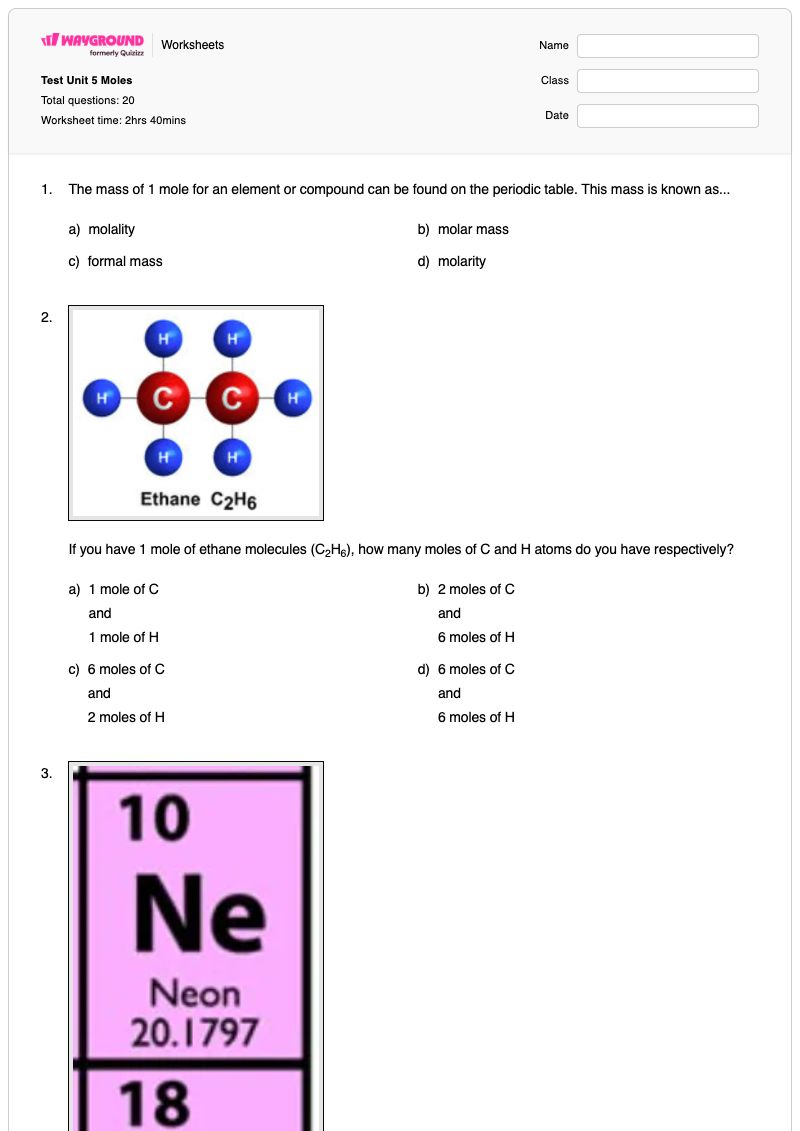
If you have 1 mole of ethane molecules (C 2 H 6 ), how many moles of C and H atoms do you have respectively?

If you have 1 mole of ethane molecules (C2H6), how many moles of C and H atoms do you have respectively?

a)

1 mole of C

and

1 mole of H

b)

2 moles of C

and

6 moles of H

c)

6 moles of C

and

2 moles of H

d)

6 moles of C

and

6 moles of H

3.
Identify the sample with the most moles: 20.18 g of neon or 39.95 g of argon

Identify the sample with the most moles:

20.18 g of neon

or

39.95 g of argon

a)

20.18 g of neon

b)

39.95 g of argon

c)

They are both equal to 1 mole

4.

Identify the number of moles in 6.02 x 10²³ molecules of H2O.

a)

1 mole

b)

2 moles

c)

6.02 moles

d)

6.02 x 10²³ moles

5.

Identify the type of Representative Particle.

One mole of sulfur hexafluoride (SF6) contains 6.02 x 10²³ _____.

a)

atoms

b)

formula units

c)

ions

d)

molecules

6.

Identify the conversion factor (ratio) needed to calculate the following:

Calculate the number of molecules in 4 moles of glucose, C6H12O6.

a)
Identify the conversion factor (ratio) needed to calculate the following: Calculate the number of molecules in 4 moles of…
b)
Identify the conversion factor (ratio) needed to calculate the following: Calculate the number of molecules in 4 moles of…
c)
Identify the conversion factor (ratio) needed to calculate the following: Calculate the number of molecules in 4 moles of…
d)
Identify the conversion factor (ratio) needed to calculate the following: Calculate the number of molecules in 4 moles of…

7.

SELECT ALL CORRECT ANSWERS - The mole can be used to measure:

a)

The amount of volume for a gas at STP.

b)

The amount of molecules in a covalent substance

c)

The amount of mass for a compound.

d)

The amount of pressure an object applies.

8.

Identify the conversion factor (ratio) needed to calculate the following:

Calculate the number of moles in 7.0x1044 formula units of (NH4)3PO4.

a)
Identify the conversion factor (ratio) needed to calculate the following: Calculate the number of moles in 7.0x10 44 formula…
b)
Identify the conversion factor (ratio) needed to calculate the following: Calculate the number of moles in 7.0x10 44 formula…
c)
Identify the conversion factor (ratio) needed to calculate the following: Calculate the number of moles in 7.0x10 44 formula…
d)
Identify the conversion factor (ratio) needed to calculate the following: Calculate the number of moles in 7.0x10 44 formula…
9.

Identify the abbreviation for mole.

a)

M

b)

m

c)

mol

d)

ml

10.

Identify the unit of measurement for Avogadro's number.

a)

meters

b)

particles

c)

grams

d)

liters

11.

SELECT ALL THAT APPLY:

Which of the following is equivalent to 1 mole?

a)

1 mole of Scandium

b)

72.61 grams of Germanium

c)

6.02x1026

formula units of LiBr

d)

6.02x10²³ molecules of CO2

12.

Calculate the molar mass of copper(II)sulfate pentahydrate:

CuSO4 ⋅ 5H2O

a)

90.10 g

b)

14,381.76 g

c)

159.62 g

d)

249.72 g

13.

Calculate the moles magnesium in a 91.0 gram sample.

a)

8.4 mol Mg

b)

21 mol Mg

c)

2.5 mol Mg

d)

3.6 mol Mg

14.

Calculate the mass, in grams, of a gas sample containing 52.0 L of nitrogen (N2).

a)

41.57 g N2

b)

52.0 g N2

c)

41.57 L N2

d)

65.05 g N2

15.

Reorder the following instructions on how to complete the given mole conversion:

Convert 2.5 grams of oxygen gas (O2) to liters.

a)

Write the value that is given as the first ratio, in grams.

b)

Write the ratio to convert the given mass value, to moles.

c)

Write the ratio to convert the given mole value, to liters.

d)

Multiply all top ratio values together, then multiply all the bottom ratio values together, then divide the top value by the bottom value.

e)

Give an answer with the appropriate units, in liters, and substance, O2.

1)
2)
3)
4)
5)
16.

Identify the type of Representative Particle.

One mole of calcium carbonate (CaCO3) contains 6.02 x 10²³ _____.

a)

atoms

b)

formula units

c)

ions

d)

molecules

17.

Identify the following as ionic, covalent or metallic:

FeCl3

​ (a)  

Wybierz spośród poniższych słów
Ionic
Covalent
metallic
18.

Identify the following as ionic, covalent or metallic:

NaNO3

​ (a)  

Wybierz spośród poniższych słów
Ionic
Covalent
metallic
19.

Identify the following as ionic, covalent or metallic:

C6H12O6

​ (a)  

Wybierz spośród poniższych słów
Covalent
Metallic
Ionic
20.

Identify the following as ionic, covalent or metallic:

H2S

​ (a)  

Wybierz spośród poniższych słów
Covalent
Metallic
Ionic
WaygroundKlucz odpowiedzi

Test Unit 5 Moles

Łączna liczba pytań: 20

1.
b)

molar mass

2.
b)

2 moles of C

and

6 moles of H

3.
c)

They are both equal to 1 mole

4.
a)

1 mole

5.
d)

molecules

6.
b)
7.
a)

The amount of volume for a gas at STP.

, b)

The amount of molecules in a covalent substance

, c)

The amount of mass for a compound.

8.
a)
9.
c)

mol

10.
b)

particles

11.
a)

1 mole of Scandium

, b)

72.61 grams of Germanium

, d)

6.02x10²³ molecules of CO2

12.
d)

249.72 g

13.
d)

3.6 mol Mg

14.
d)

65.05 g N2

15.
a, b, c, d, e
16.
b)

formula units

17.
Ionic
18.
Ionic
19.
Covalent
20.
Covalent

Często zadawane pytania

Co obejmuje arkusz ćwiczeń dotyczący mola w jednostce testowej 5?

Ten arkusz ćwiczeń z przyrody dla klasy 9 obejmuje związki między molami, w tym masę molową, liczbę Avogadra, cząstki reprezentatywne, indeksy dolne wzorów chemicznych oraz przeliczanie masy, moli, cząstek i objętości gazów. Zawiera 20 pytań w formacie wielokrotnego wyboru, wielokrotnego wyboru, rozwijanej listy i kolejności, które pomagają uczniom zidentyfikować współczynniki przeliczeniowe, obliczyć wielkości takie jak masa molowa CuSO₄·5H₂O, oraz określić kolejność kroków przeliczania gramów O₂ na litry.

W jaki sposób mogę wykorzystać ten arkusz do nauki przeliczania molowego?

Wprowadzenie do arkusza ćwiczeń polega na omówieniu mola jako cząstek o wymiarach 6,02 × 10²³ i zmodelowaniu, jak wzór chemiczny określa liczbę atomów w jednym molu związku, na przykład 2 atomy węgla i 6 atomów wodoru w C₂H₆. Następnie poproś uczniów, aby wykorzystali elementy przelicznika i zadanie dotyczące uporządkowanego przeliczania gramów O₂ na litry, aby wyjaśnić każdy etap analizy wymiarowej, w tym dlaczego jednostki się skracają i dlaczego ostateczna odpowiedź musi zawierać litry i O₂. Wykorzystaj pytania dotyczące obliczania masy, cząstek i objętości gazu do ćwiczeń z przewodnikiem przed samodzielnym zadaniem pełnego arkusza ćwiczeń.

Na jakie błędy powinienem zwrócić uwagę w arkuszu ćwiczeń „Mole” z jednostki testowej 5?

Uważaj, aby uczniowie nie mylili indeksów dolnych z liczbą moli w próbce – na przykład odczytując C₂H₆ jako jeden mol węgla i jeden mol wodoru zamiast 2 mole węgla i 6 moli wodoru. Uczniowie mogą również użyć nieprawidłowego terminu „cząstka reprezentatywna”, błędnie odczytać 6,02 × 10²³ jako liczbę moli zamiast cząsteczek lub wybrać nieprawidłową potęgę dziesięciu we współczynniku konwersji. Podczas obliczeń i porządkowania elementów sprawdź, czy używają masy molowej do przeliczeń mas, uwzględniają wszystkie części CuSO₄·5H₂O, skreślają jednostki w prawidłowej kolejności oraz podają żądaną jednostkę i substancję.

Jak mam przypisać i ocenić ten arkusz kalkulacyjny dotyczący pieprzyków?

Możesz przypisać test Unit 5 „Mole” w formacie PDF do wydruku lub jako quiz cyfrowy w Wayground. Arkusz zawiera pełny klucz odpowiedzi, a przesłane materiały można oceniać, skanując prace uczniów za pomocą aplikacji Wayground for Teachers. Opcja PDF jest również przydatna w klasach, w których uczniowie ograniczają czas spędzany przed ekranem, ćwicząc obliczenia dotyczące mola.

Jak mogę wyróżnić tę kartę pracy dotyczącą pieprzyków dla moich uczniów?

Użyj zaawansowanych ustawień arkusza, aby dostosować odstępy i rozmiar czcionki wokół wzorów chemicznych, opcji przeliczników i wieloetapowych monitów obliczeniowych. Możesz również włączyć czcionkę dostosowaną do potrzeb osób z dysleksją lub przetłumaczyć arkusz na inny język, jeśli ułatwi to uczniom dostęp do instrukcji przeliczania moli i odpowiedzi. Te opcje na poziomie pliku mogą ułatwić czytanie 20-elementowego arkusza w formacie mieszanym bez zmiany jego zawartości chemicznej.

Gdzie mogę znaleźć więcej darmowych arkuszy roboczych tego typu na Wayground?

Wayground oferuje bogatą kolekcję darmowych arkuszy ćwiczeń do druku i zadań praktycznych z różnych przedmiotów, z plikami PDF do pobrania i kluczami odpowiedzi, które pomogą uczniom opanować podstawowe umiejętności i pojęcia. Więcej zasobów znajdziesz na stronie https://wayground.com/en-us/worksheets.