
 Worksheets
Free Fall
Total questions: 9
Worksheet time: 5mins
Name
Class
Date
1.
What happens to the total distance that a ball travels as it falls off the side of a cliff?
a)
The distance remains constant
b)
The distance increases at a uniform rate
c)
The distance increases at a nonuniform rate
d)
The distance decreases at a uniform rate
2.
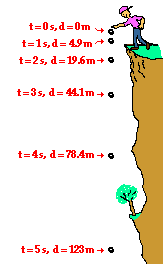
What happens to the velocity of a ball as it is dropped off a cliff?
a)
It decreases at a uniform rate
b)
It increases at a uniform rate
c)
It is constant
d)
It increases at a non-uniform rate
3.
What is the velocity of a ball that has been dropped off a cliff after 1 , 2, 3, 4, and 5 seconds? (concept development page 4).
a)
10, 20, 30, 40, 50 m/s
b)
5, 10, 15, 20, 25 m/s
c)
5, 20, 45, 80,125 m
d)
10,10,10,10,10 m/s
4.
What is the distance a ball falls after 1,2,3,4,5 seconds?
a)
10, 20, 30, 40, 50 m (meters)
b)
5, 20, 45, 80,125 m (meters)
c)
5, 10,15, 20, 25 m (meters)
d)
10, 25, 60, 90,120 m (meters)
5.
What is the acceleration of a ball that is dropped off the side of a cliff after 1,2,3,4,5 seconds?
a)
5,10,15, 20, 25 m/s2
b)
10, 20, 30, 40, 50 m/s2
c)
5, 20, 45, 80, 125 m/s2
d)
10,10,10,10,10 m/s2
6.
In a normal environment, why does a bowling ball and feather hit the ground at different times when dropped from the same height?
a)
They don't; they hit the ground at the same time.
b)
One is more dense than the other.
c)
One is heavier than the other.
d)
Air resistance
7.
A ball is thrown in the air with an initial velocity of 40 m/s. How long does it take to reach back to the point it was thrown from?
a)
4 seconds
b)
2 seconds
c)
6 seconds
d)
8 seconds
8.
A ball is thrown up in the air with an initial velocity of 40 m/s. What is the ball's velocity after 2 seconds?
a)
0 m/s
b)
20 m/s traveling upward
c)
20 m/s traveling downward
d)
40 m/s traveling downward
9.
A ball is thrown up in the air with an initial velocity of 40 m/s. What is the ball's velocity after 6 seconds?
a)
20 m/s traveling upward.
b)
10 m/s traveling downward.
c)
20 m/s traveling downward.
d)
30 m/s traveling downward.
100 %

