
 Worksheets
Electricity Unit Review
Total questions: 16
Worksheet time: 9mins
Name
Class
Date
1.
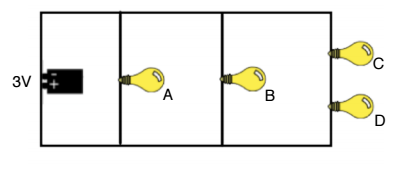
This image represents what type of circuit.
a)
closed
b)
opened
c)
series
d)
parallel
2.
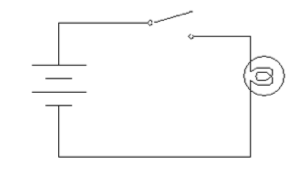
Will the light bulb in this circuit light and why/why not?
a)
yes, because it has two batteries.
b)
yes, because it is in a circuit
c)
no, because the switch is open.
d)
no, because the bulb is burned out.
3.
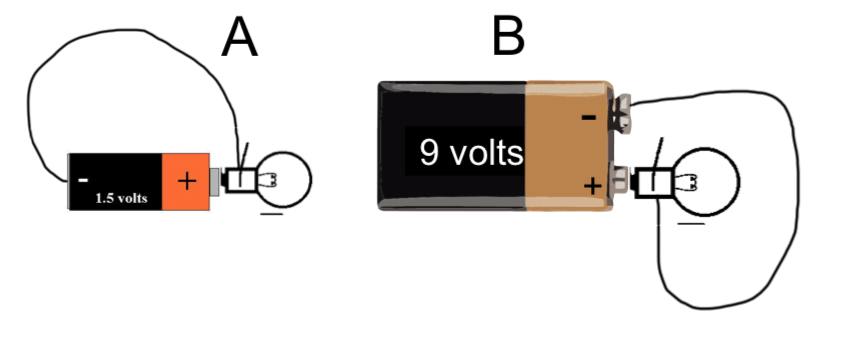
Which light will be brighter and why?
a)
Bulb A because it's circuit is closed.
b)
Bulb B because it's circuit is closed.
c)
Bulb B because it has more volts.
d)
Bulb A because it has less volts.
4.
Current is referred to as:
a)
flow of electricity
b)
flow of electrons
c)
circuits
d)
batteries
5.
When voltage increases, what happens to the current?
a)
decreases
b)
increases
c)
both increase and decrease
6.
When the resistance increases in a circuit, what happens to the current?
a)
decreases
b)
increases
c)
both
7.
When something opposes the flow of current is known as:
a)
resistor
b)
conductor
c)
stinker
d)
insulator
8.
Electricity flows in a:
a)
circuit
b)
current
c)
wire
d)
water
9.
Anything that allows current to flow freely is known as a:
a)
insulator
b)
resistor
c)
conductor
d)
cotton candy
10.
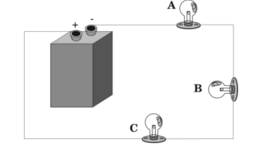
What type of circuit is represented by the diagram?
a)
closed
b)
open
c)
series
d)
parallel
11.
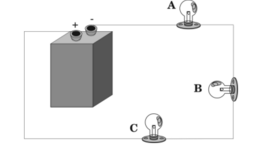
The battery in the image has 12 volts, how many volts does each light bulb receive?
a)
12 volts
b)
3 volts
c)
4 volts
12.
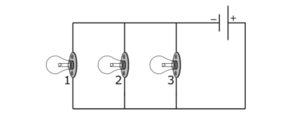
If bulb 1 burns out, what will occur?
a)
bulbs 2 and 3 will go out
b)
bulbs 2 and 3 will stay lit
c)
bulbs 2 and 3 receive more volts
d)
nothing will happen
13.
If a TV works using 30 Amps through the electrical wire with 5 ohms of resistance. How much voltage is needed?
a)
6 V
b)
150 V
c)
35 V
d)
120 V
14.
A alarm clock draws 2 Amps of current when connected to a 120 V circuit. How much resistance will there be?
a)
60 Ohms
b)
2 Ohms
c)
122 Ohms
d)
240 Ohms
15.
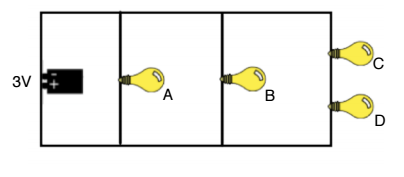
How many volts will battery C and D receive?
a)
3 V
b)
1 V
c)
1.5 V
d)
6 V
16.
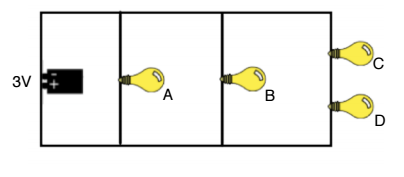
How many volts will battery A and B both receive?
a)
1. 5 V
b)
6 V
c)
3 V
d)
1 V
100 %

