
 Worksheets
Solar System
Total questions: 20
Worksheet time: 19mins
Name
Class
Date
1.
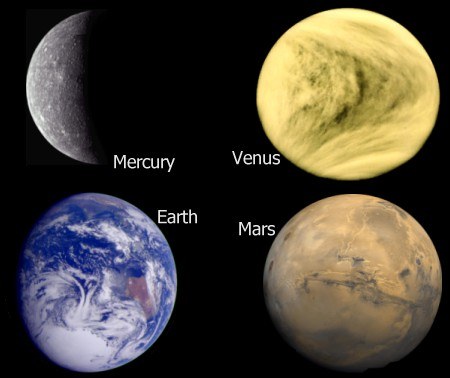
Earth and the other planets closest to the Sun are made mostly of _______
a)
gas
b)
metal
c)
water
d)
rock
2.

The moon is a natural ______ of Earth.
a)
comet
b)
axis
c)
satellite
d)
space probe
3.

Earth's ________ on its axis causes day and night.
a)
rotation
b)
revolution
c)
phase
d)
comet
4.

One kind of _______ is the crescent Moon.
a)
axis
b)
asteroid
c)
phase
d)
space probe
5.

One full orbit of an object around another object is called a ________.
a)
axis
b)
rotation
c)
revolution
d)
satellite
6.

The __________ has planets, moons, comets, and asteroids.
a)
solar system
b)
earth
c)
rotation
d)
United States
7.
One of the main differences between the outer and inner planets is __________.
a)
The inner planets all have water
b)
the inner planets are much bigger than the outer planets
c)
the outer planets are gas planets
d)
the outer planets have rings, and the inner planets don't
8.
Where is the asteroid belt found?
a)
between earth and mars
b)
Between Uranus and Neptune
c)
Between Mercury and Venus
d)
Between Mars and Jupiter
9.
Select the order from smallest to largest.
a)
Sun, Milky Way, solar system, universe
b)
Sun, Milky Way, universe, solar system
c)
Sun, solar system, Milky Way, universe
d)
Sun, solar system, universe, Milky Way
10.
Why does Earth have different seasons?
a)
because of the distance between Earth and the sun
b)
because of the speed of Earth as it rotates on its axis
c)
because of the amount of light blocked by the moon on its axis
d)
because of the tilt of Earth on its axis as it moves around the sun
11.
Which factor makes Earth different from all the other planets in the solar system in its ability to support life?
a)
The Earth is exposed to rays from the sun.
b)
The Earth has only one moon that orbits around it.
c)
The Earth rotates in an elliptical orbit around the sun.
d)
The Earth has a breathable atmosphere.
12.
Which best explains why the moon has phases?
a)
The moon’s position changes in relation to the sun and Earth.
b)
The sun’s position changes in relation to the moon and Earth.
c)
The Earth casts a shadow on the moon as it rotates.
d)
The moon rotates along its axis
13.
Day and night is caused by the _____________ of earth on its axis.
a)
revolution
b)
orbit
c)
rotation
14.
As the Earth travels around the sun, this tilt causes different areas of the Earth’s surface to get different amounts of daylight at different times of the year. The angle of the Sun’s rays to the surface also causes areas to have more or less of the Sun’s energy. This causes the ________.
a)
months
b)
day and night
c)
seasons
d)
years
15.
Which outer planets have rings?
a)
Just Saturn
b)
Saturn and Jupiter
c)
Jupiter, Neptune, and Saturn
d)
all 4 of them
16.

a pattern of stars that form an imaginary picture or design in the sky
a)
Orbit
b)
Rotate
c)
constellation
d)
Milky Way
17.
A spiral galaxy of stars that contains our Sun
a)
Planisphere
b)
Intensity
c)
Star
d)
Milky Way
18.
The pattern of stars in a constellation stays the same, but a planet can be seen in different locations at different times because _______________.
a)
Stars don't move; planets revolve and rotate
b)
Stars and planets revolve and rotate.
c)
Stars not planets move
d)
Planets don't move; Stars revolve and rotate.
19.
Which color star has medium temperature?
a)
Bluish-White
b)
Yellow
c)
Reddish-Orange
20.
Which of the following causes seasons?
a)
the earths tilt
b)
the earths rotation
c)
the earths revolution around the sun
d)
the earths size
100 %

