
 Worksheets
Moon Phases / Seasons / Tides
Total questions: 32
Worksheet time: 17mins
Name
Class
Date
1.

We see 1/2 of the moon illuminated. What is the phase and visibility?
a)
Full moon , 100%
b)
Full moon, 0%
c)
New moon, 100%
d)
New moon, 0%
2.

We see 1/8 of the moon illuminated, the light is reflected and decreasing on the left side. Name the phase and visibility:
a)
Waning Gibbous, 75%
b)
Waxing Gibbous, 75%
c)
Waning crescent, 25%
d)
Waxing crescent, 25%
3.

We see almost 1/2 of the moon illuminated, reflected and decreasing on the left side. Name the phase and visibility.
a)
Waxing Gibbous, 75%
b)
Waxing Gibbous, 25%
c)
Waning Gibbous, 25%
d)
Waning Gibbous, 75%
4.

The far side of the moon is illuminated and we see no reflected light. What is the phase and visibility?
a)
New moon , 100%
b)
New moon, 0%
c)
Full moon, 100%
d)
Full moon, 0%
5.

We see 1/8 of the moon illuminated, light is reflected and increasing on the right side. Name the phase and visibility.
a)
Waxing crescent, 75%
b)
Waning crescent, 25%
c)
Waxing crescent, 75%
d)
Waxing crescent, 25%
6.

We see 1/8 of the moon illuminated, light is reflected and increasing on the right side. Name the phase and visibility.
a)
Waxing crescent, 75%
b)
Waning crescent, 25%
c)
Waxing crescent, 75%
d)
Waxing crescent, 25%
7.

We see 1/4 of the moon illuminated, light is reflected and decreasing on the left side. Name the phase and visibility.
a)
New moon, 0%
b)
Full moon, 100%
c)
1st quarter, 50%
d)
3rd quarter, 50%
8.

We see almost 1/2 moon illuminated, light is reflected and increasing on the right side. Name the phase and visibility.
a)
Waxing gibbous, 75%
b)
Waxing crescent, 75%
c)
Waning gibbous, 75%
d)
Waning crescent, 75%
9.

We see 1/4 of the moon illuminated, light is reflected and increasing on the right side. Name the phase and visibility.
a)
New moon, 0%
b)
1st quarter, 50%
c)
Full moon, 100%
d)
3rd quarter, 50%
10.
14 days after a new moon is the _________ which is _______% visible.
a)
1st quarter, 50%
b)
3rd quarter, 50%
c)
Full moon, 0%
d)
Full moon, 100%
11.
3.5 days from the new moon is the ___________ which is _____% visible.
a)
Waxing crescent, 25%
b)
Waning crescent, 25%
c)
Waxing gibbous, 75%
d)
Waning gibbous, 75%
12.
One month from the new moon is the __________ and is _____% visible.
a)
New moon, 100%
b)
Full moon 100%
c)
New moon, 0%
d)
Full moon, 0%
13.
Why do some people describe a quarter moon as a half moon?
a)
1/2 of what we see from Earth is lit.
b)
It is a misconception
c)
The hills, clouds or mountains cover the other half
d)
We do not see half of the moon
14.

Which moon phase is visible at position 4?
a)
new moon
b)
1st quarter
c)
full moon
d)
3rd quarter
15.

What season is letter A?
a)
Winter
b)
Summer
c)
Spring
d)
Fall
16.
When the Northern Hemisphere is pointing towards the sun, what season is the Southern Hemisphere?
a)
Winter
b)
Spring
c)
Fall
d)
Summer
17.
What are the reasons for the seasons?
a)
Earth's tilt and rotation.
b)
Earth's rotation and revolution.
c)
Earth's tilt and revolution.
d)
Earth's tilt and resolution
18.
What is the Earth's tilt in degrees?
a)
25.3 degrees
b)
32.5 degrees
c)
28.5 degrees
d)
23.5 degrees
19.
How long after a new moon will it take to see another new moon?
a)
12 days
b)
29.5 days
c)
27.3 days
d)
365 days
20.
Where is the new moon ALWAYS located in a diagram of the moon phases?
a)
closest to the full moon
b)
closest to the 1st quarter moon
c)
closest to the sun
d)
closest to the waning gibbous
21.
Sunlight hits Earth’s surface most directly at the _______. Because of this, this particular area doesn't experience seasons.
a)
north pole
b)
south pole
c)
equator
22.
A cycle is something that happens over and over again, like the seasons and day & night.
a)
True
b)
False
c)
Maybe
d)
Not sure
23.
The type of tide that occurs during the full or new moon is called___. It shows the greatest difference in the low and high tide.
a)
spring tide
b)
summer tide
c)
neap tide
d)
fall tide
24.

At position A, which hemisphere would have summer?
a)
Northern hemisphere
b)
Southern hemisphere
25.

At position C, which hemisphere would have winter?
a)
Northern hemisphere
b)
Southern hemisphere
26.

At position D in the Northern hemisphere it would be _____?
a)
Summer
b)
Winter
c)
Spring
d)
Fall
27.
What happens when there is a spring tide
a)
high tides
b)
really high tides
c)
low tides
28.

Which moon phase is shown in this diagram?
a)
new moon
b)
1st quarter
c)
full moon
d)
last quarter/3rd quarter
29.

Wha type of tide would this arrangement of earth-moon-sun create?
a)
full moon tide
b)
new moon tide
c)
neap tide
d)
spring tide
30.

Which moon phase is shown in this diagram?
a)
new moon
b)
first quarter
c)
full moon
d)
last quarter/3rd quarter
31.
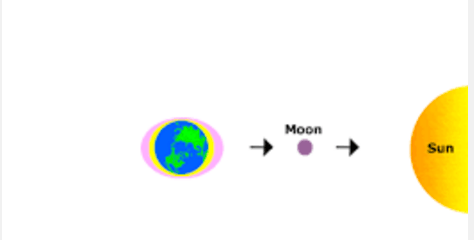
What type of tides would this arrangement of earth-moon-sun create?
a)
neap tide
b)
spring tide
c)
new moon tide
d)
full moon tide
32.
Tides are caused by ___________
a)
wind
b)
gravitational pull of moon
c)
waves gravitation toward land
d)
rain
100 %

