

wayground logo

Free Printable Worksheets

NEW

Font size

S
M
L
XL
Worksheets

World War II

Total questions: 25

Worksheet time: 17mins
Name
Class
Date
1.
I was the emperor of Japan during World War II.  The military had a lot of power in my government.
a)
Benito Mussolini
b)
Hirohito
c)
Adolf Hitler
d)
Harry S. Truman
2.
I was the leader of the Nazi party, and I became the dictator of Germany in 1933.
a)
Hirohito
b)
Adolf Hitler
c)
Benito Mussolini
d)
Franklin D. Roosevelt
3.
I was the dictator of Italy during World War II.
a)
Benito Mussolini
b)
Joseph Stalin
c)
Winston Churchill
d)
Adolf Hitler
4.
Which of the following is true about Japanese aggression in Asia?
a)
Japan invaded and took over Albania and Ethiopia.
b)
Japan invaded and conquered Austria, Czechoslovakia, and Poland.
c)
Japanese forces took over most of eastern China.
d)
Japan invaded and conquered Germany.
5.
Which country took over Austria, Czechoslovakia, and Poland?
a)
Japan
b)
Italy
c)
Germany
d)
United States
6.
Germany, Japan, and Italy formed an alliance known as the ...
a)
Allies
b)
Axis Powers
c)
Wartime Heros
d)
Nazis
7.
Great Britain, France, Canada, and the Soviet Union formed an alliance known as the ...
a)
Axis Powers
b)
Nazi Party
c)
Allied Powers
d)
Rough Riders
8.
Many Americans made sacrifices during the war so that soldiers would have plenty.  Some of the items rationed during the war were ...
a)
rubber
b)
coffee
c)
meat
d)
ALL of the answers are correct
9.
December 7, 1941 is an important day in history.  On that morning, _______________ airplanes made a surprise attack on the U.S. Naval base at Pearl Harbor, Hawaii.
a)
German
b)
Italian
c)
Russian
d)
Japanese
10.
Why did President Roosevelt ask Congress to declare war on Japan?
a)
the attack at Pearl Harbor
b)
the attack at Iwo Jima
c)
the sinking of the Lusitania
d)
the explosion of the USS Maine
11.
Why did the United States Marines fight a fierce battle against the Japanese on the island of Iwo Jima?
a)
Japan had taken Iwo Jima from the United States, and the US was simply taking it back.
b)
The U.S. was trying to invade and conquer Japan.
c)
The U.S. Marines wanted to raise an American flag on the island.
d)
The island was close to Japan, and it was a good place for American planes to land.
12.
On June 6, 1944, 60,000 American and Allied troops gathered in southern England, crossed the English Channel, arrived on the beaches of Normandy, France and surprised the Germans.  This operation was known as...
a)
VE Day
b)
D-Day
c)
 VJ Day
d)
the Holocaust
13.
Germany had invaded and taken over France.  The U.S. and Allied troops defeated Germany and ran them out of France.  The day Germany surrendered to the Allies is known as ________.  People sang and danced in the streets all over Europe and the United States.
a)
VJ Day
b)
D-Day
c)
VE Day
d)
the Holocaust
14.
Hitler was responsible for the murder of more than six million Jews between 1933 and 1945.  This terrible period of history is known as the ...
a)
Holocaust
b)
Death Valley
c)
attack on Pearl Harbor
d)
Iwo Jima
15.
First, Hitler hurt the Jews economically by ordering Germans not to shop in stores owned by Jews.  Then, his army made them leave their homes and live in crowded areas called ghettos.  The Jews were forced to work as slaves.  Finally, Jews were forced into _________________ or death camps where they were starved or murdered by breathing poison gas.
a)
concentration camps
b)
prisoner of war camps
c)
Aryan supremacy camps
d)
anti-Semitism camps
16.
The Japanese were fierce warriors.  Battles with them had huge casualties because they never gave up and were willing to sacrifice themselves.  Americans had seen this happen at Iwo Jima and other battles as __________ pilots crashed their planes into U.S. ships on purpose.
a)
skilled
b)
kamikaze
c)
fighter
d)
bomber
17.
The Allies thought about invading Japan, but they worried that too many soldiers would die.  President Harry Truman made a very difficult decision to use new ____________ against Japan.
a)
kamikaze warfare
b)
United Nations
c)
atomic bombs
d)
air power
18.
In August of 1945, U.S. bombers dropped atomic weapons on the Japanese cities of _________ and ____________.
a)
Tokyo and Osaka
b)
Nagoya and Yokohama
c)
Osaka and Kyoto
d)
Hiroshima and Nagasaki
19.
Japan officially surrendered to the U.S. and Allied troops on August 14, 1945.  That day is officially known as ______________.
a)
VE Day
b)
D-Day
c)
VJ Day
d)
Iwo Jima Day
20.
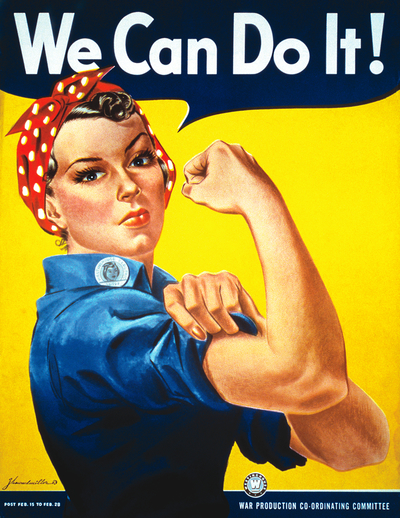
A fictitious character appearing on government posters encouraging women to help in the war effort was ...
a)
Rosie the Riveter
b)
Wanda the Welder
c)
Barbara the Builder
d)
Tina the Typist
21.
The Tuskegee Airmen were ...
a)
a group of African American pilots that flew alongside bombers going to Europe
b)
a group of Asian American pilots that flew alongside bombers going to Europe 
c)
a group of Italian American pilots that flew alongside bombers going to Europe
d)
a group of Canadian pilots that flew alongside bombers going to Europe
22.
Which of the following describes the United Nations?
a)
an international peace-keeping organization that works to prevent wars
b)
works alongside organizations like the American Red Cross to provide relief to areas who have experienced natural disasters or devastation from war
c)
protects basic human rights; intervenes when people's basic rights are being taken away or denied
d)
ALL of the answers are correct
23.

Former first lady, ________________, served as one of the first five U.S. delegates to the United Nations.

a)

Nancy Reagan

b)

Barbara Bush

c)

Eleanor Roosevelt

d)

"Lady Bird" Johnson

e)

Michelle Obama

24.

The Women's Army Corp (a division of women in the military) and Rosie the Riveter are both examples of ...

a)

women's roles in society changing during World War II.

b)

women serving in the military during World War II.

c)

women serving in combat during World War II.

d)

women working in their homes during World War II.

25.

During World War II, people planted victory gardens in which they planted their own vegetables. Some also voluntarily decided not to eat meat on certain days of the week. Both of these statements support which idea?

a)

The government used rationing to limit how much citizens could buy.

b)

While U.S. soldiers were away fighting in Europe and the Pacific, citizens at home did their part to support the war effort.

c)

Citizens collected rubber, copper, steel, and other goods to be recycled.
