
NEW
Font size
S
M
L
XL
 Worksheets
Water Cycle Review
Total questions: 16
Worksheet time: 8mins
Name
Class
Date
1.
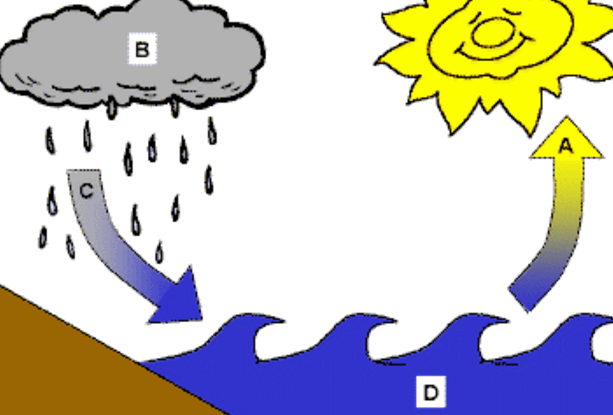
Letter A is representing what part of the water cycle?
a)
Condenstation
b)
Evaporation
c)
Accumulation
d)
Precipitation
2.
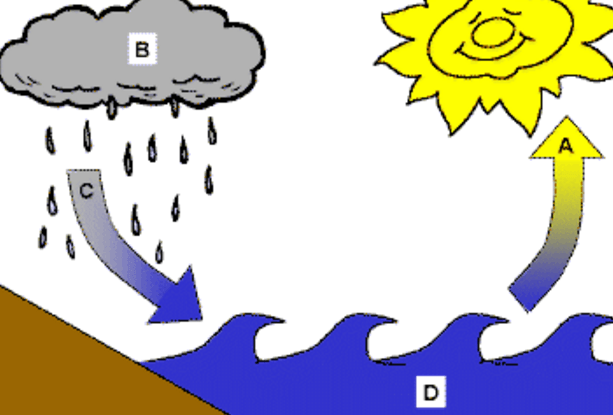
Letter B is representing what part of the water cycle?
a)
Condenstation
b)
Evaporation
c)
Accumulation
d)
Precipitation
3.
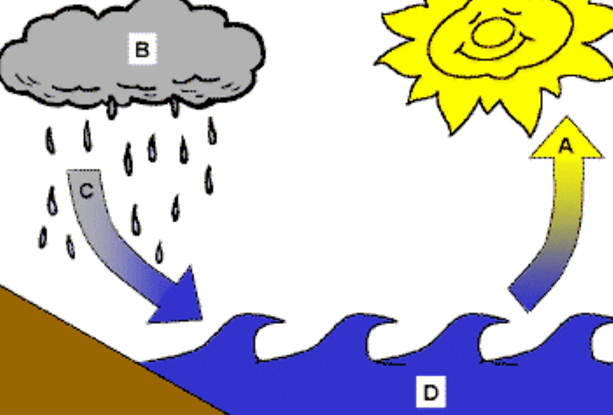
Letter C is representing what part of the water cycle?
a)
Condenstation
b)
Evaporation
c)
Accumulation
d)
Precipitation
4.
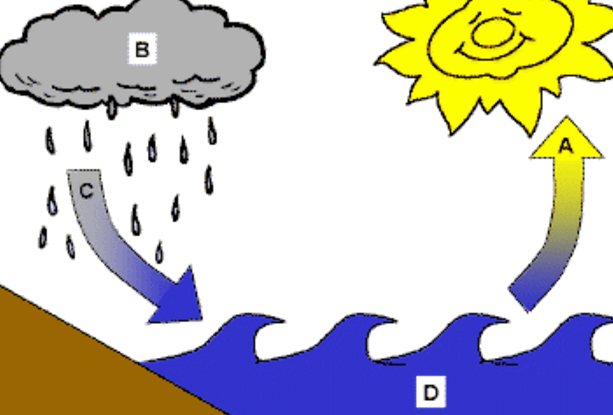
Letter D is representing what part of the water cycle?
a)
Condenstation
b)
Evaporation
c)
Accumulation
d)
Precipitation
5.
The water cycle is ____________
a)
The process by which water moves in and out of the atmosphere.
b)
A blanket of air that surrounds the earth.
c)
gravitational pull of the moon causing the oceans on the Earth to rise and fall.
d)
the creation of oxygen by plant through photosynthesis.
6.

Which of the following best describes what happens during precipitation?
a)
Water from the land is returned to the ocean
b)
Ocean water is evaporated into the atmosphere
c)
Water from the atmosphere is returns to Earth's surface
d)
Water vapor in the atmosphere is condensed into clouds.
7.
A student looks outside her window after it has rained. She sees many puddles of water. later that same day, the puddles are gone. Which process explains why the puddles are gone?
a)
accumulation of runoff
b)
precipitation
c)
evaporation
d)
condensation
8.
Which of the following is a part of the water cycle?
a)
The earth rotating or spinning on its axis every 24 hours
b)
The heat of the sun causes water to evaporate and rise in the air
c)
The changes in the appearance of the moon
d)
Wind changing the formation of rocks over time
9.
What provides the energy for the water cycle?
a)
The water
b)
The earth
c)
The moon
d)
The sun
10.
Which of the following describes the process of condensation?
a)
The heat of the sun causes water to evaporate and rise in the air
b)
Water droplets getting larger and returning back to Earth.
c)
Water vapor turns back into drops of water forming clouds
d)
Water gathering on land and running into the ocean
11.
Condensation creates-
a)
rain
b)
clouds
c)
ice
d)
groundwater
12.
In which step of the water cycle does water change from liquid to a gas?
a)
evaporation
b)
condenstation
c)
participation
d)
accumulation
13.
Water that falls to Earth’s surface as rain, snow, or ice is called
a)
evaporation
b)
condensation
c)
transpiration
d)
precipitation
14.
Which of the following statements is true?
a)
Water cannot be recycled.
b)
The Sun is the source of energy for the water cycle.
c)
Water is not a basic need of living things.
d)
The state of matter of water cannot change.
15.
Condensation occurs when water vapor cools and changes from a
a)
gas to a solid
b)
liquid to a gas
c)
gas to a liquid
d)
solid to a gas
16.

The arrows in the picture below are repenting the process of
a)
The sun cooling the water in the lake
b)
The clouds pulling up water from the lake
c)
The water from the lake changing into a gas
d)
The water falling from the clouds into the lake
Reset

