
 Worksheets
Microorganisms
Total questions: 19
Worksheet time: 5hrs 45mins
Name
Class
Date
1.
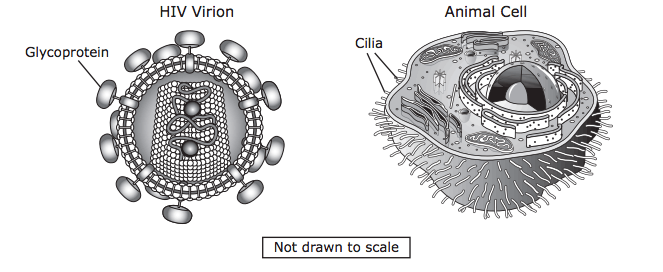
Models of the human immunodeficiency virus (HIV) and an animal cell are shown below.
What is the difference in the function of the glycoprotein structures of an HIV virion and the cilia of an animal cell?
What is the difference in the function of the glycoprotein structures of an HIV virion and the cilia of an animal cell?
a)
The glycoprotein structures are used for attachment, and the cilia are used to move fluids surrounding the cell.
b)
The glycoprotein structures are used to obtain nutrition, and the cilia are used to secrete proteins.
c)
The glycoprotein structures are used to provide physical support for the viral envelope, and the cilia strengthen the cell membrane.
d)
The glycoprotein structures are used for defense, and the cilia are used for locomotion.
2.

Some students used information they gathered from lab investigations to prepare a table. They entered the table in their lab notebooks.
Which of these correctly identifies the two cells described in the table?
Which of these correctly identifies the two cells described in the table?
a)
Cell 1 is eukaryotic, and Cell 2 is prokaryotic.
b)
Cell 1 is prokaryotic, and Cell 2 is eukaryotic.
c)
Both Cell 1 and Cell 2 are eukaryotic.
d)
Both Cell 1 and Cell 2 are prokaryotic.
3.

H1N1 flu is a highly contagious viral infection caused by the influenza A (H1N1) virus. The symptoms of H1N1 flu are listed in the box below. An antiviral agent administered within 48 hours of the appearance of symptoms can reduce the severity of the illness.
Why is it important to administer an antiviral agent to an infected person within 48 hours of the appearance of symptoms?
Why is it important to administer an antiviral agent to an infected person within 48 hours of the appearance of symptoms?
a)
The H1N1 virus is dormant in cells.
b)
The H1N1 virus replicates quickly
c)
The H1N1 virus does not mutate.
d)
The H1N1 virus is transmitted through a vector host, such as a mosquito.
4.

Using a light microscope, a student identified the following characteristics of four organisms found in a sample of pond water.
Based on the observations of the student, which organisms most likely belong to the taxonomic group for bacteria?
Based on the observations of the student, which organisms most likely belong to the taxonomic group for bacteria?
a)
Organisms 1 and 2
b)
Organisms 3 and 4
c)
Organisms 1 and 4
d)
Organisms 2 and 3
5.
Some fungi secrete substances that are toxic to bacteria that compete with them for food. Scientists have used their knowledge of this ability of fungi in order to produce which of the following substances?
a)
Yogert
b)
Fertilizers
c)
Plastics
d)
Antibiotics
6.
A person infected with the human immunodeficiency virus (HIV) may not have any symptoms for a period of time. During this period the virus affects the body by doing which of the following?
a)
The virus produces toxins that weaken immune cells and prevent them from reproducing.
b)
The virus damages immune cells while using their machinery to produce copies of itself.
c)
The virus uses nutrients meant for immune cells to fuel its own cellular respiration.
d)
The virus changes the identity of the nucleotides of immune cells to prevent the immune system from functioning normally.
7.

Four different types of cells are shown below.
Which characteristic is shared by all four cells?
Which characteristic is shared by all four cells?
a)
A mechanism for transforming sunlight into energy
b)
Self-locomotion
c)
Membrane-bound organelles that transport substances
d)
Genetic material composed of DNA
8.
Severe acute respiratory syndrome (SARS) is an illness caused by a coronavirus. Symptoms including a high fever, headaches, and body aches typically occur two to seven days after infection by the virus. SARS is more serious in elderly patients. This information suggests that the reproductive cycle of the SARS virus is —
a)
lysogenic, because the virus is a coronavirus
b)
lytic, because the virus causes respiratory illness
c)
lysogenic, because the virus primarily affects older people
d)
lytic, because of the quick onset of symptoms after infection
9.
The Linnaean taxonomic system classifies organisms into divisions called taxa. If two organisms belong to the same taxonomic group, they are related. Similarity at which of these levels indicates the closest relationship?
a)
Kingdom
b)
Class
c)
Order
d)
Genus
10.

The diagram below represents the nitrogen cycle in a student’s aquarium. Ammonia, nitrites, and, to a lesser degree, nitrates can be harmful to fish. The student wants to keep the nitrogen in this aquarium cycling normally without having to continually change the water.
Which of the following should the student add more of to help remove nitrates and improve the natural cycling of nitrogen in this aquarium?
Which of the following should the student add more of to help remove nitrates and improve the natural cycling of nitrogen in this aquarium?
a)
Fish
b)
Plants
c)
Nitrobacter
d)
Water
11.

A photograph of a virus is shown below.
The projections on the surface of this virus allow the virus to —
The projections on the surface of this virus allow the virus to —
a)
move inside a host cell
b)
attach to a host cell
c)
control a host cell’s DNA
d)
signal other viruses to infect a host cell
12.
Having a standard taxonomic system benefits the scientific community by allowing scientists from all over the world to do which of the following?
a)
Have a common system for the classification of locations containing fossils
b)
Use a similar system to classify the impact of removing species from ecosystems
c)
Have a common understanding in the classification of organisms
d)
Understand how other scientists classify predator–prey relationships
13.
Health-care workers are exposed to many different types of pathogenic and nonpathogenic microorganisms. Which body systems work together to protect the body from pathogens?
a)
Muscular and vascular
b)
Digestive and excretory
c)
Circulatory and immune
d)
Endocrine and reproductive
14.
Both euglena and cyanobacteria are photosynthetic unicellular organisms found in pond water. The feature that distinguishes euglena from cyanobacteria is the —
a)
ability to maintain homeostasis
b)
presence of ribosomes
c)
ability to reproduce
d)
presence of a nuclear membrane
15.
Arthropods are joint-legged animals. Spiders, crabs, pill bugs, centipedes, and millipedes are examples of the many types of arthropods. Which of these arthropods are most closely related?
a)
Arthropods of the same family
b)
Arthropods of the same class
c)
Arthropods of the same genus
d)
Arthropods of the same species
16.
A student sets up a compost bin outdoors. Inside the bin microorganisms convert the student’s vegetable and paper scraps into rich fertilizer. Which of the following best describes the role that these microorganisms play in natural habitats?
a)
The microorganisms help balance the numbers of producers and consumers.
b)
The microorganisms help keep nutrients cycling through the ecosystem.
c)
The microorganisms turn solar energy into sugars.
d)
The microorganisms function as autotrophs.
17.
Cold sores are caused by the herpes simplex virus type 1. A company that wants to develop antiviral drugs would ask a research immunologist to study —
a)
the mechanism used by the virus to infect cells
b)
how closely related the virus is to cold viruses
c)
the metabolism of the virus
d)
meiosis in the virus
18.

Loriciferans are microscopic multicellular animals that live in various marine sediments. Scientists have discovered genera of Loriciferans in a deep-sea habitat that lacks oxygen. Before this discovery, some prokaryotes and some unicellular eukaryotes were known to inhabit anaerobic environments. Among the newly discovered Loriciferans is Spinoloricus sp. nov., which is pictured below.
Scientists determined that organisms of the genus Spinoloricus were eukaryotes and not prokaryotes because Spinoloricus cells have —
Scientists determined that organisms of the genus Spinoloricus were eukaryotes and not prokaryotes because Spinoloricus cells have —
a)
flagella
b)
hereditary material
c)
cell walls
d)
nuclear membranes
19.
Methanogens, thermophiles, and halophiles are some of the most primitive life-forms found on Earth and thrive in very harsh environments. These unicellular, prokaryotic organisms most likely belong to which of the following kingdoms?
a)
Fungi
b)
Eubacteria
c)
Protista
d)
Archaebacteria
100 %

