wayground logo

Free Printable Worksheets

NEW

Font size

S
M
L
XL
Worksheets

6th grade Space Review

Total questions: 56

Worksheet time: 49mins

Name
Class
Date
1.
What planet do Galilean moons orbit around?
a)
Pluto
b)
Saturn
c)
Jupiter
d)
Neptune
2.
Which planets have retrograde rotation?
a)
Neptune & Uranus
b)
Venus & Uranus
c)
Uranus & Saturn
d)
Venus & Neptune
3.
The bigger the ____________ the stronger the gravitational pull.
a)
distance
b)
orbit
c)
gravity
d)
mass
4.
What is the sun made of?
a)
Hydrogen & sodium
b)
Hydrogen & helium
c)
Helium & argon
d)
Hydrogen & oxygen
5.
The smaller the ________________ the stronger the gravitational pull.
a)
distance
b)
mass
c)
orbit
d)
year
6.
What is a comet made of?
a)
Rocks
b)
The tears of ancient Greeks
c)
Cool space things
d)
Ice & dust
7.
What are asteroids made of?
a)
Rock & metal
b)
Ice & dust
c)
Potatoes
d)
A planet that has been shattered
8.
Where are comets found?
a)
Kuiper belt
b)
Oort cloud
c)
Kuiper belt & Oort cloud
d)
Asteroid belt
9.
Which is the hottest planet?
a)
Earth
b)
Venus
c)
Mars
d)
Mercury
10.
What nationality was the first man to walk on the moon?
a)
American
b)
Russian
c)
Greek
d)
Canadian
11.
What nationality was the first man to be in outer space?
a)
Russian
b)
American
c)
Greek
d)
Canadian
12.
Our solar system includes anything that orbits around the ______________.
a)
moon
b)
Earth
c)
sun
d)
black hole
13.
Which galaxy do we live in?
a)
Milky Way galaxy
b)
Andromeda galaxy
c)
Spiral galaxy
d)
Snickers galaxy
14.
Which planet has the shortest year?
a)

Mars

b)
Earth
c)
Venus
d)
Mercury
15.
What is a meteoroid that hits Earth called?
a)
Meteorite
b)
Meteoroid
c)
Meteor
d)
Asteroid
16.
What is the tail of a meteoroid called?
a)
Meteor
b)
Tail
c)
Comet
d)
Shooting star
17.
A planet spinning on its axis is known as a ____________.
a)
Revolution
b)
Rotation
c)
Radiation
d)
Year
18.
Small, dense, rocky planets are known as __________  _____________.
a)
gas giants
b)
outer planets
c)
terrestrial planets
d)
asteroids
19.
What is the only planet to be tilted on a horizontal axis?
a)
Saturn
b)
Neptune
c)
Venus
d)
Uranus
20.
What is NOT a way to increase gravitational attraction? 
a)
Increase mass
b)
Decrease distance
c)
Increase distance
21.
Does a person's mass change when they go into outer space?
a)
Yes
b)
No
22.
Why are the outer planets much cooler than the inner planets?
a)
Because they are further away from the sun
b)
Because they are closer to the sun
c)
Because they are made of gas
d)
Because there is not life on them
23.
Where is the asteroid belt located? 
a)
Between the Kuiper belt and Oort cloud
b)
Between the inner and outer planets
c)
Next to the sun
d)
Between Jupiter and Saturn
24.
The spinning of the Earth on its axis that causes night and day.
a)
Rotate
b)
Revolve
25.
The sun and everything that revolves around it.
a)
solar system
b)
galaxy
c)
universe
d)
rotation
26.
The imaginary line running through the center of Earth.
a)
axis
b)
moon
c)
constellation
d)
orbit
27.
The star at the center of our solar system.
a)
Sun
b)
moon
c)
orbit
d)
axis
28.
What causes Earth's seasons?
a)
the tilt of Earth's axis
b)
Earth's rotation
c)
the revolution of the Moon
d)
Earth's distance from the Sun
29.
The rotation of Earth on its axis causes the pattern of _____.
a)
night and day
b)
constellations
c)
Earth's seasons
d)
the phases of the moon
30.
It takes Earth _________ to make one complete rotation on its axis.
a)
24 hours
b)
365 days
c)
28 days
d)
24 days
31.
It takes Earth _____________ to make one revolution or orbit around the Sun.
a)
365 days
b)
365 hours
c)
28 days
d)
24 hours
32.
A rocky body that orbits around a planet.
a)
moon
b)
star
c)
axis
d)
Sun
33.
What is an asteroid?
a)
rocky, metallic tiny planet that orbits the sun
b)
chunk of dirt and ices
c)
a mixture of gases
d)
a smaller chunk of stony matter, also known as a shooting star
34.
What is a meteor?
a)
rocky, metallic tiny planet that orbits the sun
b)
chunk of dirt and ices
c)
a mixture of gases
d)
a smaller chunk of stony matter, also known as a shooting star
35.
What is a comet?
a)
rocky, metallic tiny planet that orbits the sun
b)
chunk of dirt and ices
c)
a mixture of gases
d)
a smaller chunk of stony matter, also known as a shooting star
36.
Which of the following is true?
a)
Earth is the center of the solar system
b)
The sun orbits the earth
c)
Gravity exists only on Earth
d)
The sun is the center of the solar system
37.
How long is Earth's rotation?
a)
one day
b)
one year
c)
one decade
d)
one hour
38.
How long is Earth's revolution?
a)
one day
b)
one year
c)
one decade
d)
one hour
39.
Why do planets orbit the sun (and not float around in space)?
a)
the moons are keeping them in place
b)
They were hit by an asteroid
c)
they were hit by a comet
d)
the sun's gravity keeps them in place
40.
What is the movement of the planets around the Sun called?
a)
Rotation
b)
Spin
c)
Orbit
d)
Twirl
41.
What is the largest planet in our Solar System?
a)
Mercury
b)
Jupiter
c)
Saturn
d)
Neptune
42.
What is the hottest planet in our System?
a)
The Sun
b)
Mars 
c)
Mercury
d)
Venus
43.
Which planet has been re-classified as a dwarf planet?
a)
Mars
b)
Mercury
c)
Neptune
d)
Pluto
44.

Scientists track an icy object with an orbit that ranges from the Kuiper Belt to a path between Earth and Sun. How would this object BEST be classified?

a)

an asteroid

b)

a comet

c)

a meteor

d)

a star

45.

Which information will BEST help scientists determine if an object is a comet, an asteroid, or a

meteoroid?

a)

the object’s diameter

b)

the object’s composition

c)

the shape of the object’s orbit

d)

the speed at which the object travels

46.

Which of these locations in the solar system contains the MOST asteroids?

a)

the surface of the Sun

b)

between Saturn and Uranus

c)

between Mars and Jupiter

d)

between Mercury and Venus

47.

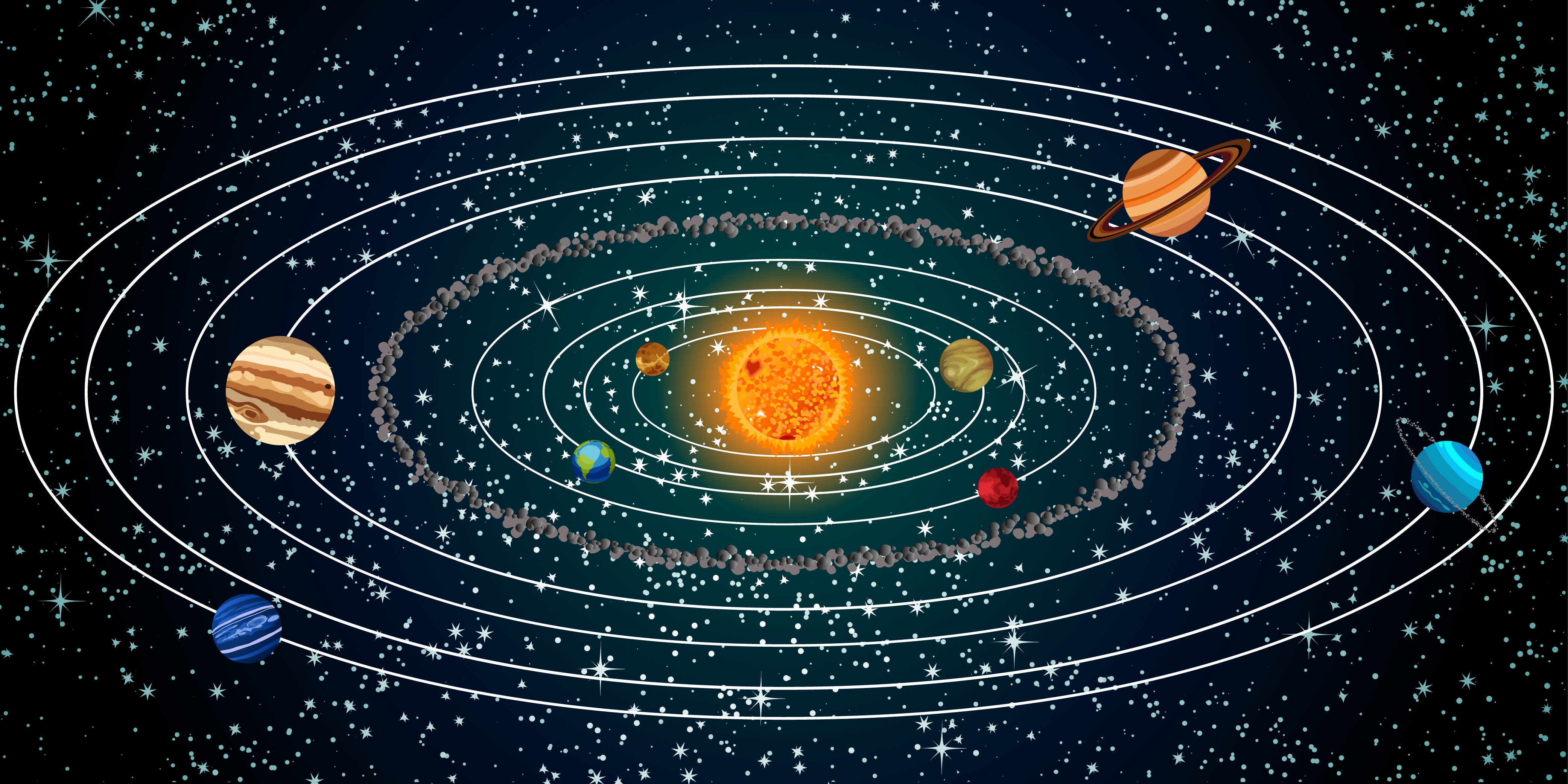
The model shows planets in Earth's solar system. What information can be observed from this model?

a)

the distance of the planets from each other

b)

the composition of the planets' atmospheres

c)

the size of the planets compared to each other

d)

the speed of the planets' orbits around the Sun

48.

Pluto is called a dwarf planet. It is smaller than the planets in the solar system. The diameter of each solar system planet is listed in the table. Which planet is MOST likely closest to Pluto in size?

a)

Mars

b)

Mercury

c)

Jupiter

d)

Neptune

49.

The chart shows information about planets. The diameter of a planet is the distance from one side to the other through the middle at the widest part. Which two planets are closest in size?

a)

Uranus and Neptune

b)

Venus and Mars

c)

Jupiter and Saturn

d)

Mercury and Earth

50.

Earth is a part of the galaxy known as the ...

a)

Andromeda galaxy

b)

Snickers galaxy

c)

Milky Way galaxy

d)

Starburst galaxy

51.

The inner planets include...

a)

Mercury, Venus, Earth, and Mars.

b)

Jupiter, Saturn, Uranus, and Neptune.

c)

Mercury, Saturn, Jupiter, and Earth.

d)

Venus, Mars, Neptune, and Uranus.

52.
Gravity on the moon is _____ than that on the Earth.
a)
the same
b)
greater
c)
less
d)
non existent
53.
A meteorite is DIFFERENT from a comet mainly because
a)
has a tail of ice and gas
b)
is found in orbit between Jupiter and Mars
c)
enters the Earth's atmoshere
d)
has a nucleus mad of rock and snow.
54.
What is the ISS?
a)
International Student Services
b)
Inside Sun Secrets
c)
International Space Station
d)
Iraq Space Services
55.
Any object that revolves around another object
a)
orbiter
b)
satellite
c)
moon
d)
stalker
56.
Instrument that travels into the solar system, gathers information and sends it back to Earth
a)
Space shuttle
b)
Rocket
c)
Space ship
d)
Space probe