
 Worksheets
The Big Bang Theory and Planetary Motion Review
Total questions: 15
Worksheet time: 17mins
Name
Class
Date
1.
How old is our universe?
a)
13.8 thousand years
b)
13.8 million years
c)
13.8 billion years
d)
13.8 trillion years
2.
The event that marks the beginning of our known universe
a)
Theory of Evolution
b)
Big Bang Theory
c)
Cell Theory
d)
Blackhole theory
3.

What was the universe like after the Big Bang?
a)
Cool and Thin
b)
Only two dimentional
c)
Flat and Freezing
d)
Hot and Dense
4.

Who thought the universe was expanding?
a)
Hubble
b)
Copericus
c)
Ptolemy
d)
Socrates
5.

What does the Big Bang theory suggest?
a)
The universe was just there
b)
The Milky Way is the only solar system
c)
The universe is continually expanding
d)
The universe started as a point and is moving towards each other
6.
Which statement is true?
a)
The galaxies are moving toward us.
b)
The galaxies are moving away from us.
c)
The universe remains static or unchanged in motion.
d)
None of the above
7.
Which of the following is NOT true about the Big Bang Theory?
a)
It is the scientific explanation of how life began on Earth and evolved over time.
b)
It is the scientific explanation for the origin of the universe.
c)
It states that the universe expanded from a single point and is still expanding today.
d)
It states that the universe used to be much hotter and smaller.
8.
What forces cause a planet to orbit?
a)
gravity and orbit
b)
gravity and inertia
c)
gravity and mass
d)
gravity and weight
9.
What would happen to the planets in the solar system if the sun’s gravitational force were to suddenly disappear?
a)
They will stop moving and become static.
b)
They will stop spinning.
c)
They will fly away in straight lines.
d)
They will start moving toward the Sun
10.
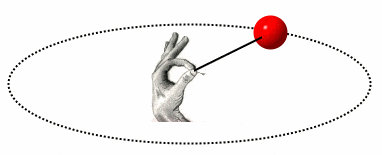
Which force in the Solar System is similar to the tension in the string?
a)
Friction
b)
Inertia
c)
Force
d)
Gravity
11.

The tendency of an object to resist changes in its motion is...
a)
inertia
b)
force
c)
acceleration
d)
velocity
12.

The force of attraction between all matter.
a)
inertia
b)
friction
c)
net force
d)
gravity
13.
Planets orbit the Sun in a shape called a(n)
a)
circle
b)
ellipse
c)
focus
d)
perihelion
14.
A planet moves __________ when it is farthest from the sun.
a)
faster
b)
slower
15.
The path a planet travels around the sun is called its
a)
orbit
b)
ellipse
c)
barycenter
d)
precession
100 %

