
 Worksheets
Hertzsprung-Russell Diagrams
Total questions: 19
Worksheet time: 13mins
Name
Class
Date
1.
Which of the following is not an accepted use of an H-R diagram?
a)
Visual way to “graph” and categorize stars based on their characteristics
b)
Allows astronomers to recognize patterns in types of stars
c)
Allows us to track the life cycle of stars as they change over time
d)
Allows us to determine the distance of stars with great accuracy
2.
Absolute magnitude is defined as...
a)
the brightness of an object in space, measured as if you’re 10 parsecs away from the object.
b)
Total energy emitted by a space object per unit time.
c)
the brightness of an object in space, as it appears from Earth
d)
the color of an object in space, described on a number scale.
3.
If an object has a luminosity of 7.5, this means...
a)
the object is 7.5 times brighter than the sun.
b)
the object is 7.5% brighter than the sun
c)
the object has a redder color than the sun.
d)
the object is 7.5 times smaller than the sun.
4.
The effective temperature of a star is related to its...
a)
solar system
b)
luminosity
c)
absolute magnitude
d)
color
5.
Spectral class is a way of describing a star’s
a)
size
b)
luminosity
c)
age
d)
color
6.
The color index of a star provides information about that star’s
a)
age
b)
luminosity
c)
absolute magnitude
d)
temperature
7.
An open cluster has ___________ stars.
a)
less than 100
b)
more than 100,000
c)
less than 50
d)
more than 500
8.
A globular cluster has ___________ stars.
a)
less than 100
b)
more than 100,000
c)
less than 50
d)
more than 500
9.

This is an H-R Diagram of a star cluster. Which of the following is true about the stars in Area 1 (bound by the red box)
a)
These stars are red giants.
b)
These stars are white dwarfs.
c)
These stars are main sequence stars.
d)
These stars are in the first half of their life span.
10.

This is an H-R Diagram of a star cluster. The stars that are not in Area 1 or Area 2 are part of the...
a)
main sequence
b)
white dwarf group
c)
blue giant group
d)
instability strip
11.

These are H-R Diagrams of different star clusters. Which one of these clusters is oldest and how do you know?
a)
The right; It has the highest proportion of stars that have become red giants.
b)
The middle; it has the highest proportion of stars in the main sequence.
c)
The right; It has the highest proportion of brown dwarf stars.
d)
The left; it has the highest number of blue giants.
12.

In which region of the H-R Diagram would you be likely to find Blue Giants?
a)
W
b)
X
c)
Y
d)
Z
13.

In which region of the H-R Diagram would you be likely to find the oldest stars?
a)
W
b)
X
c)
Y
d)
Z
14.
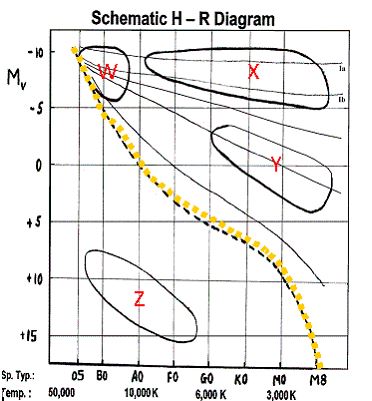
In which region of the H-R Diagram would you be likely to find stars fusing hydrogen to make helium in their cores?
a)
W
b)
X
c)
Y
d)
The orange dashed line
15.

In which region of the H-R Diagram would you be likely to find stars that are in hydrostatic equilibrium?
a)
W
b)
X
c)
Y
d)
The orange dashed line
16.

In which region of the H-R Diagram would you be likely to find the brightest, reddest stars?
a)
W
b)
X
c)
Y
d)
The orange dashed line
17.

What is the primary difference between a star of spectral class K0 in the Y region, compared to a star of spectral class K0 in the X region?
a)
temperature
b)
color
c)
brightness
d)
color index
18.
The luminosity of a star correlates most closely with a star's...
a)
size
b)
color
c)
spectral class
d)
temperature
19.

Which corner of the H-R diagram has the stars with the shortest life spans?
a)
upper left
b)
upper right
c)
lower left
d)
lower right
100 %

