
 Worksheets
Electrolysis Y10
Total questions: 25
Worksheet time: 22mins
Name
Class
Date
1.

Name gas A
a)
hydrogen
b)
chlorine
c)
water
d)
sodium hydroxide
2.

Name product C
a)
hydrogen
b)
chlorine
c)
water
d)
sodium hydroxide
3.
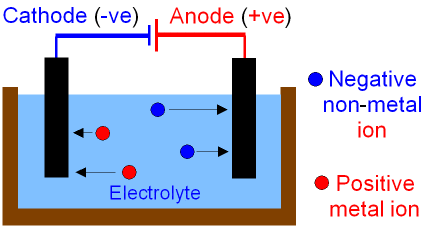
Electrolysis is .....
a)
conduction of electricity by the ionic compound in solid state
b)
conduction of electricity by ionic compound in molten and aqueous state
4.
positive electrode in electrolysis is called as....
a)
anode
b)
cathode
5.

Name gas A & B
a)
Gas A - hydrogen
Gas B - Oxygen
Gas B - Oxygen
b)
Gas A - Oxygen
Gas B - Hydrogen
Gas B - Hydrogen
6.

Name the product at B
a)
hydrogen
b)
chlorine
c)
water
d)
sodium hydroxide
7.
Name the product at B
a)
hydrogen
b)
chlorine
c)
water
d)
sodium hydroxide
8.
What is electrolysis?
a)
breaking down of a compound using a current
b)
making a compound using a current
9.
Which statement correctly describes the 2 electrodes?
a)
The anode is negative and the cathode is positive
b)
The anode and cathode are both positive
c)
The anode is positive and the cathode is negative
d)
The anode and cathode are both negative.
10.
What happens at the positive electrode?
a)
Positive non-metal ions are attracted
b)
Positive metal ions are attracted
c)
Negative non-metal ions are attracted
d)
Negative metal ions are attracted
11.
Explain why the electrolyte has to be a liquid
a)
So the ions can move
b)
So the electrons can move
c)
So that it doesn't get too hot
d)
So the fish are ok
12.
What happens to the metal ions during electrolysis?
a)
Nothing
b)
Reduction; they gain electrons
c)
Oxidation; they gain electrons
d)
Reduction; they lose electrons
13.
Why can ionic compounds not conduct electricity when they are solid?
a)
their electrons are not free to move
b)
their ions are free to move
c)
their ions are not free to move
d)
their electrons are free to move
14.
Describe oxidation in terms of electrons
a)
oxidation is gain of electrons
b)
oxidation is loss of electrons
15.
What would the charges be on the ions that make up Al2O3?
a)
Al2+ and O3-
b)
Al2- and O3+
c)
Al3+ and O2-
d)
Al3- and O2+
16.
What would the charges be on the ions that make up NaCl?
a)
Na+ and Cl-
b)
Na- and Cl+
c)
Na+ and Cl-
17.
Complete the half equation Al3+ -->
a)
Al3+ - 3e- --> Al
b)
Al2+ + 3e- --> Al
c)
Al3+ + 3e- --> Al
d)
Al3+ --> Al + 3e-
18.
What element is used to make up the electrodes?
a)
oxygen
b)
iron
c)
carbon
d)
magnesium
19.
Finish the statement...."Opposites..."
a)
repel
b)
attract
c)
do nothing
20.
When NaCl solution is electrolysed what has forms at the anode?
a)
Hydrogen
b)
Oxygen
c)
Chlorine
d)
Sodium
21.
What is the equation to show what happens to Cl ions at the anode.
a)
Cl- --> Cl + e-
b)
2Cl- --> Cl2 + 2e-
c)
Cl2 + 2e- 2Cl-
d)
Cl2 + 2e- --> 2Cl-
22.
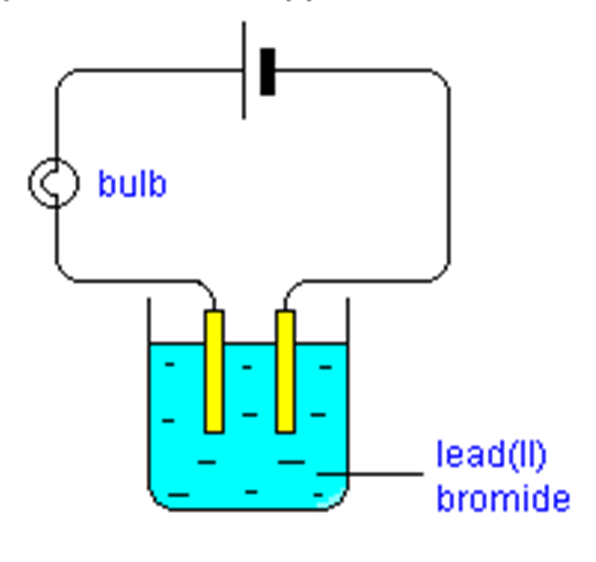
The diagram shows the electrolysis of lead(II) bromide using inert electrodes. Why does the bulb only light up when the lead(II) bromide is melted?
a)
Bromine atoms in lead(II) bromide are converted to ions when it is melted
b)
Electrons flow through the lead(II) bromide when it is melted
c)
The ions in lead(II) bromide are acting as the mobile charge carriers when it is melted
d)
There are no ions in solid lead(II) bromide
23.
Reduction occurs at the
a)
anode
b)
cathode
24.
What is the product formed at the cathode during the electrolysis of molten magnesium fluoride?
a)
magnesium
b)
hydrogen
c)
fluorine
d)
oxygen
25.
What is the product formed at the anode during the electrolysis of concentrated copper(II) chloride?
a)
copper
b)
chlorine
c)
hydrogen
d)
oxygen
100 %

