
 Worksheets
Physical Science Unit 2 - Forces (Practice)
Total questions: 35
Worksheet time: 39mins
The SI unit of force is...
Kilograms
Newtons
Meters per second
Pounds
If a baseball and a cannonball are dropped from the same height at the same time, which ball will hit the ground first? (Assume air resistance is negligible.)
the cannonball
the baseball
The balls land at the same time.
the ball with the larger volume
For every force exerted on an object, there is an equal and opposite force exerted on a different object.
Newton’s first law of motion
Newton’s second law of motion
Newton’s third law of motion
If a force of 26 N is exerted on two balls, one with a mass of 0.52 kg and the other with a mass of 0.78 kg, which ball will have greater acceleration? (F = ma)
The one with a mass of 0.78 kg will have greater acceleration.
The one with a mass of 0.52 kg will have greater acceleration.
They will both accelerate at the same rate.
Without any force to change it, an object at rest stays at rest, and an object in motion stays in motion.
Newton’s first law of motion
Newton’s second law of motion
Newton’s third law of motion
A greater applied force is required to move an object with more mass than one with less mass.
True
False
If you exert a net force of 8 N on a 2 kg object, what will its acceleration be?
2 m/s2
4 m/s2
16 m/s2
10 m/s2
The swimmer moves her hand backward and to the left, causing her body to move forward and to the right.
Newton's 1st Law
Newton's 2nd Law
Newton's 3rd Law
A force of 20 N acts on a 5 kg block. What is its acceleration?
4 m/s2
100 m/s2
10 m/s2
5 m/s2
An object will have greater acceleration if a greater force acts on it.
Newton's 1st Law
Newton's 2nd Law
Newton's 3rd Law
A force in the opposite direction to the motion of an object will cause the object to
speed up
slow down
turn
crash
When the net force is zero, the forces acting on an object are balanced. True or false.
true
false
What can a force do?
All of the above
Start a motion
Stop a motion
Change the direction of motion
An object with zero net force can be moving.
true
false
An object with zero net force could be moving in a circle at a constant speed.
false
true

A truck traveling at a constant speed is carrying some boxes. If the truck comes to a sudden stop, what will most likely happen to the boxes?
They will stay in the middle of the truck.
They will slide toward the front of the truck.
They will slide toward the back of the truck.
They will fall off the side of the truck.
What is the formula that describes the relationship between an object's mass, its acceleration, and the applied force?
y = mx + b
a2 + b2 = c2
Fa = m
F = ma
Which law states that if I push against a wall, the wall pushes back against me?
Law 2
Law 3
You hit a wall with a stick. The equal but opposite reaction is _____
the wall pushes against you
the stick pushes against you
you push against the stick
the wall pushes against the stick
Will a roller coaster filled only with heavy riders go faster down the track than one filled only with light riders?
Yes
No
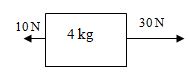
Calculate the acceleration of the 4 kg block shown in the diagram below.
20 m/s2
5 m/s2
0.2 m/s2
80 m/s2

Calculate the net force.
16 N
4 N
0.25 N

Calculate the acceleration.
8
1
.125
5
Which of the following factors directly affect sliding friction between two objects? (Select all that apply.)
speed of the sliding object
surface area in contact
roughness of the surfaces
force pushing the surfaces together
Which of the following factors directly affect the air resistance acting on an object? (Select all that apply.)
speed of the object
surface area
mass
weight
What happens to an object's velocity when a net force is applied in the same direction as its motion?
It decreases
It remains constant
It increases
It reverses direction
If two objects of different masses are dropped from the same height in a vacuum, what will happen?
The heavier object will hit the ground first.
The lighter object will hit the ground first.
Both objects will hit the ground at the same time.
The objects will float.
A heavy object and a lightweight object are falling, and both have reached terminal velocity. Which object is falling faster?
The heavy object
The lightweight object
They fall at the same speed
A heavy object and a lightweight object are falling, and both have reached terminal velocity. Which object has more air resistance acting on it?
The heavy object
The lightweight object
They experience the same air resistance
A box is being pulled along the ground at a constant velocity with a pulling force of 220 N. What is the force of friction acting on the box? What is the net force acting on the box?
The friction force is 0 N and the net force is 220 N
The friction force is 220 N and the net force is 0 N
Both friction and the net force are 0 N
Both friction and the net force are 220 N

