
 Worksheets
Refraction & Snell's Law
Total questions: 35
Worksheet time: 27mins
Name
Class
Date
1.
A ray of light traveling from air into crown glass strikes the surface at an angle of 30 degrees. What is the angle of refraction? (air n=1, crown glass n=1.532)
a)
39.7 degrees
b)
19.2 degrees
c)
59.1 degrees
d)
12.3 degrees
2.
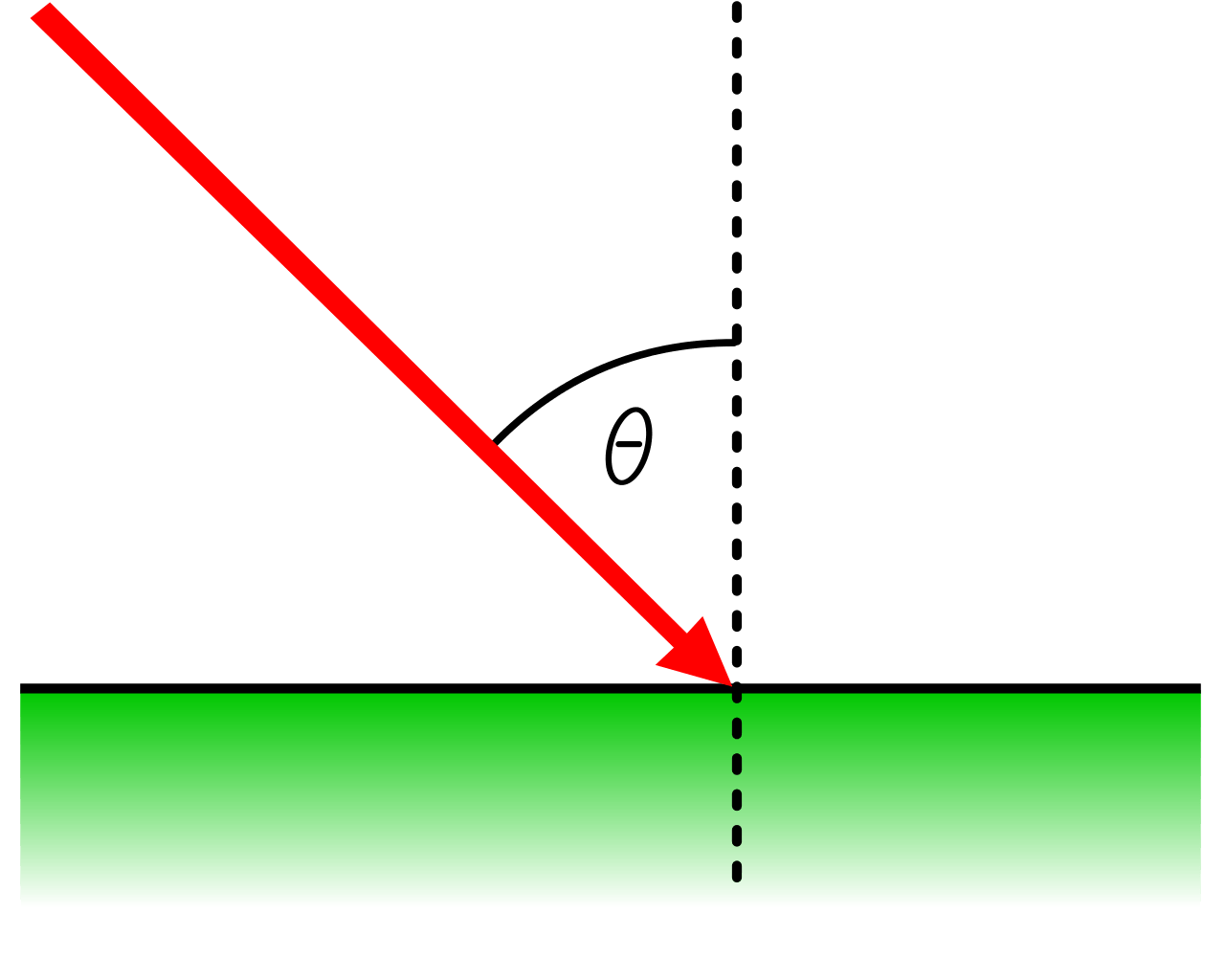
According to the Law of reflection, a light ray striking a mirror
a)
continues moving through the mirror in the same direction
b)
moves into the mirror at a slightly different angle
c)
bounces off the mirror toward the direction it came from
d)
bounces off the mirror at the same angle it hits.
3.

Glass has a _____________ index of refraction than air.
a)
Equal
b)
Greater
c)
Less
d)
Impossible to say
4.

The fact the two angles are the same is an example of....
a)
Refraction
b)
Angle of Incidence
c)
Law of reflection
d)
Magnification
5.
The measure of how much light refracts is called...
a)
Refraction
b)
Law of reflection
c)
reflected ray
d)
Index of refraction
6.

This shows the phenomenon known as....
a)
reflection
b)
refraction
c)
mirrors
d)
focal point
7.

How does light behave as it enters these mediums?
a)
continue its path as straight line.
b)
bends toward the normal
c)
bends away from the normal
d)
reflects
8.
The velocity of light in vacuum is _______ m/s.
a)
3x10⁸
b)
3x10¹²
c)
3x10⁶
d)
3x10¹⁰
9.
Absolute refractive index of any medium is always _______.
a)
less than 1
b)
greater than 1
c)
1
d)
0
10.
The formula to calculate the refractive index is
a)
n=cv
b)
n=v/c
c)
n=c/v
d)
v=nc
11.
What is the index of refraction of a refractive liquid if the angle of incidence in the air is 35 degrees and the angle of refraction is 14 degrees?
a)
1.33
b)
2.21
c)
2.37
d)
1.72
12.
What is the index of refraction of a refractive medium if the angle of incidence in the air is 40 degrees and the angle of refraction is 29 degrees?
a)
1.32
b)
2.06
c)
1.523
d)
1.586
13.
If the angle of incidence of light traveling through air, and then striking water is 30 degrees what is the angle of refraction? (n=1 air, n=1.33 water)
a)
15 degrees
b)
22 degrees
c)
43 degrees
d)
17 degrees
14.
Light has the highest velocity in which medium?
flint glass n=1.70
barium glass n=1.60
crown glass n=1.523
water n=1.33
diamond n=2.45
flint glass n=1.70
barium glass n=1.60
crown glass n=1.523
water n=1.33
diamond n=2.45
a)
diamond
b)
water
c)
flint glass
d)
barium glass
15.
Light has the lowest velocity in which medium?
flint glass n=1.70
barium glass n=1.60
crown glass n=1.523
water n=1.33
diamond n=2.45
flint glass n=1.70
barium glass n=1.60
crown glass n=1.523
water n=1.33
diamond n=2.45
a)
diamond
b)
water
c)
flint glass
d)
barium glass
16.
Light has the lowest velocity in which medium?
flint glass n=1.70
barium glass n=1.60
crown glass n=1.523
water n=1.33
diamond n=2.45
flint glass n=1.70
barium glass n=1.60
crown glass n=1.523
water n=1.33
diamond n=2.45
a)
diamond
b)
water
c)
flint glass
d)
barium glass
17.
The separation of white light into its component colors is known as:
a)
polarization
b)
refraction
c)
reflection
d)
dispersion
18.
If a pulse of red light and a pulse of blue light travel in vacuum
a)
The red pulse travels faster because its index of refraction is smaller
b)
The blue pulse travels faster
c)
The two pulses travel at the same speed
d)
The relative speed depends on the exact wavelengths of the red and blue pulses
19.
According to Willebord Snell, light passing from air to glass will cause the light to
a)
maintain its original speed
b)
accelerate while it is in glass
c)
increase its speed
d)
reduce its speed
20.
How many colors are in the rainbow?*
a)
Nine
b)
Five
c)
Seven
21.
What do you need to make a rainbow? *
a)
A prism
b)
A book
c)
A train
22.
The velocity of light in vacuum is _______ m/s
a)
3x10⁸
b)
3x10¹²
c)
3x10⁶
d)
3x10¹⁰
23.
We can see objects because of_______
a)
reflection
b)
refraction
c)
transmission
d)
diffraction
24.
a curved piece of glass or other transparent material that refracts light
a)
lens
b)
mirror
c)
mirage
d)
reflection
25.
a transparent material that refracts light; it is thinner in the center than at the edges
a)
concave lens
b)
convex lens
c)
concave mirror
d)
convex mirror
26.
a transparent material that refracts light; it is thicker in the center than at the edges
a)
concave lens
b)
convex lens
c)
concave mirror
d)
convex mirror
27.

How does light behave as it enters these mediums?
a)
continue its path as straight line.
b)
bends toward the normal
c)
bends away from the normal
d)
reflects
28.
According to Willebord Snell, light passing from air to glass will cause the light to
a)
maintain its original speed
b)
accelerate while it is in glass
c)
increase its speed
d)
reduce its speed
29.
The velocity of light in vacuum is _______ ms(-1)
a)
3x10⁸
b)
3x10¹²
c)
3x10⁶
d)
3x10¹⁰
30.
Absolute refractive index of any medium is always _______.
a)
less than 1
b)
greater than 1
c)
1
d)
0
31.
The formula to calculate the refractive index is
a)
n=cv
b)
n=v/c
c)
n=c/v
d)
v=nc
32.
Swimming pools and the ocean look shallower than they really are due to:
a)
reflection
b)
dispersion
c)
refraction
d)
total internal reflection
33.
A light ray hits a plane surface at 20 degrees. What is the angle between the incident and reflected rays.
a)
20o
b)
40o
c)
70o
d)
30o
34.
What is a property of a transparent object?
a)
Almost all of the light rays that reach it are scattered.
b)
Almost all of the light rays that reach it are absorbed.
c)
Almost all of the light rays that reach it are reflected.
d)
Almost all of the light rays that reach it pass through it.
35.
What is most likely to happen to light that hits an opaque object?
a)
All of the light passes through the object.
b)
None of the light passes through the object.
c)
Most of the light disappears.
d)
Some of the light passes through the object.
100 %

