
 Worksheets
Evidence of Evolution
Total questions: 31
Worksheet time: 27mins
Name
Class
Date
1.
Which of the following pieces of evolution evidence deals with similar molecules in related individual species?
a)
fossil record
b)
comparative embryology
c)
DNA comparison
d)
comparative anatomy
2.
Which of the following pieces of evolution evidence deals with comparing similar structures in various species?
a)
fossil record
b)
comparing embryology
c)
comparing biochemistry
d)
comparing anatomy
3.
Which of the following pieces of evolution evidence deals with structures common in embryos that form differently or for different purposes in adult form?
a)
fossil record
b)
comparing embryology
c)
comparing biochemistry
d)
comparing anatomy
4.

The forelimbs of penguin, alligator, bat, human are which of the following?
a)
homologous structures
b)
vestigial structures
5.

If an organism has a vestigial structure, that structure likely once had a function in a(n)
a)
close relative
b)
early ancestor
c)
unrelated organism
d)
embryological stage
6.

Two organisms that are closely related would have
a)
very similar DNA sequence
b)
exactly the same DNA sequences
c)
no proteins in common
d)
completely different DNA sequence
7.

How would you describe this evolution?
a)
Homologous structure
b)
Analogous structure
c)
Structural adaption
d)
Functional adaption
8.

Which best describes these fossils?
a)
The oldest fossils can be found on the lower layers
b)
The oldest fossils can be found at the top layers
c)
The youngest fossils are always found on the bottom layers
d)
You can not tell the age of any of these fossils
9.

Structures with the same parts have different functions; suggests that organisms share a common ancestry
a)
vestigial structures
b)
homologous structures
c)
adaptive radiation
d)
fossil
10.

The diagram above shows an embryo of different vertebrates at different stages of development. Which field of study would support the similarities in development as evidence for evolution?
a)
comparative biochemistry
b)
paleontology
c)
comparative biogeography
d)
comparative embryology
11.

The forelimbs of vertebrates, like the ones pictured here, are similar in terms of number of bones and the orientation of bones. Which best describes how comparing homologous structures provides evidence of evolution?
a)
The genes for the body plan and forelimb layout were present in a common ancestral species vertebrates share, thus passed onto all vertebrates.
b)
Similar anatomical structures show how animals adapt to changing environments
c)
Homologous structures show that different species evolve at different rates
d)
Homologous structures don’t actually provide evidence for evolution
12.
A fossil of an extinct dinosaur is found and the anatomy of the fossil shows similarities to that of a bird. What could this mean?
a)
This is purely by chance and isn't significant
b)
The extinct dinosaur and modern bird share a common ancestor
c)
All dinosaurs evolved into birds and that's why there aren't any dinosaurs alive today
d)
Dinosaurs choose to fly, and evolved into birds to escape predation and capture food
13.

The diagram illustrates an embryonic stage of two organisms.
Which of the following can be determined by observing the embryos shown in the diagram
Which of the following can be determined by observing the embryos shown in the diagram
a)
The organisms share a common ancestry.
b)
The organisms belong to the same genus.
c)
The organisms are native to the same geographic areas.
d)
The organisms will grow into anatomically similar adults.
14.

Structures that have different mature forms but develop from the same embryonic tissue are called
a)
analagous
b)
adaptations
c)
homologous
d)
fossils
15.
Whales are aquatic mammals that contain a pelvis bone. Even though it does not aid in its movement, the function must have been used by a common ancestor of the whale. Thus, the pelvis is referred to as a(n)
a)
vestigial structure
b)
analogous structure
c)
homologous structure
16.
If species A and B have very similar genes and proteins, what is probably TRUE?
a)
species A and B share a relatively recent common ancestor
b)
species A evolved independently of species B for a long period
c)
species A is younger than species B
d)
species A is older than species B
17.
Anatomical remnants (left over structures) that were important in the organism's ancestors, but are no longer used in the same way.
a)
Homologous Structures
b)
Analogous Structures
c)
Vestigial Structures
d)
Comparative Anatomy
18.
Structures that are similar in form (structures) with different functions such as the wings of a bat and the arms of humans.
a)
Homologous Structures
b)
Vestigial Structures
c)
Analogous Structures
d)
Molecular Homology
19.
This can show the changes that occurred over time for a specific type of creature. Older fossils are found deeper than more recent fossils.
a)
Phylogeny
b)
Homologous Structures
c)
Fossil Record
d)
Vestigial Structures
20.
Comparing embryos at different stages of development can show different relationships between species.
a)
Embryology
b)
Cladogram
c)
Homologous Structures
d)
Analogous Structures
21.
The comparing of similarities and differences of body structures in form and function.
a)
Analogous Structures
b)
Common Ancestry
c)
Comparative Anatomy
d)
Fossil Record
22.
Structures that are very different in structure or anatomy but have similar functions such as the wings of a bird and a butterfly.
a)
Vestigial Structures
b)
Homologous Structures
c)
Analogous Structures
d)
Cladogram
23.
Which of the following pieces of evolution evidence deals with aged and identified fossils?
a)
fossil record
b)
comparative embryology
c)
comparative biochemistry
d)
comparative anatomy
24.

Which three animals are most distantly related?
a)
The elephant, Manatee, and Yellow Frog
b)
The Yellow Frog, Salamander, and Bird
c)
The Lungfish, Crocodile, and Bird
d)
The Elephant, Lungfish, and Crocodile
25.

How many animals have an amniotic egg?
a)
2
b)
3
c)
4
d)
5
26.

Which two orgainsms have hair?
a)
Sharks & Ray Finned Fish
b)
Primates & Rodents
c)
Birds & Crocodiles
d)
Rabbits & Birds
27.

According to this cladogram, sharks are MOST closely related to which organism?
a)
Amphibians
b)
Ray finned fish
c)
Crocodiles
d)
Birds
28.
Deer fighting for a mate is an example of ____________.
a)
overproduction
b)
competition
c)
variation
d)
selection
29.
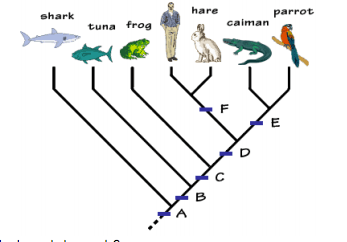
On the cladogram, which organism is the closest relative of the human?
a)
Frog
b)
Hare
c)
Caiman
d)
Parrot
30.
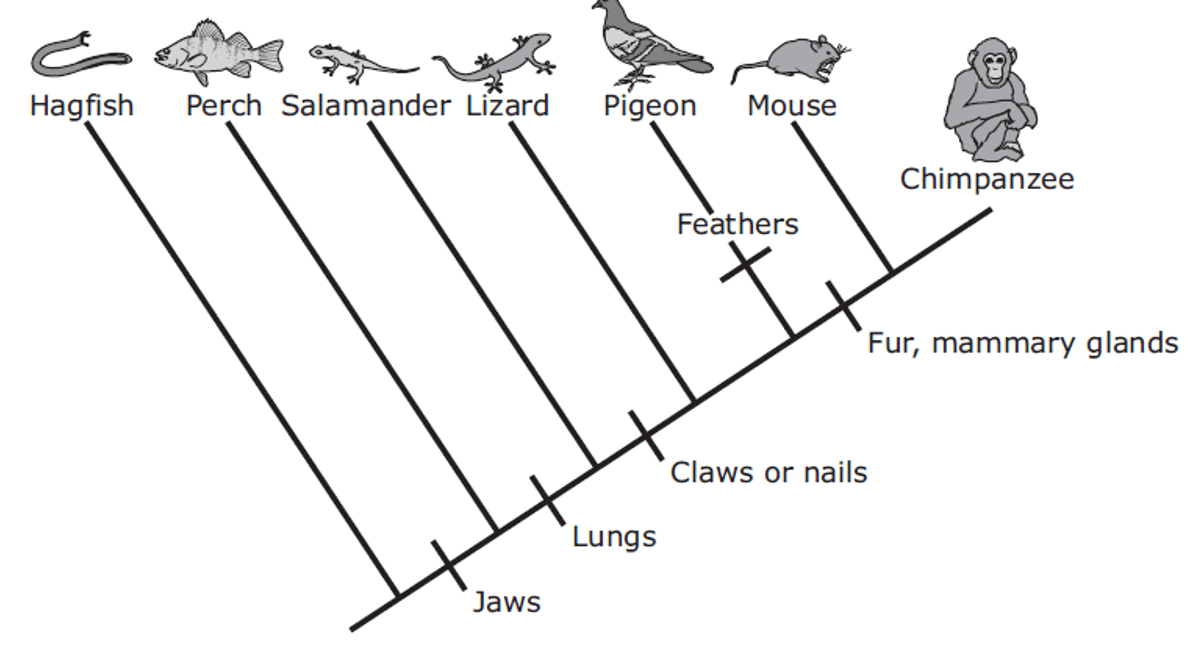
All the animals to the right of the hagfish would have the common characteristic of -
a)
Fur
b)
Claws or nails
c)
Lungs
d)
Jaws
31.

According to this cladogram, birds are LEAST related to -
a)
Amphibians
b)
Sharks
c)
Ray Finned Fish
d)
Crocodiles
100 %

