
 Worksheets
Economics: Chapter 2 Test Review
Total questions: 37
Worksheet time: 19mins
Name
Class
Date
1.

Consumers in command economies have an unlimited amount of all goods available to them.
a)
True
b)
False
2.

In a pure market economy, market forces coordinate production as if by an "invisible hand."
a)
True
b)
False
3.

The United States is a mixed economy, but markets play a relatively large role.
a)
True
b)
False
4.

A traditional economy is shaped largely by custom or religion.
a)
True
b)
False
5.

Any movement along the PPF (production possibilities frontier) involves produce less of one good to produce more of the other.
a)
True
b)
False
6.

An outward shift of the PPF (production possibilities frontier) reflects an economic downturn.
a)
True
b)
False
7.

In a market economy, what rights give resource owners the freedom to use their resources as they see fit?
a)
monopoly rights
b)
voting rights
c)
property rights
d)
economic rights
8.

Which of the following is NOT true of a pure market economy?
a)
resource owners have property rights
b)
markets are regulated by the government
c)
prices guide resources to the most productive use
d)
markets answer the what, how and for whom questions
9.
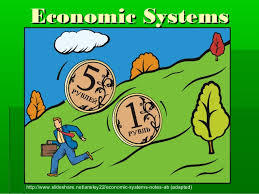
An economic system is the set of mechanisms and institutions that resolve the what, how, and for whom questions that all economies must answer.
a)
True
b)
False
10.

An economic system in which all resources are government-owned and all production is directed by the central plans of government is known as a
a)
pure market economy
b)
mixed economy
c)
pure command economy
d)
monopoly economy
11.

The economy of the United States can be described as
a)
traditional economy
b)
pure market economy
c)
command economy
d)
mixed economy
12.

Transitional economies are in the process of
a)
privatization
b)
monopoly-building
c)
centralizing economic decisions
d)
getting rid of private property
13.

In a pure market economy, firms do not produce public goods because
a)
government produces all public goods
b)
firms cannot sell public goods profitably
c)
firms do not receive the benefits of public goods
d)
government has an absolute advantage in producing public goods
14.

An example of a public good, in an economic context, is
a)
national defense spending
b)
lower new car prices
c)
longer library hours
d)
cheaper gas prices
15.
Suppose a steel factory pollutes the water that local residents must drink, but the market price of steel fails to reflect such costs. Because the pollution costs are outside the market transaction, they are called
a)
public costs
b)
opportunity costs
c)
externalities
d)
rules of the game
16.

Which factor might best help an economy grow?
a)
less immigration
b)
labor force increases
c)
cleaner air
d)
lowering educational standards
17.

The law of comparative advantage helps explain
a)
why some products do better than others
b)
opportunity costs
c)
how economists work
d)
why a person talented in many things can get more done by specialization
18.
Being able to make something using fewer resources than other producers require would give you a(n)
a)
monopoly
b)
absolute advantage
c)
comparative advantage
d)
comparative disadvantage
19.

The main medium of exchange in the United States is
a)
barter
b)
money
c)
stock
d)
bonds
20.

Most economies today are
a)
mixed economies
b)
traditional economies
c)
pure market economies
d)
pure command economies
21.
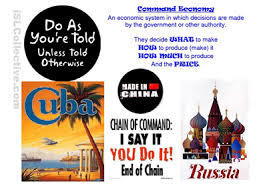
Which of the following is a problem with pure command economies?
a)
difficulty enforcing property rights
b)
excess consumer goods
c)
inability to provide for national defense
d)
environmental damage
22.

Which type of economy produces the highest standard of loving for its citizens?
a)
transitional
b)
market-oriented
c)
traditional
d)
command
23.

Converting government enterprises into private enterprises is a process called
a)
privatization
b)
specialization
c)
division of labor
d)
communism
24.

According to Adam Smith, although each individual pursues his or her self-interest in a market economy, the "invisible hand" o ____ promotes the general welfare.
a)
market competition (forces)
b)
specialization
c)
privatization
d)
communism
25.

__ occurs when individual workers focus on single tasks, enabling each worker to become more efficient and productive.
a)
specialization
b)
privatization
c)
property rights
d)
communism
26.
According to the law of comparative advantage, the worker with the lower ___ of producing a particular output should specialize in that output.
a)
opportunity cost
b)
division of labor
c)
property rights
d)
public goods
27.

A system of exchange in which products are traded directly for other products is
a)
money
b)
barter
c)
division of labor
d)
privatization
28.

__ serves as a medium of exchange because it is the one thing that everyone is willing to accept in exchange for all goods and services.
a)
money
b)
barter
c)
opportunity cost
d)
property rights
29.

The ___ organizes the production process so that each worker specializes in a separate task.
a)
division of labor
b)
privatization
c)
communism
d)
property rights
30.

__ assures resource owners that they have the use of their resources and are free to supply those resources to the highest bidder.
a)
property rights
b)
public goods
c)
opportunity cost
d)
privatization
31.

Private firms do not produce so-called ___, such as national defense.
a)
public goods
b)
private goods
c)
opportunity cost
d)
market forces
32.

A command economy is sometimes called ___.
a)
communism
b)
liberitarianism
c)
capitalism
d)
activism
33.
The law of increasing opportunity cost states that each additional unit of one good requires the economy to give up successively larger increments of the other good.
a)
True
b)
False
34.
What could shift an economy's PPF?
a)
changes in resources available
b)
changes in capital goods
c)
changes in technology
d)
All of these
35.
What do points inside the PPF represent?
a)
inefficiency
b)
unattainable combinations of resources
c)
division of labor
d)
none of these
36.
What do points outside the PPF represent?
a)
inefficiency
b)
unattainable combinations of resources
c)
division of labor
d)
none of these
37.
What is the role of entrepreneurs in a pure command economy?
a)
They have no role.
b)
To create new products or methods of production.
c)
To work for the government as inventors.
100 %

