
 Worksheets
Classification of Kingdoms
Total questions: 29
Worksheet time: 16mins
Name
Class
Date
1.
Which class is a vertebrate that lives in water and on land in its lifetime?
a)
mammal
b)
reptile
c)
fish
d)
amphibian
2.
When using a dichotomous key to identify organisms, what do we look at?
a)
physical features
b)
weather patterns
c)
habitat
d)
eye color
3.

A dichotomous key for trees is provided. Hikers found a tree that has large brown cones and single sharp needles. What species of tree have the hikers found?
a)
Juniper
b)
Pine
c)
Spruce
d)
Fir
4.

What trait best SEPARATES these animals into groups.
a)
The color of the animals skin/fur
b)
Body covering (fur/blubber)
c)
The gender of the animal (male or female)
d)
How old the animals are
5.

These birds were all classified together. What explanation best shows the classification for ALL of these birds
a)
Some birds have long beaks
b)
Birds use their beaks for survival and gathering food
c)
some birds have colorful beaks
d)
some birds have small beaks
6.

How are humans and birds alike
a)
They both have fur and wings
b)
they both give live birth and are cold blooded
c)
they both are warm blooded and are vertebrates
d)
they both have exoskeletons and are invertebrated
7.
On the playground, a group of students observed an animal that had an exoskeleton, eight legs, and joints. The animal they observed was
a)
mammal
b)
vertebrate
c)
mollusk
d)
invertebrate
8.

Which plant does not belong in this group?
a)
daisy
b)
rose
c)
fern
d)
liverwort
9.

How are cacti and pine trees similar?
a)
They both have leaves
b)
they both produce flowers
c)
They are both vascular plants
d)
they are both non-vascular plants
10.
Mosses, liverworts, and hornworts are ___ plants.
a)
non-vascular bryophytes
b)
vascular pteridophytes
c)
vascular angiosperms
d)
vascular gymnosperms
11.
Vascular, seeded plants that contain seeds in cones (or naked seeds) are:
a)
angiosperms
b)
gymnosperms
c)
deciduous
d)
moss
12.
Vascular, seeded plants that contain seeds in fruits (covered seeds) are:
a)
angiosperms
b)
gymnosperms
c)
deciduous
d)
moss
13.

Which of these is not a plant?
a)
evergreen
b)
flower
c)
wheat
d)
mushroom
14.

Pteridophytes such as Whisk ferns reproduce with the help of:
a)
spores
b)
seeds
15.
Redwood trees can grow to be very tall. They can grow so tall because they are
a)
vascular.
b)
deciduous.
c)
nonvascular.
d)
flowering.
16.

These plants are angiosperms because
a)
They reproduce through seeds
b)
They reproduce through cones
c)
They reproduce through spores
d)
They are actually gymnosperms
17.
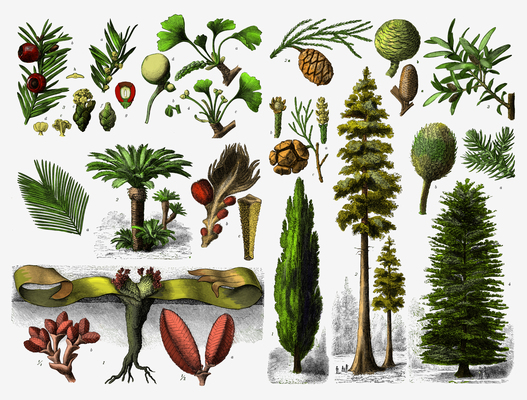
These plants are gymnosperms because
a)
they reproduce through cones
b)
they are vascular
c)
their seeds are visible
d)
all of the above
18.
The scientific name for an organism is made from the:
a)
class and family name
b)
genus and species name
c)
domain and kingdom name
d)
kingdom and phylum name
19.
Members of this kingdom can live in extreme tempertures and conditions such as deep ocean trenches or volcanoes
a)
Eubacteria
b)
Protista
c)
Fungi
d)
Archaebacteria
20.
Term given to describe the 2 name naming system is:
a)
dichotmous key
b)
binomial nomenclature
c)
2 scientific names
d)
binomial key
21.

Which is the most specific classification level?
a)
Domain
b)
Kingdom
c)
Genus
d)
Species
22.
Scientific names are written in ________
a)
Telugu
b)
French
c)
Tamil
d)
Latin
23.

An illustration and a dichotomous key are given. What is the correct classification for this organism?
a)
Class Insecta
b)
Order Amblygygi
c)
Order Araneae
d)
Order Scorpiones
24.
A botanist discovers a new plant in the jungle. Which of the
following observations of the plant’s characteristics would be useful in determining its identity with a dichotomous key?
following observations of the plant’s characteristics would be useful in determining its identity with a dichotomous key?
a)
It was discovered in the summertime by a teenager
b)
It is wet from a recent rain storm.
c)
It has long stems and its leaves curl up on the ends
d)
It is eaten by native jungle ants.
25.

Bonus: List correctly from left to right
These vascular bundles show
These vascular bundles show
a)
A monocot and a dicot
b)
a dicot and a monocot
26.

From the table, which two animals are MOST CLOSELY related
a)
House Cat and Red Fox
b)
Red Fox and Dog
c)
Dog and Wolf
d)
Wolf and Gopher
27.
A snake, iguana, and a turtle are all grouped together because they share similar characteristics. Which of the following characteristics do they NOT share?
a)
smooth, wet skin
b)
cold blooded
c)
lay eggs and dry skin
d)
vertebrates
28.

Although clown fish do not have sharp teeth, they are in the same class as sharks because
a)
They both have scales.
b)
They have the same outer color.
c)
They have the same body shape (fins, backbone)
d)
They both eat the same things.
29.

Which are the largest (broadest) classification levels?
a)
Phylum and class
b)
Family and order
c)
Genus and species
d)
Domain and Kingdom
100 %

