
 Worksheets
Global warming pretest
Total questions: 25
Worksheet time: 6hrs 31mins
Name
Class
Date
1.
Which of the following is not a way in which carbon can exit living plant material in the carbon cycle?
a)
Consumed by an animal
b)
wildfires
c)
dead plant material can be buried under sediment and eventually become fossil fuels
d)
They are all ways in which carbon can exit living plant material in the carbon cycle.
2.
Carbon is released into the atmosphere through all of the following ways except:
a)
respiration
b)
cow flatulence
c)
photosynthesis
d)
all of the above
3.
Which of the following is contributing to an overload of the carbon cycle?
a)
deforestation
b)
photosynthesis
c)
oceans
d)
all of the above
4.
The atmosphere contains ____________________ which is needed for photosynthesis.
a)
oxygen
b)
carbon dioxide
c)
nitrogen
d)
all of the above
5.
What role do the oceans play in the carbon cycle?
a)
They have no role
b)
They are a major absorber (sink( of carbon dioxide
c)
both a and b
d)
neither a nor b
6.
How are humans making greenhouse gases of our own?
a)
with large-scale agriculture
b)
burning forests
c)
burning fossil fuels in our cars
d)
all of the above
7.
Things you can do to help decrease global warming include:
a)
Eat more ice cream.
b)
Keep your freezer door open.
c)
Keep your air conditioner on high.
d)
Turn off your lights when you’re not using them.
8.
Which of the following activities contributes the most to carbon emissions globally?
a)
Deforestation
b)
Agriculture
c)
Burning fossil fuels
d)
Respiration
9.
Carmen is going to the market to purchase food for her family. She is very conscious of her choices and is working to reduce her carbon footprint. Which of the following would help her to be successful in her endeavor?
a)
Purchasing meats packaged at the local supermarket, but trucked in from out of state
b)
Purchasing fresh fruits and vegetables at the local supermarket that were shipped from out of state
c)
Purchasing fresh fruits and vegetables from the local farmer’s market
d)
None of these choices will reduce her carbon footprint
10.
Loss of sea ice by melting in the Arctic Ocean _____________.
a)
will result in cooler temperatures in the Arctic
b)
will result in sea-levels rising
c)
Will have no effect on ecosystems
d)
None of the above
11.
If the climate becomes warmer, sea levels will _____________.
a)
rise,but this will have no impact on humans
b)
fall, which will increase the amount of available land
c)
rise, causing some pacific islands to disappear
d)
fall, which will have no impact on humans
12.
Climate change may have an impact on the following:
a)
Energy and human health
b)
Air quality, oceans, and coastal zones
c)
Agriculture
d)
All of the above
13.
Which of the following might be a beneficial effect of global warming?
a)
Rising sea levels
b)
Increased tourism in certain areas
c)
Increased pests and crop disease in warmer areas
d)
Earlier flowering times for certain plant species
14.
Which of the following is a way that polar bears will be impacted by climate change?
a)
Melted ice will make hunting easier.
b)
Polar bears will face less competition as the climate warms, grizzly bears will stop traveling north.
c)
Increasing numbers and strength of spring rainstorms can cause bear dens to collapse.
d)
Climate change will result in less pollution.
15.

Which picture best represents how the amount of carbon dioxide in the atmosphere has changed over the past 500 years?
a)
top left
b)
bottom left
c)
top right
d)
bottom right
16.
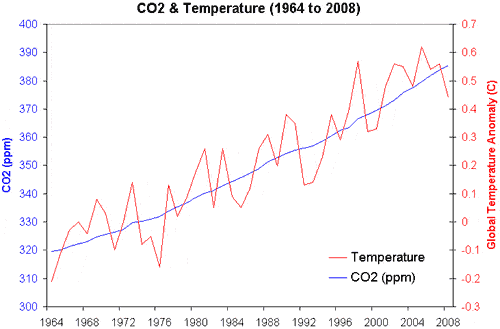
The graph below shows CO2 emissions and temperatures from 1909 to 1949. What conclusion is best supported by the graph?
a)
There is no relationship between carbon dioxide concentrations and temperatures
b)
As carbon dioxide concentrations increase, temperatures increase
c)
As carbon dioxide concentrations increase, temperatures decrease
d)
As carbon dioxide concentrations decrease, temperatures increase
17.
What causes Global Warming?
a)
The Warming of the Earth
b)
Carbon Dioxide being released
c)
All of the above
d)
People
18.
Melting ice caps have caused sea levels in the north to rise. For the first time in hundreds of years, ships can pass through the fabled Northwest Passage above North America.
a)
True
b)
False
19.
Which of the following is NOT an affect of Global Warming?
a)
Rain
b)
Disease Spread
c)
Flooding
d)
Heat
20.
What is carbon footprint?
a)
the total amount of greenhouse gases that are emitted into the atmosphere
b)
the release of a gas
c)
a place or environment where a plant or animal naturally or normally lives of grows
d)
a certain type of greenhouse gas
21.
What is the average weather for a particular time and region called?
a)
drought
b)
weather
c)
emissions
d)
climate
22.
What is the definition of weather?
a)
a period of abnormally dry weather that lasts at least 2 years
b)
the specific condition of the atmosphere at a particular place and time
c)
a complex community of organisms and the community's environment
d)
a release of toxic gas
23.
What is a natural phenomenon that helps regulate the temperature of the Earth called?
a)
Greenhouse Gas
b)
Greenhouse Effect
c)
Nonrenewable Resources
d)
Renewable Resources
24.
A natural resource that CANNOT be produced, regrown, or reused fast enough to keep up with how quickly it is used.
a)
Renewable resource
b)
Nonrenewable resource
c)
thermal energy
d)
environmental resource
25.
A natural resource that can be produced, regrown, or reused fast enough to keep up with how quickly it is used is called...
a)
nonrenewable resource
b)
repeated resource
c)
renewable resource
d)
rejected resource
100 %

