
 Worksheets
Physical Properties Practice Test
Total questions: 40
Worksheet time: 36mins
Name
Class
Date
1.
If I mix two different substances in separate beakers of water, and one seems to disappear and the other sinks to the bottom, which physical property am I most likely testing?
a)
Thermal Conductivity
b)
Mass
c)
Solubility
d)
Magnetism
2.
If I mix Substance X and Substance Z in separate beakers of water, and Substance Z seems to disappear and Substance X sinks to the bottom, which conclusion can be made?
a)
Substance X is soluble and Substance Z is not soluble.
b)
Substance X is not soluble and Substance Z is soluble.
c)
Substance X has no density and Substance Z has a lot of density.
d)
No conclusions can be made because Substance Z disappeared
3.

I have a block of wood that is 1 meter long, 1 meter wide and 1 meter tall (1 cubic meter in volume). I have listed the results of some tests in a chart.
Which results of the test will remain the same for a small piece of the same block?
Which results of the test will remain the same for a small piece of the same block?
a)
solubility, mass, volume
b)
magnetism, conductivity, density
c)
mass, density, magnetism
d)
conductivity, volume, solubility
4.

Using the image, which conclusion can be drawn from this information?
a)
Substance W has the greatest density.
b)
Substance Z is denser than substance Y and less dense than substance W.
c)
Substance X is denser than substance Z and less dense than substance Y.
d)
Substance Y has the least density
5.
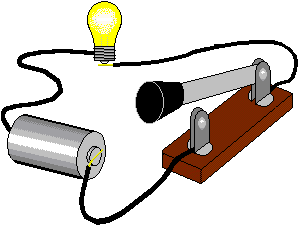
Using these tools, which physical property could someone find out more about?
a)
Thermal Conductivity
b)
Electrical Conductivity
c)
Relative Density
d)
Solubility
6.
If a student were to wrap ice in several different substances and check to see if the ice had melted every 2 minutes, what physical property would the student be testing?
a)
solubility
b)
density
c)
thermal conductivity
d)
mass
7.

Some students tested 3 substances and recorded their findings about physical properties in the chart. Which substance is magnetic, a conductor and has a volume between 4 cubic centimeters and 8 cubic centimeters?
a)
Substance A
b)
Substance B
c)
Substance C
d)
no way to tell
8.
My family likes orange juice with pulp in it. Before we drink it, we need to shake it to mix the bits of pulp in the container. What physical property of the pulp makes this necessary?
a)
Mass
b)
Volume
c)
Density
d)
Conductivity
9.
Students were using tools to test certain items. They found several items that were both electrical conductors and magnetic. Which tools were they most likely using?
a)
hot plate, thermometer and magnets
b)
electric circuits and magnets
c)
balance, graduated cylinder, magnet
d)
stop watch, electric circuit, pan balance.
10.
Which property determines whether one substance will sink or float in another substance?
a)
texture
b)
density
c)
volume
d)
temperature
11.

Elise wants to classify matter based on a physical property. Using the tool shown, how could she classify objects?
a)
by mass
b)
by volume
c)
by density
d)
by temperature
12.

Put the liquids in order from most dense to least dense?
a)
4, 3, 2, 1
b)
1, 2, 3, 4
c)
3, 4, 2, 1,
d)
4, 3, 1, 2
13.

The plastic covering is there to:
a)
Provide a conductor for electrical energy to flow.
b)
Provide an insulator so that electrical energy will not pass outside of the wires.
c)
Provide a conductor so that electrical energy can NOT flow.
d)
Provide an insulator so that electrical energy can flow.
14.
What type of material makes the best insulators?
a)
Aluminum
b)
Copper
c)
Plastic
d)
Metal
15.
You can measure ______ with grams.
a)
mass
b)
volume
c)
conductivity
d)
melting point
16.
Anything that has mass and takes up space is called
a)
volume
b)
matter
c)
magnetism
d)
electricity
17.

Group together based on similar traits:
a)
Classify
b)
Matter
c)
Float
d)
Physical Properties
18.

This is testing ___________
a)
relative density
b)
solubility
c)
mass
d)
conductivity
19.

The water is ______ dense than the boat
a)
more
b)
less
20.

The blue ball has ________ mass than the red one.
a)
less
b)
more
21.
Mass, relative density, solubility, color, texture, state of matter, conductivity, etc.
a)
Physical state
b)
Insulators
c)
Physical Properties
d)
Inferences
22.

More dense than the corn oil, but less dense than the water...
a)
glycerin
b)
wood
c)
plastic
d)
copper wire
23.

Molecules spread out and move FAST!
a)
solid
b)
gas
c)
liquid
24.

Molecules are tightly packed together
a)
solid
b)
liquid
c)
gas
25.
What do sugar, salt, Kool-Aid powder, Crystal Light, etc., do in liquid water?
a)
turn into ice
b)
remain in powder form
c)
dissolve
26.

If you poured 3 liquids that do not mix how could you tell which one is the most dense?
a)
The liquid on top
b)
The liquid in the middle
c)
The liquid at the bottom
27.

The ability of a substance to dissolve is called...
a)
conductivity
b)
relative density
c)
solubility
28.
If an ice cube is left out in room it will change from one state of matter to another. Which is the correct order of State of Matter that the ice cube will go through?
a)
Gas, Solid, Liquid
b)
Liquid, Solid, Gas
c)
Liquid, Gas, Solid
d)
Solid, Liquid, Gas
29.
A substance that resists change and holds it's shape.
a)
liquid
b)
solid
c)
water
d)
clouds
30.
Group together based on similar traits:
a)
Classify
b)
Matter
c)
Float
d)
Physical Properties
31.
A substance that resists change and holds it's shape.
a)
liquid
b)
solid
c)
water
d)
clouds
32.
Volume is a(n) _______________________ physical property of matter.
a)
observable
b)
measurable
33.
Odor is a(n) _______________________ physical property of matter.
a)
observable
b)
measurable
34.
Length is a(n) _______________________ physical property of matter.
a)
observable
b)
measurable
35.
Temperature is a(n) _______________________ physical property of matter.
a)
observable
b)
measurable
36.
Texture is a(n) _______________________ physical property of matter.
a)
observable
b)
measurable
37.
Color is a(n) _______________________ physical property of matter.
a)
observable
b)
measurable
38.
Which example is not matter>
a)
rocks
b)
people
c)
air
d)
light
39.

Which of these best describes the texture of this metal pan?
a)
small
b)
smooth
c)
flexible
d)
shiny
40.
Does not change, stays the same.
a)
boiling point
b)
thermal energy
c)
constant
100 %

