
 Worksheets
8th grade Periodic table
Total questions: 144
Worksheet time: 4hrs 52mins
Name
Class
Date
1.
all matter is made of what
a)
energy
b)
atoms
c)
electrons
d)
compounds
2.
The positive particles of an atom are
a)
electrons
b)
positrons
c)
neutrons
d)
protons
3.
the central region of an atom where its neutrons and protons are is its
a)
nucleus
b)
electron cloud
c)
core
d)
center
4.
Particles in an atom that are neutral and have no charge are
a)
negatrons
b)
electrons
c)
neutrons
d)
protons
5.
True or False? Neutrons have a negative charge
a)
True
b)
False
6.
What is the atomic number for an element with three protons?
a)
2
b)
1
c)
3
d)
6
7.
A particle that moves around the nucleus is a(n)...
a)
Proton
b)
Neutron
c)
Electron
d)
Quark
8.
In the modern periodic table elements are arranged by:
a)
atomic mass
b)
atomic number
c)
valence electrons
d)
number of isotopes
9.

What does the 1.00794 stand for?
a)
Hydrogen
b)
atomic number
c)
atomic mass
d)
atomic explosion
10.
all matter is made of what
a)
energy
b)
atoms
c)
electrons
d)
compounds
11.
The positive particles of an atom are
a)
electrons
b)
positrons
c)
neutrons
d)
protons
12.
The positive particles of an atom are
a)
electrons
b)
positrons
c)
neutrons
d)
protons
13.
the central region of an atom where its neutrons and protons are is its
a)
nucleus
b)
electron cloud
c)
core
d)
center
14.
an atom with atomic number 6 would have how many protons
a)
6
b)
12
c)
3
d)
cannot be determined
15.
Particles in an atom that are neutral and have no charge are
a)
negatrons
b)
electrons
c)
neutrons
d)
protons
16.
Which of the following is a negatively charged subatomic particle?
a)
Electron
b)
Proton
c)
Neutron
d)
Quark
17.
The particles that are found in the nucleus of an atom are
a)
neutrons and electrons
b)
electrons only
c)
protons and neutrons
d)
protons and electrons
18.
The atomic number of an elements is the total number of which particles in the nucleus?
a)
neutrons
b)
protons
c)
electrons
d)
protons and electrons
19.
What is the atomic number for an element with three protons?
a)
2
b)
1
c)
3
d)
6
20.
What is the atomic number for an element with three protons?
a)
2
b)
1
c)
3
d)
6
21.
Which particle has a similar mass to a proton?
a)
Electron
b)
Neutron
c)
Photon
d)
Marble
22.

What is the number of protons that the element in this image contain?
a)
14
b)
7
c)
15
d)
18
23.

What are the 3 particles that make-up the atom?
a)
protons, neutrons, and isotopes
b)
neutrons, isotopes, and electrons
c)
positives, negatives, and electrons
d)
protons, neutrons, and electrons
24.

What is the biggest difference between an atom of cobalt (Co) and an atom of nickel (Ni) as shown in the periodic table entries?
a)
An atom of nickel has more protons.
b)
An atom of cobalt has more electrons.
c)
An atom of cobalt has a lower number of neutrons.
d)
An atom of nickel has a higher value for atomic mass.
25.

Charles needs a very lightweight metal. Use the periodic table to determine which he would choose.
a)
silicon
b)
magnesium
c)
iondine
d)
tungsten
26.
Fluorine, chlorine, bromine, iodine, and astatine make up Group 17, the halogens. Why are these elements grouped together?
a)
They are all very reactive nonmetals with similar chemical properties.
b)
They are all nonreactive gases with similar physical properties.
c)
Their atoms all have eight electrons in their outer energy levels.
d)
They all have the same atomic number.
27.
Which of the following best describes the properties of metals?
a)
hard, brittle, and nonconductive
b)
liquid, dark, and conductive
c)
shiny, malleable, and conductive
d)
soft, oily, and very reactive
28.
How are the elements in the periodic table arranged?
a)
by their atomic mass
b)
by their chemical symbol
c)
by their chemical name
d)
by their atomic number
29.
What does the number of electrons in the outer level indicate about the element?
a)
how reactive the element is
b)
how malleable the element is
c)
how brittle the element is
d)
how ductile the element is
30.
vertical columns in the periodic table are _________ of elements with similar properties.
a)
groups
b)
periods
31.
_______ are horizontal rows of elements that contain increasing numbers of protons and electrons.
a)
groups
b)
periods
32.

According to its location on the periodic table, sodium (Na) can be described as
a)
an alkaline-earth metal.
b)
a transition metal.
c)
an alkali metal.
d)
a metalloid.
33.
In the modern periodic table elements are arranged by:
a)
atomic mass
b)
atomic number
c)
valence electrons
d)
number of isotopes
34.
Each column in the periodic table is called a
a)
period
b)
group
c)
cluster
d)
unit
35.

The yellow atoms are called
a)
metals
b)
nonmetals
c)
metalloids
d)
noble gases
36.
How many electrons does Oxygen need to fill its outer shell?
a)
3
b)
4
c)
1
d)
2
37.
How many Valance electrons does Iodine Have?
a)
6
b)
16
c)
7
d)
17
38.

The period for Bromine is ___________.
a)
3
b)
2
c)
4
39.
The periodic table has __ periods.
a)
18
b)
8
c)
2
d)
7
40.
An element's identity is determined by the number of
a)
electrons.
b)
protons.
c)
neutrons.
d)
valence.
41.
Group 18 elements are known as the _____ _____ and have full valence shells.
a)
royal gases.
b)
supreme solids.
c)
noble gases.
d)
legit liquids.
42.
The majority of elements on the periodic table are
a)
man made.
b)
nonmetals.
c)
metals.
d)
gases.
43.
Which elements have the most similar chemical properties?
a)
K and Na
b)
K and Ca
c)
K and Cl
d)
K and S
44.
The elements in this group have 5 valence electrons and include elements N, P, and As.
a)
Group 5
b)
Group 1
c)
Group 18
d)
Group 15
45.
The elements in this group only have 1 valence electron and include Li, Na, and K.
a)
Group 11
b)
Group 1
c)
Group 3
46.
Which of the following is not a property of metals?
a)
brittle
b)
malleable
c)
lustrous
d)
conductive
47.
The periodic table has __ groups.
a)
8
b)
7
c)
18
d)
2
48.
Rows on the period table are called _____ while columns are called _____.
a)
groups, families
b)
groups, periods
c)
periods, groups
d)
families, groups
49.
How many electrons do atoms need to be stable?
a)
1
b)
2
c)
6
d)
8
50.
How is the periodic table arranged by?
a)
Color of elements
b)
Order of atomic number
c)
density level
d)
Temperature of melting point
51.
What does the atomic number tell you about the element?
a)
The number of neutrons in the atom of the nucleus
b)
The density of the atom
c)
The number of protons in the atom of the nucleus
d)
The mass of an atom of a chemical element
52.
How many elements are there?
a)
103
b)
113
c)
118
d)
121
53.
What are the horizontal row in the periodic table called?
a)
periods
b)
family
c)
column
d)
group
54.
How many elements are there?
a)
103
b)
113
c)
118
d)
121
55.
What does the atomic number tell you about the element?
a)
The number of neutrons in the atom of the nucleus
b)
The density of the atom
c)
The number of protons in the atom of the nucleus
d)
The mass of an atom of a chemical element
56.

What is the element symbol of this element?
a)
Calcium
b)
20
c)
Ca
d)
40.08
57.

What is the atomic number of this element?
a)
21
b)
40.08
c)
30
d)
20
58.
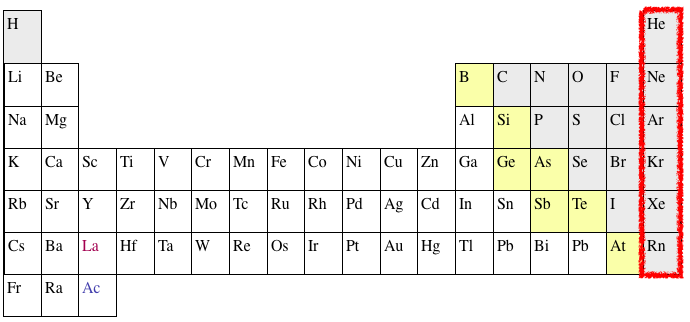
What element family is circled above?
a)
halogen
b)
Noble gases
c)
alkali metals
d)
transition metals
59.

What happens to the atomic number of elements as you move left to right, up to down on the periodic table?
a)
The atomic number stays the same
b)
The atomic number decreases
c)
The atomic number decreases then increases
d)
Th atomic number increases
60.
What are characteristics of metals?
a)
Shiny, high conductivity, malleable
b)
dull, poor conductor, brittle
c)
semiconductors, solid at room temperature, metallic luster
61.
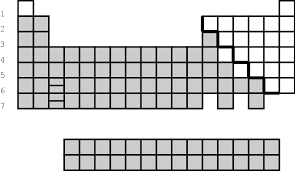
The colored part of the periodic table is.....
a)
nonmetals
b)
metals
c)
metalloids
d)
gases
62.
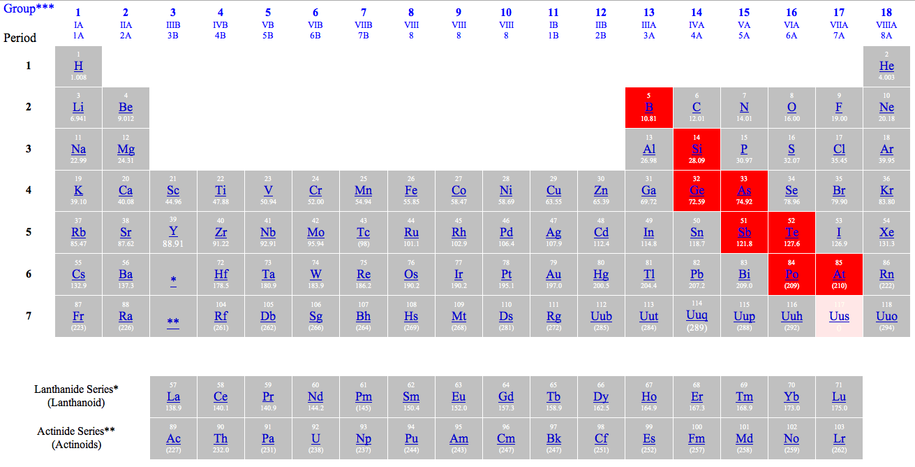
The red part of the periodic table is...
a)
metalloid
b)
non metal
c)
noble gases
d)
metal
63.
Why are substances classified together in a table?
a)
They have similar properties
b)
They all have very different properties
c)
They all have the same properties
64.
Why are substances classified together in a table?
a)
They have similar properties
b)
They all have very different properties
c)
They all have the same properties
65.
Which element group is the least reactive (stable)?
a)
Transition metals
b)
Halogens
c)
Alkali metals
d)
Noble gases
66.
Who first arranged the periodic table?
a)
Vladimir Mendeleev
b)
Dmitri Mendeleev
c)
Ivan Mendeleev
d)
Vasily Mendeleev
67.
How many periods are in the periodic table?
a)
7
b)
8
c)
5
d)
6
68.
When was the periodic table made?
a)
1873
b)
1865
c)
1869
d)
1858
69.
How many of the elements on the periodic table occur in nature?
a)
83
b)
90
c)
76
d)
104
70.
What is the name of the group that never reacts--ever ever they are stable with a full outermost ring!!!
a)
noble gases
b)
transition
c)
halogens
d)
borons
71.

The yellow atoms are called
a)
metals
b)
nonmetals
c)
metalloids
d)
noble gases
72.

What does the 1.00794 stand for?
a)
Hydrogen
b)
atomic number
c)
atomic mass
d)
atomic explosion
73.

The atoms along the staircase are called
a)
metals
b)
nonmetals
c)
metalloids
d)
noble gases
74.
A ___________ is an arrangement of elements in columns
a)
columns
b)
rows
c)
periodic table
d)
electron shell
75.
In the modern periodic table elements are arranged by:
a)
atomic mass
b)
atomic number
c)
valence electrons
d)
number of isotopes
76.
Particles in an atom's nucleus that are neutral and have no charge are
a)
megatrons.
b)
electrons.
c)
neutrons.
d)
protons.
77.
Two elements mixed together in a liquid form
a)
element
b)
compound
c)
mixture
d)
solutions
78.
Two dry elements mixed together form
a)
element
b)
compound
c)
mixture
d)
solutions
79.
Elements on the right side of the of the zigzag line are normally?
a)
non metals
b)
metals
c)
metalloids
d)
rare earth metals
80.
Screen 4
Who is Niels Bohr?
Who is Niels Bohr?
a)
A scientist who discovered gravity.
b)
A scientist who discovered electricity
c)
A scientist who came of with the atom model similar to today.
d)
A scientist who discovered force and motion laws.
81.
Screen 5
What subatomic particle in an atom has a negative charge?
What subatomic particle in an atom has a negative charge?
a)
proton
b)
neutron
c)
electron
d)
nucleus
82.
Screen 6
What is the difference between atomic number and mass number?
What is the difference between atomic number and mass number?
a)
Atomic number is the electrons and mass is neutrons.
b)
Atomic number is the number of protons and the atomic mass is the number of protons plus neutrons.
c)
Atomic number is the number of neutrons and the atomic mass is the number of electrons.
d)
Atomic number is the number of protons and the atomic mass is the number of electrons.
83.
Screen 7
Which subatomic particles in an atom have opposite charges?
Which subatomic particles in an atom have opposite charges?
a)
An electron has a positive charge and neutron has a negative charge.
b)
An electron has a negative charge and a proton has a positive charge.
c)
An electron has a positve charge and a proton has a negative charge.
d)
A neutron has a negative charge and a proton has a positive charge.
84.
Screen 8
What does the electron cloud in an atomic model represent?
What does the electron cloud in an atomic model represent?
a)
Most likely places within the atom that neutrons are found.
b)
Most likely place where protons are found.
c)
Most likely places within the atom that the electrons are going to be found.
d)
Most likely places with the atom that the neutrons and protons are to be found.
85.
Screen 9 What would be the atomic number of an atom with 11 protons and 12 neutrons?
a)
an atomic number of 23.
b)
an atomic number of 12
c)
an atomic number of `3
d)
an atomic number of 11.
86.
Scree 9 What would be the atomic number of an atom with 11 protons and 12 neutrons?
a)
an atomic number of 23.
b)
an atomic number of 12
c)
an atomic number of `3
d)
an atomic number of 11.
87.
Screen 10 What are the three subatomic particles that we've talked about in this lesson that make up an atom?
a)
protons and neutrons
b)
neutrons and electrons and nucleus
c)
protons and electrons
d)
protons, neutrons and electrons
88.
Screen 10 Which particles determine the atomic number of an atom? Which particles determines the atom's mass number?
a)
The atomic number is the number of protons. The atomic mass is protons plus neutrons.
b)
The atomic number is the number of electrons. The atomic mass is the electrons and neutrons.
c)
The atomic number is the number of neutrons. The atomic mass is protons and electrons.
d)
The atomic number is the number of electrons. The atomic mass is neutrons and protons.
89.

what does the 6 represent?
a)
Atomic mass
b)
atomic number
c)
chemical symbol
d)
element name
90.
This subatomic particle always identifies the identity (name) of the element
a)
Neutron
b)
Electron
c)
Proton
d)
amu
91.
The chart that shows the arrangement of elements in order by their atomic number
a)
Electron Cloud
b)
Periodic Table
c)
amu
d)
Atomic Mass
92.
The vertical columns on the periodic table #1-18
a)
Groups
b)
Periods
c)
Subatomic Particles
d)
Rows
93.
The sum of the protons and neutrons in the nucleus of an atom
a)
Atomic Number
b)
Compound
c)
Electrons
d)
Mass Number (also called Atomic Mass)
94.
The majority of elements are classified as ________ and are located on the left side/middle of the periodic table.
a)
Metals
b)
Noble Gases
c)
Nonmetals
d)
Metalloids
95.
A "pure" substance that cannot be separated or broken down into simpler substances
a)
Compound
b)
Mixture
c)
Period
d)
Element
96.
Most of these elements are gases and are located on the right side of the periodic table
a)
Metalloids
b)
Compounds
c)
Nonmetals
d)
Metals
97.
A substance composed of two or more elements chemically bonded together. Examples are H2O and CO2.
a)
Element
b)
Compound
c)
Electron Cloud
d)
Metalloid
98.
The horizontal rows on the periodic table #1-7.
a)
Periods
b)
Element
c)
Atomic Number
d)
Group
99.
These elements are found along the zig-zag line on the periodic table.
a)
Metal
b)
Group
c)
Metalloid
d)
Nonmetal
100.
The region around the nucleus that takes of the most volume of the atom
a)
Mass Number
b)
Electron Cloud
c)
Compound
d)
Atomic Number
101.
This number is the top number in the box on the periodic table and ALWAYS equals the number of protons
a)
Neutrons
b)
Atomic Mass Number
c)
Group
d)
Atomic Number
102.
The smallest particle into which an element can be divided and still be the same substance.
a)
Atom
b)
Electron
c)
Molecule
d)
Nucleus
103.
A unifying explanation for a broad range of hypotheses and observations that have been supported by testing
a)
Statement
b)
Hypothesis
c)
Theory
d)
Equation
104.
Which is NOT a property of a metal?
a)
good conductors of thermal energy (heat)
b)
Shiny
c)
Poor conductor of electricity
d)
Mallieable
105.
Metals are malleable. What does that mean?
a)
They can be flattened without shattering
b)
They conduct electricity well
c)
They conduct heat well
d)
They are shiny
106.
An example of a nonmetal is
a)
Oxygen
b)
Gold
c)
Copper
d)
Sodium
107.
Mendeleev was
a)
Swiss
b)
Russian
c)
German
d)
American
108.
Holds the nucleus together so positively charged protons don't repel each other and fly out of the nucleus.
a)
Gravity
b)
Electromagnetic Force
c)
Strong Force
d)
Weak Force
109.
Atomic mass is measured in
a)
AMUs
b)
Pounds
c)
Kilograms
d)
Grams
110.

a)
Carbon has 6 neutrons
b)
Carbon has 12 neutrons
c)
Carbon has 12 electrons
d)
Carbon has a mass of 6 AMU
111.

a)
13 protons
b)
13 neutrons
c)
27 protons
d)
27 neutrons
112.
At room temperature, most metals are
a)
Gasses
b)
Liquids
c)
Solids
113.
Elements next to the "zigzag" in the periodic table are
a)
Nobel Gasses
b)
Dense
c)
Liquids
d)
Metalloids
114.
Electrons orbit the nucleus like planets orbit the sun.
a)
True
b)
False
115.
The symbol for lead is
a)
Le
b)
Ld
c)
Pb
d)
Co
116.
The first element on the periodic table is
a)
Helium
b)
Oxygen
c)
Lithium
d)
Hydrogen
117.
At atom with 5 protons, 6 neutrons, and 7 electrons would have an overall charge of
a)
2
b)
5
c)
0
d)
-2
118.
Chlorine has an overall charge of -1. It has 17 protons. How many electrons does it have?
a)
17
b)
16
c)
18
d)
Unable to determine
119.
Atoms with the same number of protons but different number of neutrons are
a)
Different elements
b)
Ions
c)
Isotopes
d)
Always radioactive
120.
Atoms are mostly empty space
a)
True
b)
False
121.
Which particle determines the identity of an atom?
a)
Number of electrons
b)
Number of neutrons
c)
Number of protons
122.
Electrons
a)
Are in the nucleus
b)
Travel in "clouds" or "shells" outside of the nucleus
c)
Have no charge
d)
Have the same mass as protons
123.
Which particles have the same mass?
a)
Protons & Electrons
b)
Neutrons & Electrons
c)
Protons & Neutrons
d)
None
124.

What is the number of protons that the element in this image contain?
a)
14
b)
7
c)
15
d)
18
125.
The first energy level can hold up to how many electrons?
a)
8
b)
4
c)
2
d)
5
126.
The first energy level can hold up to how many electrons?
a)
8
b)
4
c)
2
d)
5
127.
an electron has this charge
a)
positive
b)
negative
c)
neutral
128.
a neutron has this charge
a)
negative
b)
positive
c)
neutral
129.
a proton has this charge
a)
negative
b)
positive
c)
neutral
130.
all matter is made of what
a)
energy
b)
atoms
c)
electrons
d)
compounds
131.

How many Electrons does one atom of Magnesium have?
a)
12
b)
24
c)
24.305
d)
48
132.

How many Protons does one atom of Magnesium have?
a)
12
b)
24
c)
24.305
d)
48
133.
A substance that is made up for one type of atom is called an:
a)
atom
b)
element
c)
compound
d)
mixture
134.
The building blocks of all matter are called:
a)
atoms
b)
elements
c)
compounds
d)
mixtures
135.
All of the following are subatomic particles of an atom EXCEPT for:
a)
protons
b)
electrons
c)
neutrons
d)
luster
136.
In an atom, protons and neutrons are found where?
a)
The electron cloud
b)
The nucleus
137.
How many valance electrons are in group 2A?
a)
4
b)
6
c)
1
d)
2
138.
What is a valence electron?
a)
An electron in the highest occupied energy level of an atom
b)
An electron that has properties similar to a transition metal
c)
Electrons with high reactivity
d)
Noble gases
139.

How many energy shells does Gold (Au) have?
a)
11
b)
6
c)
5
d)
1
140.
How many valence electrons make the atom "happy"?
a)
2
b)
6
c)
8
d)
45
141.
The first electron shell is an exception because it is full when you have ____ electrons
a)
4
b)
1
c)
10
d)
2
142.
Atoms are electrically neutral
a)
True
b)
False
143.
Which of the following describes a scientific theory?
a)
A scientific theory, once established, can never be changed
b)
A scientific theory is a good guess made by very smart people
c)
A scientific theory explains a broad range of observed facts
d)
A scientific theory is an explanation proven beyond reasonable doubt
144.
In the modern periodic table elements are arranged by:
a)
atomic mass
b)
atomic number
c)
valence electrons
d)
number of isotopes
100 %

